
Fence Cost per Linear Foot by Material: What You Actually Pay in North Alabama
The Short Version
- Chain link installs for roughly $8 to $40 per linear foot nationally, the lowest of any common material, according to Angi fence installation data published in 2026.
- Pressure-treated pine and cedar separate by about $10 to $15 per foot on the same 6-foot privacy build, and that gap is grade and board quality, not markup.
- Gates get priced per gate, not per foot. A single 12-foot drive gate can cost more than 40 feet of fence line.
- A sloped lot near Monte Sano or Hampton Cove is quoted on the lot, because stepped and racked panels take more labor for every foot of run.
- Two honest quotes on the same yard can differ by $2,000, and the difference is usually post depth, post spacing, and picket thickness.
What a Fence Cost per Linear Foot Figure Actually Measures
Fence cost per linear foot measures the installed price of one running foot of finished fence, measured along the ground where the fence will stand, with posts, panels, hardware, and labor included. A linear foot is just a foot. The word linear is in there so nobody tries to buy fence by the square yard, which would make for a strange morning on both sides of the tape measure.
I measure the fence line, not the property line. Those two numbers are different on most lots I walk in Madison County, because a homeowner wants the fence to stop at the house corner, skip the AC pad, or cut across in front of a drainage ditch instead of running the full boundary. A 180-foot property line turns into a 142-foot fence line more often than people expect.
A 150-foot run at $28 per linear foot comes to $4,200 before gates. That multiplication is the entire appeal of per-foot pricing, and it is also where homeowners get caught, because the number found online almost never covers the same scope a local contractor is quoting.
Fence Cost per Linear Foot by Material
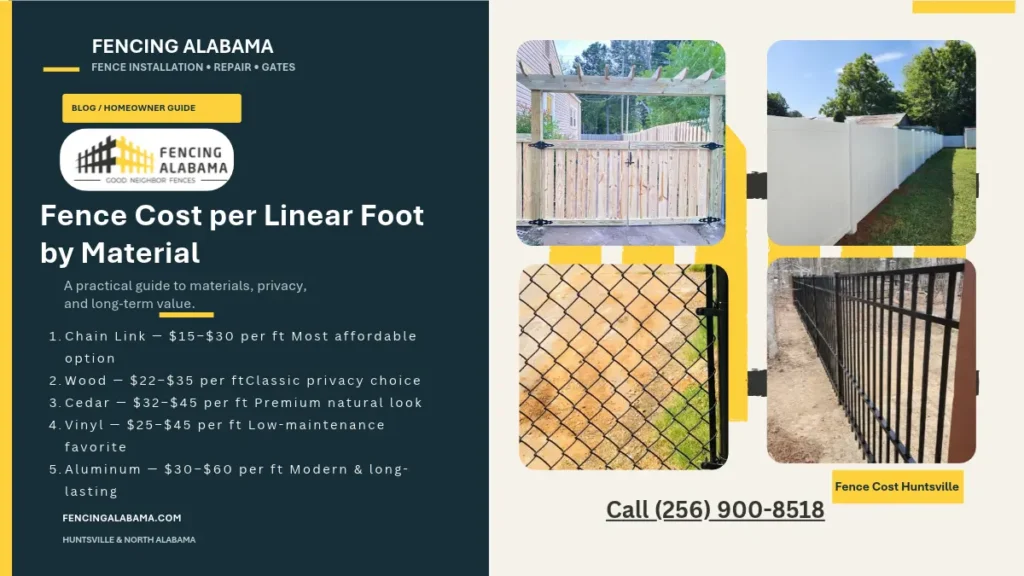
Fence cost per linear foot ranges from about $8 for chain link to $75 or more for fabricated steel, installed. The table below gives the 2026 national installed ranges for the materials I actually build in the Huntsville metro, with the lifespan each one tends to reach in this climate.
| Material | Installed cost per linear foot | Lifespan in this climate | What moves the range |
| Chain link, 4 to 6 ft | $8 to $40 | 15 to 25 years | Wire gauge, height, galvanized versus black vinyl coated |
| Pressure-treated pine privacy, 6 ft | $15 to $38 | 12 to 15 years | Picket grade, post spacing, cap and trim detail |
| Cedar privacy, 6 ft | $25 to $55 | 15 to 20 years or more | Board grade, style, whether it is sealed |
| Vinyl privacy, 6 ft | $20 to $55 | 20 to 30 years | Wall thickness, color, post reinforcement |
| Aluminum ornamental | $20 to $55 | 30 years or more | Grade, picket style, racking for slope |
| Steel and wrought iron | $25 to $75 | 30 years or more | Fabrication, custom panels, finish |
| Split rail | $10 to $20 | 10 to 15 years | Number of rails, wire mesh backing |
| Field and farm wire | $2 to $8 | 15 to 20 years | Brace assemblies, terrain, corner count |
Angi fence installation data published in 2026 puts chain link at $8 to $40 per linear foot and wood at $10 to $45 nationally, and the ranges above sit inside those bands. National ranges tell you the shape of the market. They cannot tell you what your yard costs, because no national average has walked your back line or seen how far the truck has to park from it.
If you want the fuller picture of how these materials stack up against each other on this site, the fence installation cost guide for North Alabama breaks down the same decision from the budget side.
Wood Fence Cost per Foot: Pine and Cedar Are Not the Same Purchase
Pressure-treated pine runs about $15 to $38 per linear foot installed, and cedar runs about $25 to $55 for the same 6-foot privacy build. People hear that gap and assume somebody is charging extra for a prettier name. The gap is the board. Cedar carries natural oils that resist rot and insects without chemical treatment, so it holds its shape through a run of Alabama summers that will cup and twist a wet pine picket.
Pine is the right call when the fence has a job rather than an audience. A back line that keeps a dog in and the neighbor out, behind a house where nobody sees it from the road, does not need cedar money spent on it. Twelve to fifteen years out of treated pine is a fair return, and sealing it buys the top of that range instead of the bottom.
Cedar earns its price on a front-facing run, inside an HOA neighborhood, or anywhere the fence is part of what people see when they pull up. I walk through the full tradeoff in cedar or pressure treated for an Alabama fence, and the maintenance side in how long a wood fence lasts in Alabama humidity.
What the Per-Foot Price Covers, and What It Never Covers
A per-foot fence price covers the straight run and nothing else. On a written quote from me, one linear foot of 6-foot pine privacy fence includes the posts, the concrete those posts are set in, the stringers, the pickets, the fasteners, the labor to dig and set and hang, the 811 utility locate, and hauling the scrap off your driveway when we leave.
Items that sit outside the per-foot number get their own lines on the quote. Here is what comes out of that category on a typical residential job:
- Gates of any size, walk gates and drive gates both, priced per gate.
- Removal and disposal of an existing fence, which is usually quoted per foot at its own rate.
- Stain or sealer, which is a separate service and a separate visit.
- Permit fees and HOA submittal work, which vary by jurisdiction and by board.
- Rock, roots, or a buried slab that turns a 24-inch hole into an hour of work.
When a per-foot number from one company looks $10 cheaper than everyone else, this list is where the difference usually hides. Ask what the foot buys before you compare two numbers that are measuring different things.
How Fence Height Changes the Cost per Foot
Height raises the cost per linear foot faster than the extra material alone suggests. Going from a 4-foot fence to a 6-foot fence adds roughly a third more picket, a third more rail in many builds, and a taller post that has to go deeper to hold the extra wind load.
An 8-foot fence is a different build rather than a taller version of the same one. At 8 feet, I move to heavier posts, add a third stringer, and tighten post spacing, because a solid 8-foot panel catches storm wind like a sail. North Alabama gets fronts every spring that will find the weakest post on a tall run, and the post always loses first.
Height is also the part of the job most likely to be capped by somebody other than you. Before you price an 8-foot run, read how tall a privacy fence can be in Huntsville, because the limit depends on whether your parcel sits inside a city limit, in unincorporated county, or under an architectural review board.
Why Gates Are Priced per Gate Instead of per Foot
A gate costs more than the fence it interrupts because a gate is the only part of the fence that moves. A 4-foot walk gate needs a braced frame, hinges rated for the weight, a latch, and two posts set deeper than the line posts beside them. A 12-foot drive gate can cost more than 40 feet of fence line once the frame, the hardware, and the gate posts are in it.
Spreading that cost across the per-foot rate would be dishonest arithmetic. A homeowner with one walk gate would subsidize the neighbor with two drive gates, and neither would be able to compare quotes. Gates get their own lines so you can see what each one costs and decide whether you want the second one.
Sizing comes before pricing on gates. Standard fence gate width for walk gates and drive gates covers the dimensions that work, and chain link driveway gates covers what holds up on a wide opening.
What Pushes the Price per Foot Up on a North Alabama Lot
Four site conditions raise fence cost per linear foot in this market more than anything else: slope, red clay, access, and an old fence standing where the new one goes. Each one adds labor hours to the same number of feet, and labor hours are what a quote is actually made of.
Red clay is the condition most homeowners underestimate. North Alabama clay swells when it takes on water and shrinks back in a dry spell, and that cycle levers a shallow post loose a little more every season. Setting posts deeper, with concrete on every post below the frost line, costs more per foot on day one and is the reason a fence is still straight at year twelve.
Slope changes the math in a different way. The ground rises sharply toward Monte Sano and Bailey Cove, and panels on that kind of grade have to be stepped or racked instead of run level. That work is quoted on the actual lot rather than at a flat per-foot rate, which I explain in fencing a sloped yard with racked versus stepped panels.
Access is the quiet one. If the truck parks at the curb and every post, bag of concrete, and panel gets carried around the house through a 36-inch side gate, that job takes longer per foot than the identical fence on a lot with a wide open driveway. Rural parcels around Toney and the unincorporated parts of Madison County usually have easy access and awkward terrain at the same time, which is its own pricing conversation.
Where Per-Foot Pricing Stops Being Useful
Per-foot pricing breaks down on very short runs and on very long ones. Under about 60 feet, the fixed costs of a job carry too much weight: the crew still mobilizes, the 811 locate still gets submitted, the tools still come off the trailer. A 40-foot side-yard fence can land near $45 per foot on pine when the same crew builds 200 feet next door at $26.
Long rural runs move the other direction, and then stop moving. Fencing goes cheaper per foot as the run gets longer because the fixed costs spread, but the saving flattens out once the crew is simply building the same panel over and over. After that point, terrain and corner count matter more than total length.
Corners are the other thing per-foot math hides. Every corner needs a braced post, and a yard with eight corners costs more than a yard with four at the same total footage. If you are pricing acreage rather than a backyard, what it costs to fence an acre works through the perimeter math properly.
Cost per Linear Foot Against Cost per Year
The per-foot number tells you what you pay today, and the lifespan tells you what you paid per year. Pressure-treated pine at $25 per linear foot over 13 years works out to about $1.92 per foot per year. Vinyl at $38 per linear foot over 25 years works out to about $1.52. The cheaper fence is the more expensive one on that arithmetic.
That math has an honest limit, and I say it on estimates every week. Pine can be stained, repaired board by board, and changed in style later. Vinyl cannot be stained, a cracked panel gets replaced rather than repaired, and the color you choose is the color you own for 25 years. Cheaper per year is not automatically the right answer for your yard.
The 20-year comparison between those two materials gets its own treatment in vinyl versus wood fence cost over 20 years. If chain link is in the running instead, chain link versus wood fence cost in North Alabama runs the same numbers for that pair.
Why Two Quotes for the Same Fence Differ by $2,000
Two quotes on the same 150-foot fence can sit $2,000 apart with neither contractor doing anything wrong. The spread is specification, not honesty. Five decisions account for nearly all of it, and none of them are visible in a per-foot number on its own.
- Post depth: A post set 18 inches deep and a post set 30 inches deep cost different money and last different lengths of time in clay that moves.
- Post spacing: Posts at 6 feet on center use noticeably more material than posts at 8 feet, and the fence holds a straighter line for longer.
- Concrete: Concrete on every post costs more than concrete on corners and gate posts only, which is a real practice some crews use.
- Post material: A 4×4 treated post and a steel post inside a wood fence are different prices and different lifespans.
- Picket thickness and grade: A thin, wet, knotty picket and a kiln-dried one both look fine in the driveway on install day. They stop looking alike after one summer.
When a quote comes in low, the useful question is which of those five it bought. Ask for the post depth and the post spacing in writing. A contractor who builds it properly will tell you the numbers without hesitating, because those numbers are the reason the price is what it is.
What a Written Fence Quote Should Itemize
A written fence quote should show you the per-foot rate, the footage it applies to, and every line that sits outside it. If you can read the quote and still not know what a foot of your fence costs, the quote is not finished. Here is what mine itemizes before anything gets ordered:
- Linear feet of fence, by height and material, with the per-foot rate shown.
- Each gate listed separately, with its width, type, and hardware.
- Post size, post depth, post spacing, and whether every post is set in concrete.
- Removal and haul-off of the existing fence, priced per foot, if there is one.
- Any terrain work, including stepping or racking on a grade.
- Permit or HOA submittal handling, and who is responsible for which part.
- What the workmanship warranty covers. [verify: warranty terms]
Get that written before anything is ordered. A verbal per-foot number over the phone is a guess dressed up as a price, and the correction always arrives after the posts are in the ground.
Fence Cost per Linear Foot Questions
How much should I expect to pay per foot for a 6-foot privacy fence in Huntsville?
A 6-foot wood privacy fence generally falls between $15 and $38 per linear foot installed in pressure-treated pine, and $25 to $55 in cedar, at 2026 national rates. Vinyl privacy at the same height runs about $20 to $55. Where your Huntsville yard lands inside those ranges depends on slope, access, gate count, and whether an old fence has to come out first.
I got one quote at $42 a foot and another at $26 a foot for the same fence. Is the cheap one a scam?
Not necessarily, but the two quotes are describing different fences. A $16 per foot spread on identical footage usually traces to post depth, post spacing, concrete on every post versus corners only, and picket grade. Ask both contractors for those four specifications in writing. If the cheaper quote matches the expensive one on all four, you found a better price. If it does not, you found a shorter-lived fence.
Does the fence cost per linear foot include the gate?
No. Gates are priced per gate on any honest quote, because a gate needs a braced frame, rated hinges, a latch, and deeper gate posts than the line posts around it. A 4-foot walk gate and a 12-foot drive gate are different prices, and a drive gate can exceed the cost of 40 feet of fence line. Check that your quote lists each gate on its own line.
How many linear feet of fence do I need for my backyard?
Measure the actual fence line rather than the property boundary, because most backyard fences tie into the house, skip the driveway, or stop short of a ditch. Walk the route you want the fence to take and measure it in sections, then add them together. A typical Huntsville metro backyard lands somewhere between 120 and 220 linear feet, and we confirm it with a wheel on the free on-site estimate.
Is it cheaper per foot to fence a bigger yard?
Up to a point, yes. Mobilization, the 811 utility locate, and tool setup are fixed costs that spread across more feet as the run grows, so a 200-foot job usually prices lower per foot than a 40-foot one. Past a few hundred feet the saving flattens out, because the crew is repeating the same panel. Corner count and terrain then matter more to your total than length does.
What is the cheapest fence per linear foot that still gives real privacy?
A 6-foot pressure-treated pine privacy fence is the lowest-cost option that genuinely blocks a sightline, starting around $15 per linear foot installed. Chain link is cheaper per foot, starting near $8, and it gives you containment rather than privacy. Slats pushed into chain link improve the look and never match a solid panel, which is worth knowing before you spend money on them.
Get a Written Price for Your Own Yard
Fencing Alabama has been building wood, vinyl, aluminum, and chain link fence in the Huntsville metro since 2019, from our base in Guntersville. Every estimate is done on site, in person, and comes back to you written and itemized, with the per-foot rate, each gate, and any terrain work shown separately before a single post is ordered.
Call (256) 900-8518 or schedule your free on-site estimate. We are open Monday to Saturday, 9:00 AM to 5:00 PM, and we call back the same day during business hours.
Fencing Alabama, 4741 Bakers Chapel Rd, Guntersville, AL 35976. (256) 900-8518.