
Vinyl vs Wood Fence: Cost Over 20 Years
Short answer
Over twenty years, a vinyl privacy fence in North Alabama usually costs less than a pressure-treated pine fence and slightly less than cedar, even though vinyl costs more on install day. On a 150-foot run of 6-foot privacy fence, I put vinyl around $6,350 all in, cedar around $8,500, and treated pine anywhere from $6,900 to $11,100 depending on whether the posts survive to year twenty.
The short version, before the details: vinyl vs wood
- Treated pine is the cheapest fence on estimate day and the most expensive fence by year twenty if it has to be torn out and rebuilt around year fourteen.
- Vinyl carries roughly a $1,500 premium on a 150-foot run and pays that back through stain cycles you never buy.
- Staining a 150-foot wood privacy fence eats about $2,000 in product alone across twenty years, plus 60 to 80 hours of somebody’s weekend.
- Cedar sits in the middle: highest wood material cost, longest wood lifespan, same staining bill as pine.
- If you are selling the house inside seven years, the twenty-year math does not apply to you, and pine is the better buy.
I install both materials every week across Huntsville, Madison, and the surrounding towns, and this is the arithmetic I walk homeowners through when they ask me which one is actually cheaper. Prices below are typical installed ranges for the Huntsville area in today’s dollars. They are a budgeting model, not a quote for your yard.
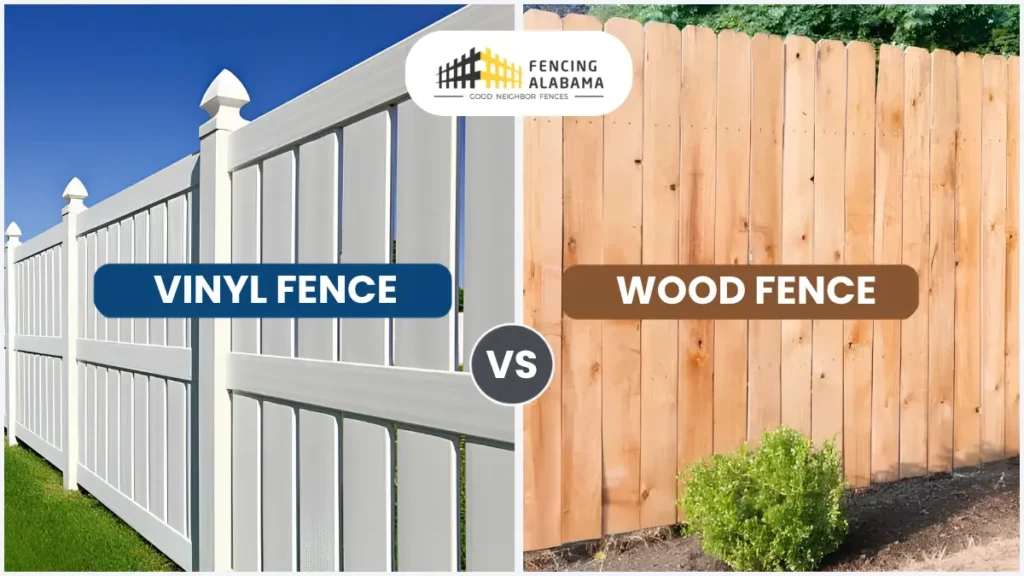
The 20-Year Cost of a Vinyl Fence vs. a Wood Fence, Side by Side
A 150-foot run of 6-foot privacy fence is the fairest way to compare vinyl and wood, because it is close to the average backyard we measure in this metro. Here is every cost line I can defend, spread across twenty years.
| Cost over 20 years, 150 ft of 6-ft privacy fence | Treated pine | Cedar | Vinyl |
| Installed price on day one | $4,200 | $6,000 | $5,700 |
| Stain or sealer, product only | $2,000 | $2,000 | $0 |
| Cleaning and wash-downs | $0 | $0 | $150 |
| Repairs across 20 years | $700 | $500 | $500 |
| Full replacement inside the window | $4,200 likely | $0 | $0 |
| Twenty-year total | $6,900 to $11,100 | $8,500 | $6,350 |
| Cost per linear foot per year | $2.30 to $3.70 | $2.83 | $2.12 |
The pine column carries a range because pine is the only material here whose outcome is genuinely uncertain at twenty years. Pressure-treated pine typically lasts 12 to 15 years in North Alabama humidity, which means a fence built today has a real chance of needing full replacement before this comparison window closes. Cedar runs 15 to 20 or more, and I have covered why in detail in the piece on how long a wood fence lasts in Alabama humidity.
What a Vinyl Fence and a Wood Fence Cost on Day One?
On install day, wood is the cheaper fence in North Alabama. Typical installed ranges here are $22 to $45 per linear foot for wood and $25 to $45 for vinyl, which the fence cost page breaks down alongside chain link and aluminum. The overlap in those two ranges confuses people, so here is why it exists: a builder-grade treated pine stockade and a heavy-wall vinyl privacy panel are both technically in range, but they are not the same fence. A builder-grade stockade and the cap-and-trim or board-on-board profiles we quote under wood fence installation sit at opposite ends of that range.
For the model above, I used $28 per foot for treated pine, $40 for cedar, and $38 for vinyl. Those are mid-range numbers for a 6-foot privacy build on a flat lot with one walk gate. Sloped lots run higher in every column because panels have to be stepped or racked rather than run level, and that is labor rather than material.
The day-one gap between treated pine and vinyl on a 150-foot run is about $1,500. Hold that number, because everything that follows is the story of what happens to it.
What a Wood Fence Costs You Between Year 1 and Year 20?
A wood privacy fence needs staining or sealing every two to three years in this climate, and that recurring bill is the single largest cost most homeowners leave out of their comparison. Untreated or unsealed wood grays and cups fast through an Alabama summer, and a fence that never gets sealed will not reach the lifespan its material is rated for.
Run the numbers on a 150-foot, 6-foot fence. That is 900 square feet per side and 1,800 square feet total, and exterior stain labels generally list 200 to 300 square feet per gallon on fence-grade wood. So one full cycle takes 6 to 9 gallons, which at $35 to $45 a gallon lands between $210 and $405 in product.
Stain that fence every three years across twenty years, and you are buying product seven times, which is roughly $2,000. Do it yourself and add 8 to 12 hours of ladder work and roller work per cycle, so 60 to 80 hours of your own weekends. Pay a crew to do it instead, and the twenty-year staining bill climbs well past the material cost, which is why I tell people to get fence staining and sealing quoted on the lot before they assume DIY is the plan for the next two decades.
Wood also asks for small repairs that vinyl does not. A split picket, a warped board that has to come off and go back on, a gate that sags after a few Alabama summers and needs a turnbuckle or a new hinge set. None of those are expensive on their own. Across twenty years, I budget about $700 for a fence that size.
What Does a Vinyl Fence Cost You Between Year 1 and Year 20?
A vinyl fence costs almost nothing to maintain because the color is molded through the panel rather than painted onto it, so there is no coating to chip, peel or reapply. Twice a year you walk the line with a hose and mild soap, mostly to take off pollen in spring and mildew shadow on the shaded north side. Call it $150 in soap and brushes across twenty years and you are being generous.
Vinyl does have a repair mode, and it is different from wood’s. Vinyl does not rot or split, but it can crack from a hard impact: a limb in a storm, a mower throwing a rock, a basketball goal that got away from somebody. A cracked vinyl panel cannot be sanded and stained back to life the way a wood picket can. It gets replaced.
Panel replacement on vinyl is genuinely easy as long as the posts either side are sound, because the rails slide out of routed post channels rather than being screwed to the face. The catch nobody mentions is color matching. A twelve-year-old white vinyl panel has weathered, and a brand-new panel next to it will read slightly brighter for a season or two until it settles. I budget $500 across twenty years for a fence that size and tell homeowners to keep one spare panel in the garage if the run faces a treeline.
The Replacement Year Most Fence Comparisons Skip
Every vinyl versus wood cost comparison I read online stops at ten years, and that is exactly where wood looks its best. The honest window is twenty years, because a treated pine fence installed today has a fair chance of being torn out and rebuilt inside it. That second install is the line item that decides this whole question.
Pressure-treated pine lasts 12 to 15 years here. If your pine fence taps out at year fourteen, you pay roughly $4,200 in today’s dollars to rebuild the same 150 feet, and your twenty-year total jumps to about $11,100. If your posts were set deep, in concrete, below the frost line, and somebody kept it sealed, the same fence can be nursed past twenty on panel repairs alone, and the total stays near $6,900, which beats vinyl.
That is the real fork in the road. Pine is either the cheapest fence over twenty years or the most expensive one, and which it turns out to be is decided almost entirely at installation by how the posts went in. Cedar is the hedge: you pay more for material up front and buy yourself a much better chance of clearing twenty years without a rebuild.
Break-even on stain product alone arrives around year thirteen, which is later than most vinyl salespeople will tell you. Pay a crew to stain instead of doing it yourself, and vinyl pulls ahead before year ten. Add a pine replacement at year fourteen, and vinyl finishes the window roughly $4,700 ahead.
How North Alabama Soil and Weather Change the Numbers?
North Alabama red clay swells when it takes on water and shrinks back in a dry spell, and that cycle levers a shallow-set post loose a little more each season. Almost every leaning fence I get called out to in this market has a post problem underneath it, not a panel problem, and the material on top of those posts is close to irrelevant. A vinyl fence on shallow posts leans exactly the same way a pine fence does.
Freeze and thaw cycles in a North Alabama winter are the other local factor, and they treat the two materials differently. Wood flexes with heaving ground and shows it as a slow lean. Rigid vinyl does not flex, so a badly installed vinyl fence cracks at the rail connection instead of leaning. Posts set below the frost line and the manufacturer-specified expansion gap at each rail joint are what prevent that, which is why cracked vinyl is nearly always an installation failure rather than a material defect.
Storm season changes the repair column for both. A solid 6-foot privacy panel, wood or vinyl, catches serious wind load, and a run on undersized posts will not hold through a bad night. Wood tends to fail by losing pickets and leaning. Vinyl tends to fail by popping a panel out of the post channel, which sometimes goes back in with nothing more than a ladder and two people.
Terrain matters more than material on the slopes toward Monte Sano and Bailey Cove. A stepped or racked run takes more labor than a flat run in either material, and we quote those on the actual lot rather than at a flat per-foot rate. That is one of the reasons a fence company in Huntsville, AL will not price a hillside lot over the phone.
People Do Not Search This the Way They Used To
Homeowners used to type “vinyl vs wood fence cost” into a search box. Now they describe the whole situation to an AI assistant and expect a straight answer back, and the questions I see quoted to me on estimates look more like this:
- “I’m fencing about 150 feet of backyard in Huntsville, and I can’t tell if paying extra for vinyl actually saves me money or if that is just a sales line.”
- “How much does it really cost to keep a wood fence stained for twenty years in Alabama?”
- “Will a vinyl fence crack in an Alabama winter, or is that only an installation problem?”
- “We are probably moving in five or six years. Is vinyl worth it or should I go with treated pine?”
- “Which lasts longer in Alabama humidity, cedar or vinyl, and is the price difference worth it?”
The answers are all above, but the fifth one deserves its own sentence: vinyl outlasts cedar in this climate, and the price difference between the two is small enough that the decision usually comes down to whether you want a wood-grain look or a maintenance-free one.
When a Wood Fence Is the Cheaper Choice Over 20 Years?
A wood fence is the better twenty-year buy when your ownership window is short. Selling inside five to seven years means you never reach the stain cycles that make vinyl look good, and you almost never recover the vinyl premium at closing, because buyers price a fence as present or absent far more than they price it as vinyl or wood.
Wood also wins when the fence has to match something. Cedar takes stain, so it can be color-matched to a house, a deck, or a neighboring run. Vinyl arrives in whatever color it was molded in, usually white or tan, and it stays that color for its entire life, whether you still like it or not.
Some Huntsville-area architectural review boards restrict vinyl or specify a wood profile for street-facing runs. The rules vary by subdivision, and they change, so pull your covenants or ask the board before you price anything. I have written up how that approval process actually runs in HOA fence approval in Huntsville subdivisions.
Finally, wood wins on very long runs where the day-one gap compounds. On 500 feet rather than 150, that $10 per foot difference is $5,000 sitting on the estimate, and some budgets simply cannot absorb it regardless of what happens in year fourteen. If you are choosing between pine and cedar for that build, the comparison in cedar or pressure treated for an Alabama fence is the one to read next.
When a Vinyl Fence Is the Cheaper Choice Over 20 Years?
A vinyl fence is the better twenty-year buy when you plan to stay in the house, because every stain cycle you skip is money that stays in your pocket and a weekend you get back. Ten years in the house is roughly where the two lines cross for most homeowners who pay someone else to maintain wood.
Vinyl also wins for anyone who knows they will not keep up with staining. A wood fence that never gets sealed does not last 12 to 15 years; it fails closer to seven, and at that point, the cheap fence has become the expensive one. I would rather sell someone vinyl fence installation than sell them a pine fence they will let gray out and replace twice.
Pool areas and shaded, damp corners favor vinyl too. Vinyl does not rot where a wood post sits in ground that stays wet, and it does not feed the mildew that grows on a north-facing wood run in Alabama humidity. Homeowners booking a fence company in Madison, AL ask about that one constantly, and the answer is the same every time: the wet corner of the yard is where wood fails first.
What Your Written Quote Should Show Before You Decide?
Compare quotes on the line items, not on the total, because two fences at the same price can be built very differently. A written, itemized estimate for either material should name the post depth and whether every post is set in concrete, the post spacing, the panel or picket grade, the gate hardware, the 811 utility locate, debris haul-off, and cleanup.
For vinyl specifically, ask three things in writing: the wall thickness or panel series, whether the rails are aluminum-reinforced on gate and end sections, and what the manufacturer’s warranty covers and whether it transfers if you sell. Vinyl warranties are commonly limited to the lifetime on the panel itself and say much less about the installation, so get both in writing.
For wood, ask what species and grade, whether the posts are rated for ground contact, and whether the first coat of sealer is included or quoted separately. A pine fence built on ground-contact posts and sealed in its first year is a fundamentally different twenty-year proposition than the same fence built on standard posts and left alone.
Every estimate we write includes materials, labor, the 811 utility locate, concrete for every post, hardware, debris haul-off, and cleanup, and the number on the invoice is the number from the estimate. That is the only fair way to compare vinyl against wood, because the maintenance math above only holds if the fence was built right in the first place.
Frequently Asked Questions
Is a vinyl fence actually cheaper than a wood fence in the long run?
Usually yes, over a twenty-year window. On a 150-foot run of 6-foot privacy fence in the Huntsville area, vinyl lands near $6,350 all in, cedar near $8,500, and treated pine between $6,900 and $11,100 depending on whether it needs a full rebuild around year fourteen. Vinyl wins because it never buys stain.
How much does it cost to stain a 150-foot wood fence?
One full cycle on a 150-foot, 6-foot fence covers 1,800 square feet across both sides, which takes 6 to 9 gallons of stain at 200 to 300 square feet per gallon. That is roughly $210 to $405 in product per cycle, repeated every two to three years. Hiring the work out costs considerably more and should be quoted on your lot.
How long does a vinyl fence last in Alabama?
A properly installed vinyl fence typically outlasts the twenty-year window used in this comparison, which is why the model shows no replacement line for it. Posts set below the frost line and the manufacturer’s expansion gap at each rail joint are what determine whether it reaches that age, far more than the brand on the panel.
Does vinyl fencing crack in cold weather?
Quality vinyl rated for outdoor use holds up through North Alabama winters. Cracking is almost always an installation problem, specifically posts set too shallow or no expansion gap at the rail connections, which leaves rigid panels fighting heaving soil instead of moving with it.
Should I pay extra for vinyl if I am selling my house in five years?
No. The vinyl premium on a 150-foot run is about $1,500, and it pays back through avoided stain cycles that you will not be around for. Buyers price a backyard on whether it has a fence, not on what the fence is made of. Treated pine, set properly and sealed once, is the better five-year buy.
Can a single vinyl panel be replaced without rebuilding the fence?
Yes. Vinyl rails slide out of routed channels in the posts, so an individual panel or picket comes out without disturbing the run, as long as the posts on either side are still sound. Expect a new panel to read slightly brighter than its weathered neighbors for a season.
Get the Real Number for Your Yard
Every figure on this page is a budgeting model built on a 150-foot flat-lot run, and your property is not that model. Footage, slope, gate count, soil, and whether an old fence has to come out all move the twenty-year math, sometimes by thousands.
We install wood and vinyl across Huntsville, Madison, Athens, Decatur and the rest of North Alabama, and we are based in Guntersville. Call (256) 900-8518 or schedule a free on-site estimate and we will measure the run, walk the line with you, and put both materials in writing so you can compare them side by side with your own numbers instead of mine.