
Chain Link vs Wood Fence Cost: What Each One Really Costs in North Alabama
Short answer
Chain link runs about $15 to $30 per linear foot installed in the Huntsville area, and wood runs about $22 to $45. On a 150-foot back yard that is roughly $2,250 to $4,500 for chain link against $3,300 to $6,750 for wood. Chain link wins on install day, and it usually still wins twenty years later
What you need to know before you call anyone for a price:
- Chain link costs less per foot than wood at every height I quote, and the gap widens as the fence gets taller.
- A pressure-treated pine fence needs stain or sealer every two to three years in Alabama humidity, and a galvanized chain link fence needs nothing.
- Wood buys you privacy and curb appeal, which chain link cannot deliver without privacy slats added to the mesh.
- Most Huntsville-metro subdivisions with an architectural review committee will not approve chain link in a front or side yard, which settles the cost question before it starts.
- Over twenty years on the same 150-foot run, I put galvanized chain link somewhere near $4,000 all in and treated pine anywhere from $6,900 to $11,100 depending on whether the posts survive to year twenty.
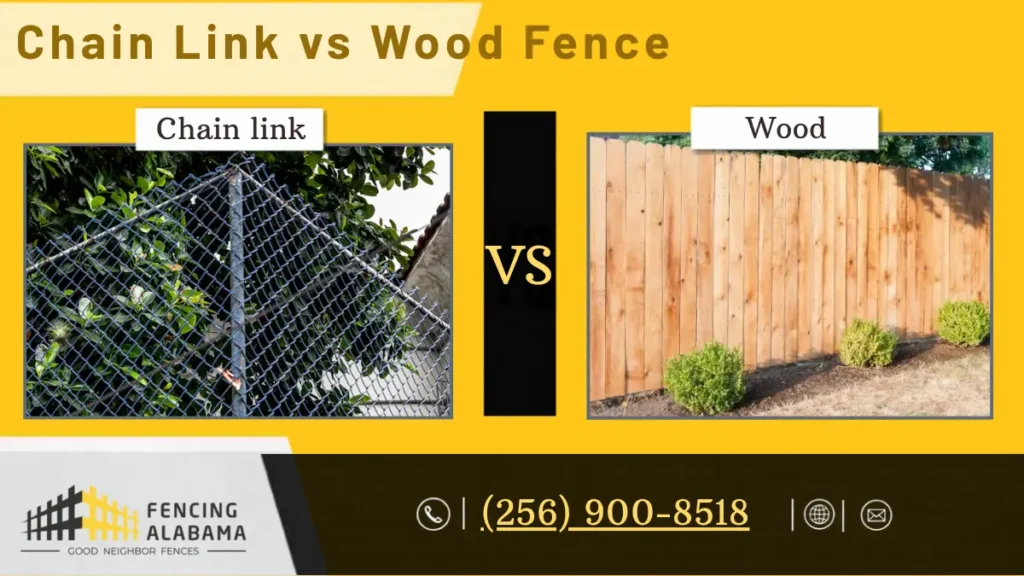
Chain Link vs Wood Fence Cost per Linear Foot
Chain link is the cheapest fence material we install per linear foot, and wood is the next one up. The table below uses the same installed ranges published on our North Alabama fence cost page, which cover materials, labor, concrete on every post, the 811 utility locate, hardware, and haul-off of the debris.
| Fence type | Installed cost per linear foot | Typical height | What moves it inside the range |
| Galvanized chain link | $15 to $30 | 4 ft to 6 ft | Height, wire gauge, gate count, terrain |
| Black vinyl-coated chain link | Upper end of $15 to $30 | 4 ft to 6 ft | Coating adds material cost over galvanized |
| Pressure-treated pine privacy | $22 to $35 | 6 ft | Picket grade, post size, style, gates |
| Cedar privacy | $32 to $45 | 6 ft | Board grade, cap and trim detail, gates |
Height moves both numbers more than most homeowners expect. Going from a 4-foot yard fence to a 6-foot privacy fence is more than a 50 percent material increase, because taller panels catch more wind and need heavier posts set in deeper holes to hold through an Alabama storm season.
Labor is the part people forget to compare. On a wood privacy fence, labor is a larger share of the bill than on chain link, because someone is setting posts, hanging rails, and fastening every picket by hand. Chain link goes up as posts, top rail, and a roll of mesh stretched tight, which is faster on a clear, flat line.
What 150 Feet of Fence Costs Each Way?
A 150-foot run is the size of a typical Huntsville-metro backyard, so it makes a fair comparison. Below is what that same line costs in each material on install day, using the ranges above.
| 150 feet installed | Low end | High end |
| 4 ft galvanized chain link | $2,250 | $3,300 |
| 6 ft galvanized chain link | $3,300 | $4,500 |
| 6 ft pressure-treated pine privacy | $3,300 | $5,250 |
| 6 ft cedar privacy | $4,800 | $6,750 |
The honest read on those numbers is that a 6-foot chain link fence and a low-end treated pine fence can land in the same neighborhood on price. The real separation shows up at the 4-foot height, where chain link does the containment job for close to half the cost of a wood privacy fence, and again at the top of the range, where cedar runs roughly double a plain galvanized line.
None of these figures are a quote. They are budgeting ranges for the Huntsville area, and the actual number for your property depends on the grade, the soil, the access, and how many gates the layout needs. We measure on site and put the real number in writing before anything gets ordered.
Why Wood Costs More to Own Than to Build?
A wood fence keeps charging you after the crew leaves, and a galvanized chain link fence does not. Pressure-treated pine needs stain or sealer every two to three years in this climate, cedar can stretch a little longer, and a galvanized chain link fence asks for nothing beyond an occasional gate hinge.
Add the stain cycles up and the arithmetic gets uncomfortable. Six or seven staining cycles over twenty years is the realistic count on a treated pine fence here, whether you buy the product and spend two Saturdays on it yourself or hire it out. That is on top of the original install, and it does not include replacing a post that rotted at the ground line.
Lifespan is the other half of it. Pressure-treated pine typically gives 12 to 15 years in North Alabama humidity, and cedar runs 15 to 20 or more, which we cover in detail in how long a wood fence lasts in Alabama humidity. A galvanized chain link fence installed with concrete on every post regularly passes twenty years with nothing done to it, because there is no wood in the ground to rot and no finish to fail.
| Same 150-foot run, twenty years | Galvanized chain link | Treated pine privacy | Cedar privacy |
| Install day | $3,300 to $4,500 | $3,300 to $5,250 | $4,800 to $6,750 |
| Maintenance over 20 years | Near zero | Stain every 2 to 3 years | Stain every 2 to 3 years |
| Likely replacement inside 20 years | No | Possible at year 12 to 15 | Unlikely |
| Rough twenty-year total | Around $4,000 | $6,900 to $11,100 | Around $8,500 |
Those twenty-year wood totals are the same ones we ran in our vinyl vs wood fence cost comparison, so the numbers stay consistent across the site. The wide spread on treated pine is not sloppiness. It is the difference between a fence whose posts were set properly and one whose posts were not.
What Chain Link Costs You That Wood Does Not
Chain link costs you privacy, and that is the reason most homeowners pay the wood premium anyway. A standard galvanized chain link fence marks the boundary, holds a dog, and lets you see the neighbor’s above-ground pool in full detail from your kitchen window.
Appearance is the second cost. Chain link reads as practical rather than finished, which matters less on a back line against a treeline in New Market and matters a great deal on a front yard in a subdivision off Bailey Cove. A wood privacy fence, especially a cap and trim fence, looks like a deliberate part of the house.
Noise and wind are the third difference, and they cut both ways. A solid 6-foot wood panel blocks some road noise and all of the sightline, and it also takes the full force of a storm front. Chain link mesh lets wind pass straight through, which is exactly why you rarely see a chain link fence flattened after a bad night in Madison County.
How Much Do Privacy Slats Add to a Chain Link Fence?
Privacy slats thread vertically through the chain link mesh and turn an open fence into a solid visual screen, and they add material and labor on top of the base per-foot price. Budget roughly $5 to $10 per linear foot on top of the chain link number for slats, and confirm the figure on your written quote rather than on a blog post.
Run that against the alternative before deciding. A 6-foot chain link fence at the top of the range plus slats can reach the price of a low-end treated pine privacy fence, at which point you are choosing between two similar prices for two fences that look nothing alike.
Slats are a strong answer in one specific situation: an existing chain link fence that is structurally fine but offers no privacy. Threading slats into mesh that is already standing costs a fraction of tearing the line out and building wood in its place, and it is the most common privacy retrofit we get asked about on chain link fence installations.
What Moves Both Prices on a North Alabama Lot?
Red clay is the first thing that moves a fence price here, and it moves both materials the same way. North Alabama clay swells when it takes on water and shrinks back in a dry spell, which levers a shallow-set post loose a little more each season, so every post on our jobs goes in concrete at a depth the soil actually calls for rather than the depth that would be fastest.
Slope is the second. The ground rises sharply toward Monte Sano and Bailey Cove, and a sloped run has to be stepped or racked instead of run level, which takes more labor than a flat line. Wood absorbs slope differently than chain link, and we break that down in racked vs stepped fence panels on a sloped yard. Sloped lots are quoted on the actual lot, never on a flat per-foot rate.
Gate count is the third, and it is the one homeowners under-budget most often. Every gate adds hardware and labor beyond the per-foot rate, and a drive gate wide enough for a mower or a truck costs considerably more than a 4-foot walk gate in either material.
Tear-out of an old fence is the fourth. Pulling concrete footings out of clay and hauling the old material off is labor either way, and it is included on our replacement jobs rather than sprung on you afterward. Rock, heavy tree clearing along the line, and a survey where the boundary is genuinely in question get quoted separately and get flagged during the on-site visit, not after.
When I Tell Homeowners to Buy Chain Link?
Chain link is the right call when the fence has one job and that job is containment. A dog that needs to stay in the yard, a large rural parcel where wood would cost four figures more per hundred feet, a back line nobody sees, or a rental property where maintenance labor is the thing you are trying to eliminate.
Acreage is where the gap stops being a preference and becomes a budget decision. Fencing a large parcel out toward Toney or Hazel Green in wood can cost thousands more than the same perimeter in chain link, and on those properties the fence is usually marking a boundary rather than screening a patio. Our fence company page for Toney covers how unincorporated county parcels differ from an in-city lot.
Dog owners should look hard at 4-foot chain link before paying for wood. A chain link line holds most breeds, costs less than a privacy fence, and lets the dog see out, which some dogs find calming and some find maddening. We go into height by breed and dig prevention on our dog and pet fencing service page.
When Wood Is the Cheaper Decision?
Wood is cheaper in the only way that matters when your HOA will not approve chain link, because a fence that gets ordered down at your expense is the most expensive fence there is. A large share of the Huntsville metro sits under an architectural review board with rules on height, material, and which way the finished face points, and chain link is commonly excluded in visible yards. Our guide to HOA fence approval in Huntsville subdivisions walks through the submission before you spend anything.
Wood is also the cheaper decision when privacy is the actual goal. Chain link plus slats gets you to a similar price for a fence that screens the yard but still reads as chain link with slats in it, and homeowners who wanted a private backyard tend not to be satisfied with that trade for long.
If wood is the answer, the material choice inside wood is worth more attention than the chain link comparison was. Cedar costs more up front and stays straighter, and treated pine costs less and performs fine when it is set and sealed properly, which we compare in cedar or pressure treated for an Alabama fence and build under wood fence installation.
What Your Written Quote Should Itemize?
A written fence quote should show you the per-foot rate, the total linear footage, each gate priced on its own line, and what happens to the old fence. If a quote is a single number with a material name next to it, you cannot compare it to anything, which is usually the point.
Post depth and concrete belong in writing too. Two quotes for the same 150 feet of 6-foot wood can differ by a thousand dollars because one crew is setting 4×4 posts shallow with no concrete and the other is setting heavier posts in concrete below the frost line. The cheap one leans in year four in this soil.
Ask specifically whether the 811 utility locate, debris haul-off, and cleanup are included or billed later. On our estimates, those are in the price, along with walking the finished line with you before the job gets called done.
Get a Real Number for Your Yard
Chain link and wood both come down to your property line, your grade, your gate count, and your HOA. We build both across Huntsville, Madison, Guntersville, and the rest of North Alabama, and the on-site visit is free with a written itemized quote before anything is ordered.
Call (256) 900-8518 for a same-day callback, or schedule a free on-site estimate and we will measure the line and price both materials side by side.
Fencing Alabama, 4741 Bakers Chapel Rd, Guntersville, AL 35976 (256) 900-8518 Monday to Saturday, 9:00 AM to 5:00 PM
Common Questions
Is a chain link fence cheaper than a wood fence?
Yes. Chain link runs about $15 to $30 per linear foot installed in the Huntsville area and wood runs about $22 to $45, so chain link is the cheaper fence at every height. The gap is widest at 4 feet, where chain link does the containment job for close to half the cost of a 6-foot wood privacy fence.
I want privacy but wood is over my budget. What are my options?
Chain link with privacy slats is the usual answer, and it costs roughly $5 to $10 per linear foot on top of the chain link rate. A second option is fencing only the section that needs privacy in wood and running chain link on the rest of the perimeter, which we do regularly on larger lots around New Market and Hazel Green.
How much does 200 feet of chain link fence cost installed?
Using Huntsville-area ranges, 200 feet of galvanized chain link runs roughly $3,000 to $6,000 installed depending on height, wire gauge, gate count, and terrain. A 4-foot line on flat, clear ground sits near the bottom of that range, and a 6-foot line on a sloped or rocky lot sits near the top.
Will a chain link fence hurt my home value compared to wood?
Chain link is generally seen as a practical boundary rather than a finished feature, and a wood privacy fence usually presents better to a buyer walking the back yard. Where it matters most is a front or side yard in a subdivision, and where it matters least is a back line against woods or a working field
My HOA rejected chain link. Is wood my only option?
Wood is the most common approved alternative, though many Huntsville-area boards also approve vinyl and aluminum ornamental fencing. Get the community’s published guidelines before you price anything, because the approved material list decides the budget rather than the other way around.
Which fence lasts longer, chain link or wood?
Galvanized chain link regularly passes twenty years in North Alabama with almost no maintenance, while pressure-treated pine typically gives 12 to 15 years and cedar 15 to 20 or more. The difference is what sits in the ground: chain link has steel posts with no finish to fail, and a wood fence lives or dies on how the posts were set and whether anyone sealed it.
Can I put a chain link fence in the front yard in Huntsville?
That depends on whether your parcel sits inside a city limit or in unincorporated Madison County, and on whether your subdivision has an architectural review committee, so confirm with the authority for your address before you build. Many neighborhoods restrict front-yard fencing by material and height regardless of what the county allows.