
Fencing a Sloped Yard: Racked vs Stepped Panels
Short answer
A racked fence follows the ground, so the rails tilt with the slope and the pickets stay straight up and down. A stepped fence keeps every panel level and drops each one down like a staircase, which leaves a triangle of open ground under each section. On most North Alabama yards I quote, racking is the better answer, and the exception is a hard, sudden grade change that no panel can bend to.
What you should take from this article
- Racking makes the panel a parallelogram: rails on an angle, pickets plumb, bottom of the fence sitting a consistent height above the dirt the whole way down.
- Stepping keeps panels square and drops them in increments, which looks sharp from the street and leaves gaps a beagle will find in under a minute.
- Site-built wood and chain link follow a slope easily. Preassembled vinyl barely racks at all. Aluminum racks only as far as the manufacturer rates the panel.
- A slope that drops around a foot across an eight-foot run is routine. A slope dropping three feet across the same run changes the whole build, and the price with it.
- A sloped run is quoted on the lot, not off a flat per-foot rate, because the post layout and the panel count both change.
What Does It Mean to Rack a Fence Panel?
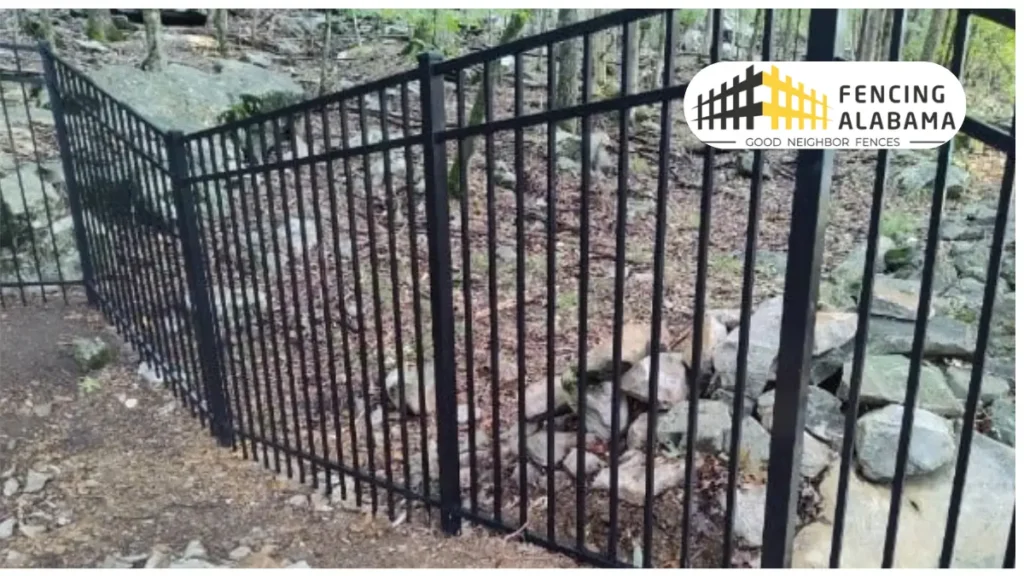
Racking a fence panel means angling the horizontal rails to match the grade while the pickets stay vertical. The panel stops being a rectangle and becomes a parallelogram. Look at a racked fence from the side, and the top line runs parallel with your yard, with no gap underneath and no stair-step silhouette.
Contractors also say raked, contoured, or “run to grade,” and all of those mean the same build. I will use racked for the rest of this article so nothing gets muddy. If a salesman tells you a fence is “contoured” and you are picturing something curved, he means racked.
Racking works because the connection between rail and post is allowed to pivot. On a site-built wood fence, I cut the rails on an angle and screw them to the post at whatever pitch the ground gives me. On an ornamental aluminum panel, the pickets are attached through punched holes in the rail that let the whole assembly flex, which is why rackable panels exist as a product category at all.
What Does a Stepped Fence Look Like?
A stepped fence holds every panel perfectly level and drops each one a fixed distance below the last, so the top line reads as a series of flat runs with a vertical jog between them. Under each panel sits a wedge of open space, widest at the downhill post and closing to nothing at the uphill post.
Stepping is the only option when a panel will not bend. Preassembled vinyl privacy sections, brick-and-column fences, and most panels that arrive welded and painted from the factory go in level or they do not go in at all.
The step height is a design decision, not an accident. Small steps on a gentle grade look almost like a racked fence and leave small gaps. Big steps on a steep grade look deliberate and architectural from the street, and they leave a gap at the low post that can swallow a mailbox.
Racked vs Stepped: The Honest Comparison
| Racked panel | Stepped panel | |
| Gap under the fence | Consistent, usually under two inches | Triangular, from nothing up to a foot or more at the low post |
| Privacy at the bottom | Full, no sightline under the boards | Open the wedge unless you fill it |
| Look from the street | Follows the land, quieter | Staircase top line, more formal |
| Pet containment | Holds a digger about as well as flat ground | Poor without a filler board or grading |
| Materials that suit it | Site-built wood, chain link, rackable aluminum | Preassembled vinyl, welded panels, masonry |
| Post height | Standard | Taller posts are needed at each step |
| Works on steep grade | Only to the material’s rack limit | Yes, with larger steps |
How Much Slope Does Your Yard Actually Have?
Grade is rise over run, and you can measure it in about ten minutes with a string line, a line level, and a tape measure. Run a string from the uphill point to a stake at the downhill point, level the string, then measure from the string down to the ground at the low end. That vertical drop across that horizontal distance is your grade.
An eight-foot run that drops twelve inches is a 12.5 percent grade, and that is a normal Huntsville backyard. Site-built wood handles it without anyone thinking twice. Most rackable aluminum panels swallow it inside their rated range.
A run that drops thirty-six inches across the same eight feet is a different animal. That is the kind of pitch I find on the uphill side of properties around Monte Sano, where the mountain does not care about your fence plan. At that pitch, panel choice narrows fast, and post layout stops being a formality.
The number I care about on an estimate is not the average slope of the yard. It is the worst eight feet of the fence line, because that section decides the method for the whole run.
Which Fence Materials Can Actually Be Racked?
Site-built wood racks freely: Because I set posts, cut rails, and attach pickets one at a time on site, a wood fence can follow almost any grade you hand it. This is the main reason wood still wins on hilly lots here. A cap and trim fence or a shadow box fence both rack fine, though the cap board on a racked run needs its miters cut carefully, or the top line looks chewed.
Chain link follows grade by default: The fabric is flexible mesh and the top rail bends, so chain link runs to the contour with no special ordering. Chain-link installed level on a slope is a mistake, not a style.
Aluminum racks as far as the factory says it racks and no further: Rackable ornamental panels are built with a swivel at the picket-to-rail connection and carry a published rack rating, usually expressed as inches of drop across the panel width. Forcing a panel past its rating bends pickets and voids the finish warranty. When a slope beats the rating, the fix is adjustable brackets, shorter panel sections, or a hybrid run that racks where it can and steps where it cannot.
Vinyl barely racks at all: Vinyl rails slot into routed holes in the post, and those routes are cut square at the factory. Standard vinyl panels are a stepping product on a slope, or they need custom-routed posts ordered for a specific angle, which costs money and adds lead time. Anyone promising a fully racked stock vinyl fence on a real slope is promising something the parts do not do.
Wrought iron and welded panels step: A welded panel is rigid by definition. It steps.
What About the Gap Under a Stepped Fence?
The gap under a stepped fence is a real problem with three real fixes, and any decent contractor will bring it up before you do. Ignoring it is how a fence passes inspection on day one and fails the dog on day three.
The first fix is a rot board, sometimes called a kickboard: a wide pressure-treated board run along the bottom of the fence, cut to follow the ground and close the wedge. It also keeps the pickets themselves out of the wet dirt, which matters in North Alabama red clay that holds water for days after a spring storm.
The second fix is grading. If the drop is concentrated in one short stretch, moving dirt is often cheaper than fighting it with fence parts. The third is to rack that one problem section and step the rest, which nobody will notice from the street, and every dog will notice from the yard.
Gaps matter most on a pool fence, where barrier code limits the clearance between the ground and the bottom of the barrier to a small figure measured in inches. A stepped panel blows past that at the low post immediately. The exact number and the way it is measured depend on the code your jurisdiction enforces, so confirm it with the authority for your address before anything gets ordered.
“Why Is My Fence Quote Higher Than My Neighbor’s for the Same Fence?”
That question comes up on sloped lots more than anywhere else, and the answer is almost always post count and post height. On a stepped run, I need taller posts to carry the high side of each step, and on a steep grade I often shorten the panel spacing, which means more holes, more concrete, and more labor for the same linear footage.
A racked wood run costs less to build than the same footage stepped in most cases, because the posts are uniform and the rails just get cut on an angle. What racking costs is skill and time on layout, since one post set at the wrong height throws the whole top line off, and you can see it from the road forever.
Neither method gets a flat per-foot number from me. A sloped run gets walked, measured, and quoted on the actual lot, and the written quote itemizes post count, post length, panel sections, and any grading or rot board separately so you can see where the difference sits. There is broader pricing context on the fence cost page if you want the flat-yard baseline first.
What Will Your HOA Think of a Stepped Fence?
Architectural review committees in the Huntsville metro care about height, material, and which way the finished side faces, and on a sloped lot the height question gets slippery. Height is normally measured from grade at each point along the fence, which means a stepped panel can be legal at its low post and over the limit at its high post on the exact same section.
I have seen approvals stall on nothing but this, because the drawing showed one height number and the committee wanted to know which end it referred to. The fix is to submit a slope elevation with the application showing the height at both ends of each section. More detail on how the approval process runs is in the HOA fence approval guide.
Review boards take anywhere from a few days to several weeks to respond, and no contractor can shorten that, mine included. Anyone who tells you they can is selling something other than fence.
How a Racked or Stepped Fence Holds Up in North Alabama?
Water is the difference between a sloped fence that lasts and one that does not, and a slope is a drainage feature, whether you planned it that way or not. Every drop of rain that hits the upper yard runs downhill, and if your fence line crosses that path, the posts at the bottom sit in the wettest soil on the property.
Red clay in this area swells when it takes on water and shrinks back during a dry stretch, and that cycle works a shallow-set post loose a little more each season. On a slope, the effect concentrates at the low end of the run, which is why so many leaning fences here lean worst at the bottom of the hill. Holes go deeper on a slope than on a flat lot, and every post gets concrete.
Posts on a steep grade also carry a side load that flat-yard posts do not, because gravity pulls the fence downhill along its own line. A long racked run on a real pitch wants a well-braced terminal post at the bottom, the same logic a farm fence uses at a corner. Skipping it is how a fence walks downhill an inch a year until the gate stops latching.
Rural lots backing onto fields around Big Cove often combine slope with a long run and a dog, which is the hardest version of this problem. Those get racked wood near the house and a wire line further out, because one fence doing both jobs does neither well. If containment is the whole point of the project, the dog and pet fencing service page covers the height and dig-prevention side.
Can You Just Cut the Pickets at an Angle Instead?
Cutting the bottoms of pickets at an angle while keeping the rails level is a third method, and it is a compromise rather than a solution. The top line stays flat like a stepped fence, the bottom follows the ground like a racked one, and the panel keeps its square shape.
It works on gentle grades and short runs. On anything steep, the top rail ends up far above the ground at the low end, the pickets get cut so short they lose their bottom rail attachment, and the fence looks like it was designed by someone who ran out of ideas halfway down the hill.
I use this on a section here and there where a run transitions between a level area and a slope. As a whole-fence strategy on a real grade, it is not worth the trim carpentry.
FAQ
Which looks better on a slope, racked or stepped?
Racked usually looks more natural on a residential lot because the fence follows the land instead of arguing with it. Stepped looks better with formal architecture, brick columns, and ornamental aluminum, where the staircase top line reads as intentional. On a gentle grade, the two look nearly identical from the street.
Can a vinyl fence be installed on a sloped yard?
Yes, but almost always by stepping it, because standard vinyl panels have square-routed posts that allow very little rack. Custom-routed posts cut for a specific slope angle can be ordered from some manufacturers, at additional cost and lead time. If your lot has real pitch and you want a continuous bottom line, site-built wood is the easier path.
How much slope is too much for a racked fence?
It depends entirely on the material. Site-built wood handles more grade than most homeowners will ever have. Rackable aluminum is limited to the manufacturer’s published rating for that panel, measured as inches of drop across the panel width, and going past it damages the panel. The honest answer for any specific yard comes from measuring the worst eight feet of the fence line.
Does a sloped yard cost more to fence?
Usually yes. Extra post depth, taller posts on stepped runs, tighter post spacing, and slower layout all add labor, and grading or a rot board adds material. How much more depends on the grade and the material, which is why a sloped lot gets an on-site measurement rather than a phone quote.
Will a stepped fence keep my dog in the yard?
Not on its own. The triangular gap at the low end of each stepped section is an open door for a dog that digs or squeezes, and small breeds clear it without digging at all. Adding a pressure-treated rot board along the bottom or grading the low spots closes it, and both should be priced into the quote from the start.
Do I need a survey before fencing a sloped property line?
A survey is worth getting any time the property line is unclear, and slope makes lines harder to eyeball because a fence built along a visual high point may sit well off the actual boundary. Property corners and pin locations come from a licensed surveyor, not from a fence contractor’s tape measure.
Get Your Sloped Yard Measured
Slope is the single thing I will not quote over the phone, because two yards with the same footage and the same material can be very different builds once you put a level on them. If your fence line runs downhill, we come out, measure the grade at the worst stretch, tell you whether that run should be racked or stepped, and leave you a written, itemized quote with the post count and any grading or rot board priced separately.
We build across the Huntsville metro from a base in Guntersville, and sloped lots are a weekly job here rather than a special case. Call (256) 900-8518 or schedule a free on-site estimate. If you already know you want ornamental panels on that hill, start with the aluminum fence installation page, and we will check the rack rating against your grade before anything gets ordered.