
Cedar or Pressure Treated for an Alabama Fence?
Cedar lasts longer and stays straighter, pressure-treated pine costs less and holds up fine if it is set and sealed properly. In North Alabama, cedar typically gives you 15 to 20 years and treated pine 12 to 15. The right answer usually depends on how much of that gap you are willing to pay for up front.
Before you read the rest:
- Cedar heartwood resists rot on its own chemistry, while pressure-treated pine relies on preservative forced into the board at a mill.
- On the $22 to $45 per linear foot installed range we publish for wood on our fence cost page, treated pine sits in the bottom half and cedar in the top half.
- Cedar moves less. Treated pine leaves the yard wet and shrinks, cups, and twists as it dries through its first Alabama summer.
- Whatever you pick for pickets, the posts below grade should be pressure-treated and stamped UC4A Ground Contact. Cedar posts are the most expensive way to make a fence lean.
- Neither wood survives red clay and 90 percent humidity without sealing. The maintenance schedule is not optional on either one.
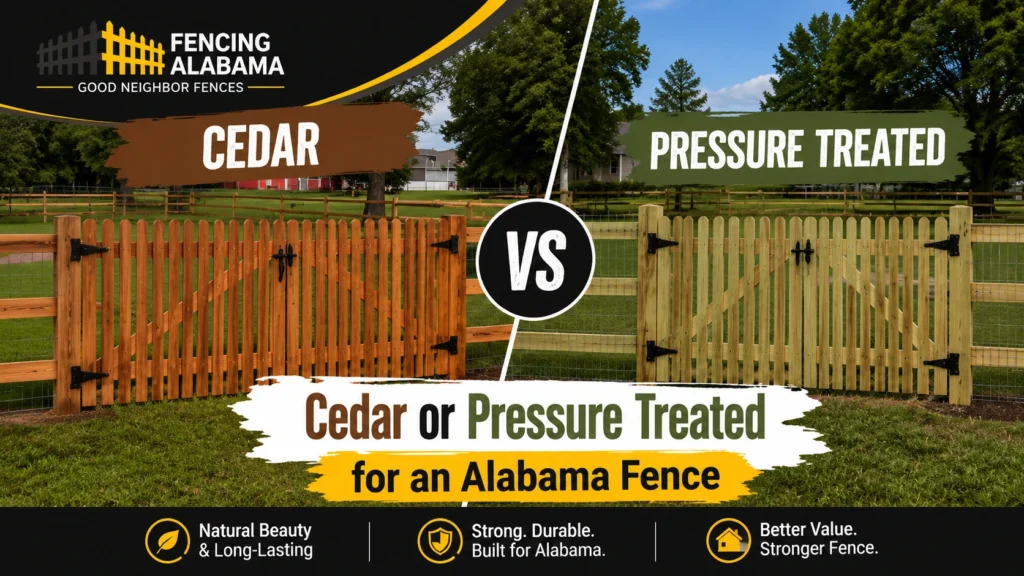
Cedar vs Pressure-Treated Pine: The Short Version
Cedar and pressure-treated pine differ on five things a homeowner actually feels: price, lifespan, how much the boards move, how they age visually, and what maintenance they demand. Everything else is detail.
| Cedar | Pressure-treated pine | |
|---|---|---|
| Typical lifespan in North Alabama | 15 to 20 years or more | 12 to 15 years |
| Installed cost, Huntsville area | Upper half of the $22 to $45 per foot wood range | Lower half of the same range |
| Rot resistance comes from | Natural oils in the heartwood | Copper preservative forced in under pressure |
| Board movement in year one | Minimal, arrives dry and stable | Noticeable, arrives wet and shrinks as it dries |
| Look if left unsealed | Silver gray, fairly even | Gray green, blotchy, often with checking |
| First stain or seal | 3 to 6 weeks after install | Wait until the wood dries out, often 3 to 6 months |
| Reseal interval here | Every 2 to 3 years | Every 2 to 3 years |
| Best use | Pickets, caps, trim, anything you look at | Posts, rails, structure, budget-driven full builds |
What Is Cedar Fencing and What Is Pressure-Treated Pine?
Cedar fencing sold in North Alabama is almost always western red cedar, a softwood whose heartwood contains natural oils that fungi and insects do not care for. Pressure-treated pine is southern yellow pine that has been loaded into a cylinder, put under vacuum and pressure, and had a copper-based preservative driven into the wood fiber. One material is born rot-resistant; the other has rot resistance installed at the mill.
The distinction matters more than it sounds, because cedar’s protection lives only in the heartwood, the darker inner wood of the tree. The pale, creamy sapwood along the edge of a cedar board has essentially no decay resistance at all. A cheap cedar picket that is half sapwood will not deliver a cedar lifespan, which is one reason two cedar quotes for the same fence can differ by thousands of dollars.
Pressure-treated pine has the opposite property. The preservative is distributed through the board by the treating process, so a treated picket is protected edge to edge. What it is protected for is printed on the end tag, and most people never read it, which is where treated pine fences go wrong.
How Long Does Each One Last in Alabama Humidity?
Cedar typically runs 15 to 20 years or more in North Alabama, and pressure-treated pine 12 to 15. Those are the same figures we use in our breakdown of how long a wood fence lasts in Alabama humidity, and they assume the fence was built correctly and sealed on schedule.
The reason both numbers are lower than what you would see in Colorado is not mysterious. A Huntsville summer runs humid for months; the ground stays damp under a solid privacy panel where the sun never reaches, and fungi in this climate get a long growing season. Wood that never fully dries out is wood that is slowly being eaten.
Here is the part that upsets the tidy comparison: the wood species is rarely what kills a fence in this market. Red clay is. North Alabama clay swells when it takes on water and shrinks back in a dry spell, and that cycle works a shallow-set post loose a little further every season. A cedar fence on 18-inch post holes will lean before a treated pine fence on 30-inch holes will, no matter what the lumber invoice said.
Termites are worth a sentence, since Alabama has plenty. Subterranean termites will eat cedar sapwood and untreated pine happily, will generally leave cedar heartwood alone, and will not eat properly treated pine. Neither material is a termite plan for your house. Both are fine for a fence.
What Do Cedar and Pressure-Treated Fences Cost Installed in Huntsville?
A wood fence installed in the Huntsville area typically runs $22 to $45 per linear foot depending on height, terrain, gates, and whether an old fence has to come out. Pressure-treated pine sits in the lower half of that band and cedar in the upper half, which on a 200-foot six-foot privacy run is a real difference measured in thousands, not hundreds.
The cost gap narrows once you look past the invoice. Cedar’s longer life spreads the cost over more years, and if a treated pine fence has to be re-picketed at year 13 while the cedar run keeps going to year 20, the cheaper fence stops being the cheaper fence. Run the numbers per year of service rather than per linear foot and the two materials land closer together than most quotes suggest.
Height changes the math more than species does. Going from a four-foot yard fence to a six-foot privacy fence is more than a 50 percent jump in material, because taller panels catch more wind and need heavier posts in deeper holes. If your budget is tight and your HOA allows it, dropping a foot of height saves more money than dropping from cedar to pine.
Slope changes it too. The ground rises hard toward Monte Sano and Bailey Cove, and a fence on a grade has to be stepped or racked panel by panel instead of run level. That is labor, not lumber, and it gets quoted on the actual lot rather than at a flat per-foot rate.
Why Did My Pressure-Treated Fence Warp and Cup Within a Year?
Pressure-treated pine warps because it leaves the treatment plant soaked. The preservative goes in as a water-borne solution, so the board you install can be carrying a serious amount of moisture, and as it gives that moisture up over its first summer, it shrinks, cups, and occasionally decides to become a shape that was not in the plan.
A homeowner who installed a straight, tight treated fence in April and is staring at gaps and a couple of banana-shaped pickets by August did not get bad lumber and did not get bad work. The wood dried. Gaps of a quarter inch between pickets that were butted tight at install are normal shrinkage, not a defect, which is why we do not build treated pine privacy fences with the boards jammed hard against each other.
Cedar arrives comparatively dry and stable and mostly stays where you put it. That stability is a meaningful part of what the extra money buys, and it is the part nobody mentions in the showroom. If the fence faces the street and you want the line to still look sharp in year three, cedar earns its price on movement alone.
Kiln-dried-after-treatment pine, sold as KDAT, solves most of the movement problem and costs closer to cedar. It is a legitimate middle option and worth asking about if you like the price of pine and hate the idea of warping.
The Part Almost Nobody Checks: What Goes in the Ground
The posts decide how long your fence stands, and posts belong in pressure-treated pine rated for ground contact regardless of what the rest of the fence is made of. On the end tag, that means the Use Category line reads UC4A Ground Contact or better. Boards stamped UC3B Above Ground are for rails and pickets, and they sit in the same aisle at every home center, unlabeled by anything except that tag.
Retention numbers on the tag confuse people, and they should, because they change with the preservative chemistry. The same UC4A ground contact rating is 0.15 pcf in micronized copper azole and 0.40 pcf in ACQ. Read the Use Category words, not the number, because a lower number is not a weaker post.
Cedar posts look like the premium choice and are usually the wrong one. Cedar heartwood resists decay well above grade, but buried in damp North Alabama clay it gives up faster than a UC4A treated post, and it costs more to do it. We set treated posts in concrete, below the frost line, on every wood fence we build regardless of the picket material.
Fasteners follow the same logic and get skipped just as often. Copper-based preservatives corrode ordinary steel, so treated wood needs hot-dip galvanized fasteners at a minimum, and stainless where you want the fence to outlive the screws. Bright screws in treated pine will rust out and streak the boards long before the wood fails.
How Much Maintenance Does Each One Actually Need?
Both woods need sealing every two to three years in this climate, and the difference is mostly in when you start and what happens if you skip it. Cedar can usually take its first coat three to six weeks after installation. Treated pine has to dry first, which in practice means three to six months, and sealing it early traps moisture and wastes the product.
There is a simple field test for whether treated pine is ready: sprinkle water on a board. If it beads up and sits there, the wood is still too wet. If it soaks in within a minute or so, the board is ready to take stain.
Left completely alone, cedar goes to an even silver gray that a lot of people like, and it does that without losing much structural life for the first several years. Treated pine left alone goes gray-green in patches, checks along the grain, and looks noticeably worse, noticeably faster. If “no maintenance ever” is the plan, cedar tolerates that plan better, though neither material hits its full lifespan under it.
The reseal interval is where Alabama differs from a drier state. Two to three years is the honest number here, not the five you will read on a national blog, because our UV load and humidity strip a finish faster. Our fence staining and sealing service exists mostly because that interval is easy to forget and expensive to remember late.
Can I Use Cedar Pickets With Pressure-Treated Posts?
Yes, and that hybrid is what a large share of the good-looking wood fences in the Huntsville metro actually are. Pressure-treated posts and rails carry the structure and sit in the wet clay; cedar pickets and cap boards carry the appearance, and you pay the cedar premium only on the wood you look at.
The savings are real because posts and rails are a minority of the board footage on a typical privacy fence, while pickets are the bulk of what you see. Spending the cedar money where it shows and the treated pine money where it is buried is the closest thing to a free lunch in this trade.
One caution on mixing: cedar and treated pine weather to different colors, so a hybrid fence that is left unsealed will not age evenly. If you go hybrid, plan on staining the whole fence to one tone rather than letting nature sort it out.
When Is Cedar the Right Call?
Cedar makes sense when the fence is visible, when the run is long enough that repairs would be disruptive, and when you plan to be in the house long enough to collect the extra five to eight years. A front-facing run in a Madison or Jones Valley subdivision is a cedar situation.
Cedar also wins on anything decorative. Cap and trim, lattice tops, arched gates, and horizontal board fences all rely on boards staying flat and straight, and treated pine’s first-summer movement shows badly on those details. If the design has a top cap on it, use cedar for the cap at minimum.
Buy cedar carefully, though. Ask what percentage of heartwood you are getting and what grade the pickets are. Cedar that is mostly sapwood costs cedar money and lasts closer to untreated pine, and that is a genuinely expensive mistake to discover in year eight.
When Is Pressure-Treated Pine the Right Call?
Pressure-treated pine is the right call on long runs where the budget is the constraint, on back and side lines that nobody sees from the street, on rental and investment property, and on any fence you intend to stain a solid color anyway. Two hundred feet of back-lot boundary does not need a premium species.
Treated pine is also correct wherever wood meets dirt or standing water. A low run at the bottom of a yard that holds water after a storm should be treated pine, ground contact rated, every time. Cedar’s advantages are above grade, and that particular stretch of fence is not living above grade in any meaningful sense.
Solid stain flattens most of the visual difference between the two woods, so if the plan is an opaque finish in a color your HOA specified, paying for cedar grain you are about to paint over is money spent on something you will never see again.
Does My HOA Care Which Wood I Use?
Most Huntsville-area architectural review committees care about height, style, and which way the finished face points, and many of them will accept either cedar or pressure-treated pine as long as the finish color matches the community standard. A minority of neighborhoods specify a species or a stain color outright, and those are the ones that generate expensive surprises.
Check before you order material, not after. A fence built to the wrong specification comes down at the owner’s cost, and boards already installed are not returnable. Our walkthrough of HOA fence approval in Huntsville subdivisions covers what those committees typically ask for and how long they take to answer.
Whether a permit or setback rule also applies depends on whether your parcel sits inside a city limit or in an unincorporated county, and those requirements change. Confirm with the authority for your specific address, which is the same advice we give in our notes on fence permit rules in Madison County. Toney and Harvest parcels frequently follow county rules rather than a municipal code.
Cedar or Pressure Treated FAQ
Is cedar worth the extra money for a fence in Alabama, or should I just get pressure treated?
Cedar is worth it if the fence is visible, if you want it to stay straight without much fuss, and if you will own the home past year 12. If the run is a back boundary, the budget is fixed, or you plan to stain it a solid color, pressure-treated pine at the same build quality is the better value. A cedar-picket, treated-post hybrid splits the difference for most Huntsville homeowners.
How long will a pressure-treated fence last in North Alabama?
Twelve to fifteen years is typical for pressure-treated pine in this climate, assuming ground contact rated posts set in concrete below the frost line and sealing every two to three years. Fences that fail at seven or eight years almost always failed at the post, not the picket. Red clay swelling and shrinking works a shallow post loose season by season until the run leans.
Do I have to stain a cedar fence, or can I let it turn gray?
You can let cedar gray out, and many North Alabama homeowners do. Cedar heartwood keeps its decay resistance as it weathers, so an unsealed cedar fence does not fail quickly. Sealing every two to three years still buys you years of service life and keeps the color, so the honest framing is that staining cedar is optional but profitable rather than mandatory.
Can I use cedar posts instead of pressure-treated?
We do not recommend cedar posts in North Alabama. Cedar’s decay resistance works well above ground but underperforms a UC4A ground contact treated post in wet clay, and it costs more. Every wood fence we build gets pressure-treated posts set in concrete, whatever the pickets are made of.
Why do two cedar fence quotes for the same yard differ so much?
Cedar grade is the usual reason. Pickets that are mostly heartwood cost considerably more than pickets carrying a lot of pale sapwood, and sapwood does not deliver cedar’s lifespan. Post depth, post spacing, rail count, and fastener type account for most of the rest. An itemized written quote lets you compare those line by line instead of guessing.
What is KDAT, and is it a good middle option?
KDAT stands for kiln-dried after treatment, which is pressure-treated pine that has been dried in a kiln after the preservative goes in. It moves far less than standard wet-treated lumber, takes stain immediately instead of after a months-long wait, and costs closer to cedar. It is a reasonable choice when you like treated pine’s protection but not its first-summer warping.
Get a Written Quote on Both
The cleanest way to settle cedar versus pressure-treated is to see both numbers for your actual yard, with your footage, your slope, and your gate count on the same page. We measure on site, price both materials, and put it in writing before anything gets ordered.
Fencing Alabama is based in Guntersville and builds wood fence installations across Huntsville, Madison, and the rest of North Alabama, including privacy fencing built to HOA specifications. If you are weighing whether an existing fence is worth keeping, our notes on choosing a fence company in North Alabama cover what to look for before you sign anything.
Call (256) 900-8518 for a same-day callback, or schedule a free on-site estimate.
Fencing Alabama, 4741 Bakers Chapel Rd, Guntersville, AL 35976 (256) 900-8518, Monday to Saturday, 9:00 AM to 5:00 PM