
Chain Link Driveway Gates: Sizes, Costs, and What Holds Up in North Alabama
Short answer
A chain link driveway gate is a steel-framed section of chain link fence built to swing or roll across a vehicle opening. On most homes I quote around Huntsville, the opening is 10 to 12 feet wide and the gate is 4 to 6 feet tall, split into two leaves so neither one is heavy enough to pull its post out of the ground. Installed, a residential double swing gate in that size usually lands between $700 and $1,500, and the single biggest thing separating a gate that still latches in year ten from one that drags by next spring is the gate post and the concrete under it.
Key points before you call anybody for a price:
- A driveway gate needs a bigger post than the rest of the fence. Line posts on a residential chain link fence are commonly 1-3/8 inch outside diameter, while a gate post carrying a drive leaf runs 2-3/8 inch or larger, in a deeper hole with more concrete.
- Two leaves beat one. A single 12-foot leaf puts every bit of leverage on one hinge post, and North Alabama clay does not forgive that.
- Gate frames are welded from tubing, not built from fence fabric alone. The frame is what stays square.
- A rolling gate needs level ground and clear run-back space beside the opening, which a lot of driveways here do not have.
- If you plan to add an opener later, say so before the posts go in, because the post size and footing for an automated gate are not the same as for a hand-swung one.
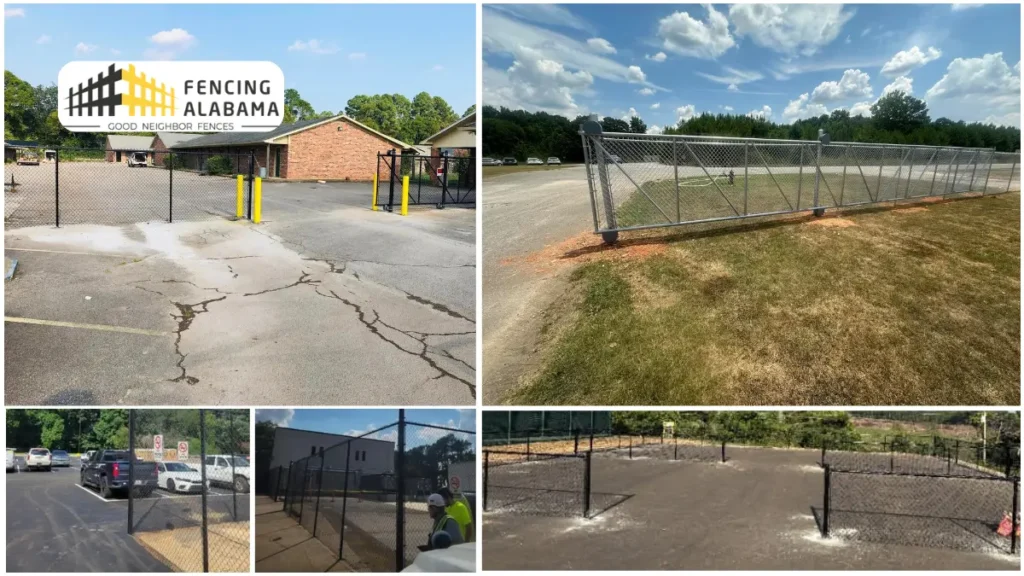
What Is a Chain Link Driveway Gate?
A chain link driveway gate is a rigid steel frame filled with chain link fabric, hung on hinges or wheels so vehicles can pass through a fence line. It does the same job as the fence around it, keeping dogs, kids, and casual foot traffic where they belong, with the difference that it moves. The fence gets to be lazy. The gate has to work every single day, in July humidity and in February mud, which is why it is the part homeowners call me about most.
The name people use varies by who they last talked to. A driveway gate, a drive gate, a double drive gate, and a drive-through gate all describe the same thing in the chain link trade. I use driveway gate throughout this article so nothing gets muddled.
Where a driveway gate differs from the walk gate by your back steps is scale. A walk gate is typically 3 to 4 feet wide and weighs little enough that a light hinge holds it. A driveway gate spans three to five times that, so the frame tubing gets heavier, the hinges get heavier, and the post it hangs on stops being a fence part and starts being a structural one.
What Parts Make Up a Chain Link Driveway Gate?
A chain link driveway gate is built from seven pieces, and knowing their names is worth real money when you compare two quotes. Most of the price difference between a cheap gate and a good one hides in this list.
| Part | What it does | What I use on a residential drive gate |
| Gate frame | The welded tube rectangle that holds everything square | 1-5/8 inch to 1-7/8 inch outside diameter galvanized tubing |
| Gate posts | The two posts either side of the opening that carry the load | 2-3/8 inch or larger, sized to leaf width and weight |
| Chain link fabric | The woven mesh filling the frame | 11 gauge residential, 9 gauge where the gate takes abuse |
| Tension bars and bands | Flat bars woven through the mesh edge, clamped to the frame | Galvanized, one set per leaf edge |
| Hinges | Male and female hinge pairs bolted to post and frame | Heavy-duty for anything over 6 feet of leaf |
| Fork latch | The spring-loaded catch that holds the leaves closed | Padlock-ready on both residential and commercial |
| Drop rod | The pin that drops into a ground sleeve to hold the inactive leaf still | Required on every double swing gate |
The drop rod is the part people skip and then call about. Without it, one leaf floats free every time you push a vehicle through, the latch takes a beating, and inside a couple of seasons the gate stops meeting in the middle. It costs almost nothing, and it is the difference between a gate that closes and a gate you have to lift.
Wider leaves also get a truss rod, which is a thin steel rod run diagonally across the frame with a turnbuckle in the middle. Tighten the turnbuckle, and you pull the sagging corner back up. On a 6-foot leaf, I can usually skip it. On anything past 8 feet, I put one in from day one, because adding it later means taking the gate down.
How Wide Should a Chain Link Driveway Gate Be?
Measure the concrete, then add room for a mirror. A standard single-car driveway in the Huntsville metro is roughly 10 to 12 feet of pavement, and a 12-foot clear opening is the size I install most often on residential jobs. A 10-foot opening works but gets tight with a full-size truck, and tight openings collect paint from side mirrors.
Chain link gate leaves come in standard sizes, which is why searches like 4ft x 6ft chain link gate and 6 ft x 12 ft chain link gate get typed so often. Read those numbers as height by width. A 4 x 6 is a 4-foot-tall leaf that is 6 feet wide, so two of them give you a 12-foot opening in a 4-foot-tall fence.
| Total opening | Common setup | Fits |
| 10 feet | Two 5-foot leaves | Cars and small SUVs, tight for a dually |
| 12 feet | Two 6-foot leaves | The residential standard, comfortable for full-size trucks |
| 16 feet | Two 8-foot leaves, truss rods on both | Boat and camper access, small equipment |
| 20 feet | Rolling gate or two 10-foot leaves | Farm and commercial traffic, tractors and trailers |
Height follows the fence it joins. A 4-foot chain-link fence gets a 4-foot gate, and a 6-foot fence gets a 6-foot gate. A gate taller than the fence beside it looks like a mistake and, worse, tells a dog exactly where the low spot is.
One measurement people miss: the gap under the gate. I set drive gates with roughly 2 to 3 inches of ground clearance so the leaves clear a rise in the drive without dragging. If you have a dog that treats 3 inches as an invitation, I add a bottom rail and a ground stop rather than lowering the whole gate into the dirt. For more on containing dogs, our dog and pet fencing page covers the height and dig-prevention side of it.
Single Swing, Double Swing, or Rolling Gate?
Double swing wins for almost every residential driveway in North Alabama, because it halves the leverage on each post and needs no extra ground beside the opening. A single swing gate hangs the whole opening off one post, and a rolling gate needs as much clear space beside the driveway as the gate is wide.
| Gate type | Best for | The catch |
| Single swing | Openings up to about 8 feet | Every pound of leverage lands on one post, so the post and footing have to be oversized |
| Double swing | Residential driveways, 10 to 16 feet | Needs swing clearance inside or outside the property line, and a level arc to swing through |
| Rolling or sliding | Level sites, tight frontages, commercial lots | Needs run-back space beside the opening equal to the gate width, plus a clean track or wheel path |
| Cantilever slide | Commercial and industrial gates | Needs roughly 50 percent extra length behind the opening for the counterbalance, and it is the priciest of the four |
Slope decides more of this than people expect. If your driveway climbs, a swing gate has to swing uphill or downhill through an arc, and neither is fun. On a rising drive, I hang the leaves to swing toward the downhill side and set the ground clearance for the high point. The same grade problems that show up on sloped yards apply here, and I walked through the panel side of that in our article on fencing a sloped yard with racked versus stepped panels.
Rolling gates get asked about a lot because they look tidy in photos. On a typical Huntsville subdivision lot, the rolling gate loses on space. A 12-foot rolling gate wants 12 feet of clear fence line beside the opening to park in, plus a wheel path that stays level. On a farm frontage in Toney or New Market, where there is 40 feet of open fence line and flat ground, a rolling gate is often the better answer.
What Does a Chain Link Driveway Gate Cost?
In this market, I typically quote a residential 10 to 12-foot double swing chain link driveway gate, 4 to 5 feet tall, at $700 to $1,500 installed, including both gate posts, footings, hardware, and the drop rod. A 6-foot-tall gate in a 16-foot opening with heavier frame tubing and truss rods usually runs $1,400 to $2,600. A 20-foot rolling gate on a commercial or farm frontage starts higher again, generally $1,800 to $3,800 depending on frame weight and site prep.
Five things move that number, and none of them are the chain link fabric:
- Frame weight and fabric gauge: Stepping from 11 gauge mesh in a light frame to 9 gauge in 1-7/8 inch tubing adds material cost across every leaf.
- Post size and footing depth: A gate post for a 10-foot leaf takes a bigger hole and more concrete than a line post, and on some sites it takes a lot more.
- Coating: Black vinyl-coated mesh and hardware cost more than bare galvanized, usually 20 to 40 percent more on the gate portion.
- Site access and demolition: An old gate to cut out, a rock shelf at post depth, or a driveway with no truck access all add labor hours.
- Automation readiness: Running conduit and a power stub while the posts are being set is cheap. Trenching across a finished driveway later is not.
A written quote should show the gate as its own line item, not buried inside a per-linear-foot fence price. If a quote says “150 ft chain link fence with gate” and gives one number, you cannot tell whether you are getting a 12-foot double drive gate or a 4-foot walk gate. Ask for it split out. Our fence cost page breaks down the rest of the pricing picture by material.
Why Chain Link Driveway Gates Sag, and How I Stop It?
A chain link driveway gate sags for one of three reasons: the hinge post moved, the frame racked out of square, or the hinges wore. Around Huntsville, the hinge post moving is the most common by a wide margin, and the cause is under the ground rather than in the steel.
North Alabama red clay swells when it takes on water and shrinks back in a dry spell. That cycle works a post loose a fraction at a time, and a gate post feels it worse than a line post because the gate hangs on it like a long lever pulling sideways all day. A fence panel with a loose post leans and looks bad. A gate with a loose post stops closing, which is the version you notice within a week.
The fix is in the hole, and it happens before the gate ever exists. I set drive gate posts in concrete at a depth matched to the leaf weight and the soil on that particular lot, not to a number on a spec sheet, and I set the two gate posts before the rest of the fence line so everything else measures off them. Where a leaf runs 8 feet or wider, I add a truss rod to the frame and a drop rod to the inactive leaf so no single connection carries the whole load.
The second cause, a racked frame, shows up as a gate that latches at the bottom but gaps at the top, or the reverse. Tightening the truss rod turnbuckle a few turns usually squares it back up. If there is no truss rod, that gate needs one, which is the argument for putting it in at install.
The third cause is worn hinges, and it is the easiest to spot. Grab the gate leaf near the hinge side and lift. If it moves up and down independently of the post, the hinge is worn or the bolts backed off. Hinge hardware on a gate that gets used daily is a consumable part, and I would rather replace a $30 hinge pair than a post. If yours is past that point, our fence repair service covers gate resets and post replacement.
Can You Add an Automatic Opener to a Chain Link Driveway Gate?
Yes, and chain link is one of the easier materials to automate because the mesh lets wind pass through instead of catching it like a solid panel. What decides the job is not the gate; it is the posts, the power, and the safety hardware.
Automated vehicular gates in the United States are covered by ASTM F2200, the standard specification for automated vehicular gate construction, and the operators themselves fall under UL 325, which is the safety standard requiring entrapment protection such as photo eyes or edge sensors. Those two documents are why an automated gate installation costs more than a motor bolted to an existing gate, and why I will not automate a gate that was not built to carry an operator.
Power is the practical hurdle. A hardwired opener needs a trench from the house or a nearby panel to the gate post, which is easy to run while the fence is going in and expensive to add afterward. Solar operators sidestep the trench and work well on a gate that cycles a handful of times a day, and they struggle on a gate that a family of five opens twenty times a day through a cloudy week in January. If an opener is anywhere in your plans, tell whoever sets your posts. Our automatic and electric gate page covers the operator side in more detail.
Galvanized or Black Vinyl Coated for a Driveway Gate?
Galvanized is the lower cost and the standard on most driveway gates I install. Black vinyl-coated mesh costs more, disappears against a tree line better than bright silver does, and adds a second layer over the zinc that helps in a spot that stays wet or shaded. Zinc-coated chain link fabric is made to ASTM A392 and vinyl-coated fabric to ASTM F668, which is worth knowing if you are comparing two quotes and one of them will not say what fabric it uses.
For a driveway gate specifically, I push people toward coated hardware regardless of which mesh they pick. The hinges and the fork latch are the moving parts; they sit at the wettest point of the fence line because rainwater runs down a driveway, and a rusted latch is the thing that makes a good gate feel cheap.
Do You Need a Permit or HOA Approval for a Driveway Gate?
A driveway gate sits at the front of the property, in the part of the yard most likely to be covered by setback rules and the part an architectural review board actually looks at, so it draws more scrutiny than a backyard fence. Whether a permit applies depends on whether your parcel is inside a city limit or in unincorporated county, and requirements change, so confirm with the authority for your address before anything is ordered.
Front yard fences and gates are the most commonly restricted items in Huntsville-area subdivision covenants, and an HOA can require a specific height, material, or color at the street even when the county has no objection at all. Build first, and you can be told to take it down at your own cost. Boards here take anywhere from a few days to several weeks to answer, and no contractor can speed that up, so I prepare the drawing and material spec and submit early rather than waiting for the build slot.
Two more practical items. A driveway gate that opens outward toward the road can swing into the right-of-way, which is its own problem, so I hang residential drive gates to swing inward unless the site makes that impossible. And Alabama requires a utility locate before digging, so 811 gets called on every job and the mark period gets waited out before a single post hole goes in. Gate posts go deeper than line posts, which makes the locate matter more here, not less.
For the wider rules picture, our posts on fence permit rules in Madison County and HOA fence approval in Huntsville subdivisions go through how each one works. If your parcel is out toward Toney, you are likely in unincorporated Madison County and following county rules rather than a municipal code.
How to Keep a Chain Link Driveway Gate Working?
Three minutes twice a year covers almost everything a chain link driveway gate needs. Oil the hinge pins and the fork latch spring with a light machine oil, check that the hinge bolts and tension bands are still tight, and look at where the leaves meet when closed.
That last one is your early warning system. When the leaves stop meeting flush, something moved, and catching it at a half inch of misalignment means tightening a turnbuckle. Catching it at 3 inches means resetting a post. The gap tells you which post moved too, because the leaf that dropped is hanging on the post that shifted.
Keep the ground sleeve for the drop rod clear. It fills with gravel and clay wash, especially on a gravel drive, and once the rod will not seat, people stop using it and the gate starts working itself loose. A bolt or a short piece of pipe pushed into the sleeve clears it in seconds.
Chain Link Driveway Gate Questions I Actually Get Asked
My driveway is 12 feet wide. Should I get one 12-foot gate or two 6-foot gates, and does it change the price much?
Two 6-foot leaves, almost every time. Splitting the opening halves the leverage on each hinge post, which is the load that pulls gate posts loose in clay soil. The price difference is small, usually a second set of hinges and a drop rod, and a double swing gate is far less likely to need a post reset in year five. A single 12-foot leaf is a farm gate solution, and it needs an oversized post and footing to work.
How much does it cost to put a chain link gate across my driveway in the Huntsville area?
A residential 10 to 12-foot double-swing chain-link driveway gate, 4 to 5 feet tall, typically runs $700 to $1,500 installed in the Huntsville metro, including both gate posts, concrete, hinges, latch, and drop rod. Height, fabric gauge, coating, and site conditions move it from there. Fencing Alabama gives a written itemized price with the gate as its own line, after an on-site measurement.
Can I put a chain link driveway gate on an existing chain link fence, or does the whole fence need redoing?
You can add a driveway gate to an existing chain link fence in most cases. The catch is that an existing line post is usually too light to hang a drive leaf on, so the opening needs a proper gate post set in concrete on at least the hinge side, and often both sides. Cutting an opening and reusing whatever post is already there is the single most common reason a retrofit gate sags within a year.
Will a chain link driveway gate keep my dog in, or will he just push through the gap at the bottom?
A chain link driveway gate holds most dogs, and the gap at the bottom is the weak point, not the mesh. I set drive gates with 2 to 3 inches of ground clearance so they clear the driveway surface, and a determined digger or a low-slung breed will work at that gap. A bottom rail, a ground stop, or a run of buried hardware cloth at the gate line solves it without dropping the gate into the dirt where it will drag.
What is the difference between a rolling chain link gate and a swing gate, and which one do I need?
A swing gate pivots on hinges through an arc, and a rolling gate travels sideways along the fence line on wheels or a track. Swing gates suit most residential driveways in North Alabama because they need no extra fence line beside the opening. A rolling gate needs clear run-back space roughly equal to the gate width and reasonably level ground, which makes it a better fit for farm frontages and commercial lots than for a subdivision lot.
How long does it take to install a driveway gate, and can it be used right away?
Setting a driveway gate is usually a same-day job once materials are on site, and most residential chain link fence installs, including a gate finish in one to three days. The gate itself should not be hung and swung on fresh concrete immediately, because the footings need time to cure before they take the load of a leaf. I schedule the hang so the posts have had their cure time rather than handing you a gate that loosens its own post in the first week.
Get a Price on Your Driveway Gate
If you want a chain link driveway gate measured and priced properly, with the gate itemized separately and the post sizing matched to your opening, call Fencing Alabama at (256) 900-8518 or schedule a free on-site estimate. We are based in Guntersville and install chain link fence and gates across Huntsville, Madison, Athens, Decatur, Harvest, and the rest of North Alabama, with gate installation on new fences and existing ones. We call back the same day, and the number on the invoice is the number from the estimate.
Fencing Alabama, 4741 Bakers Chapel Rd, Guntersville, AL 35976. (256) 900-8518. Monday to Saturday, 9:00 AM to 5:00 PM.