
Standard Fence Gate Width: Walk Gate vs Drive Gate Sizing
Short answer
Repair a fence when the posts are solid and the damage sits in the boards. Replace it when the posts move. Posts carry most of the labor on a wood fence, so once about a third of them are loose or rotted at the groundline, a repair costs close to a new fence and lasts a fraction as long.
The short version
- A walk gate at 3 feet handles people, and a push mower, and a walk gate at 4 feet handles a wheelbarrow and a garbage cart without scraping.
- A drive gate at 10 to 12 feet handles a pickup, and anything under 10 feet turns backing in into a weekly test of your patience.
- The gate opening and the gate leaf are two different numbers, and the hardware eats about 2 inches between them.
- A single swing leaf over 6 feet wide starts pulling its hinge post out of North Alabama clay, so wide openings get two leaves.
- Measure the machine, not the catalog. A 42-inch mower deck does not mean a 42-inch mower.
I have been building fences and gates around Huntsville and Madison County since 2019, and I can tell you the single most common call I get is not about a broken gate. It is a homeowner standing in their yard with a brand new zero-turn mower, looking at a 36-inch gate, doing the mental math and hoping geometry will change its mind. It will not. Let us get your number right the first time.
What Is a Walk Gate, and How Wide Should It Be?
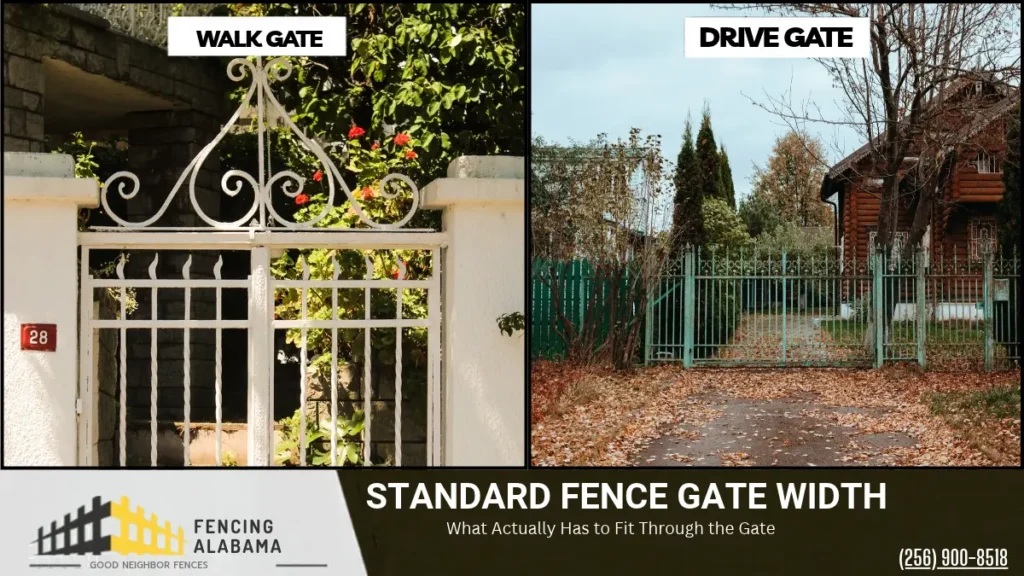
A walk gate is a single swinging gate sized for people and hand-carried equipment, and the standard walk gate width is 3 to 4 feet. I install 4-foot walk gates more often than any other size in Huntsville because 4 feet is the smallest opening that handles a wheelbarrow, a garbage cart, and a push mower without a three-point turn.
A 3-foot walk gate works when the only traffic is people. That is the right call for a side yard gate between two houses in a tight Jones Valley lot, or a second gate that exists mostly so you do not have to walk around the house. It is also the smallest opening I would build, because a standard 96-gallon roll cart runs about 27 to 30 inches wide depending on which brand your hauler uses, and 36 inches leaves you very little margin on a rainy Tuesday.
A 4-foot walk gate is the size I recommend by default on a privacy fence. A wheelbarrow runs roughly 25 to 27 inches across the handles, a push mower deck runs 21 to 22 inches, and both of those fit through 36 inches on paper. On a real yard, with mulch in the barrow and a slope under your feet, the extra foot is the difference between walking through and wrestling through.
A 5-foot walk gate is the quiet workhorse of this market. Most riding mowers will not clear 4 feet, and 5 feet gets a garden tractor through without the owner holding their breath. If you have any yard equipment at all and the fence line has room, I would rather build you a 5-foot gate once than come back in two years and rebuild a 4-foot one.
What Is a Drive Gate, and What Is the Standard Drive Gate Width?
A drive gate is a vehicle-sized gate across a driveway or a yard entrance, and the standard drive gate width is 10 to 12 feet for a residential driveway. A full-size pickup is wider than most people assume. Ford publishes the F-150 body width at 79.9 inches, which is 83.6 inches with the mirrors folded and 95.7 inches with the mirrors out. That truck needs 8 feet of clear opening just to exist in the gap, before you add any room for steering error.
A 10-foot drive gate is the practical residential minimum. Ten feet gives a pickup roughly 2 feet of total margin with the mirrors out, which sounds generous until you have backed a boat trailer through it in the dark.
A 12-foot drive gate is what I build when the driveway is straight, and the owner tows anything. Twelve feet lets you approach at a slight angle without clipping a post, and trailers always approach at a slight angle. If your driveway curves into the gate rather than running straight at it, go to 12 feet and do not debate it.
A 14 to 16-foot drive gate belongs on rural parcels where a tractor, a hay trailer, or a delivery truck has to come through. Around Toney and New Market we build a lot of these, and the posts stop being fence posts and start being structural. A 16-foot farm gate opening is common enough around here that the hardware is easy to source.
Equipment Widths: What Actually Has to Fit Through the Gate
Measure the widest point of the widest thing that will pass through the gate, then add 6 inches. That one sentence prevents most gate sizing mistakes I get called out to fix. Here are the real numbers I check before I quote a gate.
| What goes through | Real width | Gate opening I would build |
| People only | About 24 inches | 3 feet |
| 96-gallon roll cart | 27 to 30 inches | 3 feet; 4 feet is better |
| Wheelbarrow | 25 to 27 inches | 4 feet |
| Push mower | 21 to 22 inch deck | 3 feet |
| Zero-turn, 42-inch deck | 50.4 inches on a John Deere Z320R with the deck attached | 5 feet |
| Garden tractor with bagger | 45 to 52 inches | 5 feet |
| Polaris Ranger 1000 side-by-side | 62.5 inches factory width | 6 feet |
| Full-size pickup | 79.9 inch body, 95.7 inches with mirrors out | 10 to 12 feet |
| Tractor or hay trailer | Varies; measure the axle | 14 to 16 feet |
The zero-turn line is the one that costs people money. John Deere lists the Z320R at 50.4 inches wide with the mower deck attached and 43.3 inches without it, and the deck is a 42-inch deck. The number on the sticker is the cutting swath, not the machine. I have measured more than one 4-foot gate that was built the same month the owner bought a mower that could never go through it.
The other number worth checking is your own hands. Add 6 inches to whatever you measure. People steer badly when they are being watched by a neighbor, and a gate that fits perfectly fits only in a photograph.
How Do I Measure a Gate Opening Correctly?
Measure between the inside faces of the two gate posts at the height where the gate will hang, because that is the clear opening, and the gate leaf is always smaller than that number. On a swing gate, the hinges and the latch take up roughly 2 inches of that opening, so a 4-foot opening gets a gate leaf near 46 inches rather than 48.
The opening and the leaf are two separate numbers, and mixing them up is the most common ordering mistake I see. If you tell a supplier you want a 6-foot gate and you mean a 6-foot opening, you can end up with a 6-foot leaf that will not close into a 6-foot gap. Say the word opening or the word leaf out loud every time, and write it on the quote.
Measure at the top, the middle, and the bottom of the opening before you build. Posts are rarely perfectly plumb on an older fence, and a gap that measures 48 inches at the top and 46 at the bottom tells you a hinge post is already moving. That is a post problem, and on our red clay it tends to get worse, not better.
The gap between the gate and the post should be about half an inch on the latch side and whatever the hinge hardware calls for on the hinge side. Too tight and the gate binds the first humid week in June when the wood swells. Too loose and a determined dog finds it.
How Tall Should the Gate Be?
A gate matches the height of the fence it sits in, which in this market usually means 4 feet or 6 feet. A gate taller than the fence looks like a mistake, and a gate shorter than the fence is an invitation if you own a dog that can count.
Dog owners should size height off the animal rather than the fence catalog. I cover breed-by-breed guidance in our article on how high a dog fence should be by breed, and the short answer is that a gate is the weakest point of any containment fence because it is the only section with a gap on three sides.
Pool gates follow their own rules and are not a style choice. Height, latch height, swing direction, and self-closing hardware are all specified for a pool barrier, and we keep that separate in our guide to self closing and self latching pool gate rules. Do not size a pool gate off this article.
Ground clearance under the gate is part of the height conversation. I leave about 2 inches under a walk gate on flat ground so it clears grass and the occasional stick, and more on sloped ground. A gate with no clearance drags the first time the soil heaves, and North Alabama soil heaves every single year.
Single Swing or Double Gate? Where the Line Falls
A single swing leaf works up to about 6 feet wide, and past that I build a double gate with two leaves. The reason is mechanical. A 10-foot single leaf puts 5 feet of lever arm on the hinge post every time it swings, and that post is set in soil that swells when it rains and shrinks when it dries.
North Alabama red clay takes on water, expands, and then pulls back when a dry spell hits. That cycle works a post loose a little more each season, and a wide heavy gate hanging off one side accelerates it. Almost every sagging gate I have been called to fix in Madison County was a post problem rather than a gate problem, which is the same story behind most leaning fence posts in clay soil.
A double gate splits the opening into two leaves of roughly equal width, so a 12-foot opening becomes two 6-foot leaves. Each hinge post then carries half the load and half the lever arm. The inactive leaf gets a drop rod into a ground sleeve so it stays put while the active leaf does the daily work.
A rolling or cantilever gate is the answer when a driveway has no room for a leaf to swing. A swing gate needs an arc of clear ground equal to its leaf width, which a short driveway with a slope rising toward the house simply does not have. We cover the mechanics of that choice for metal gates in chain link driveway gates.
What Size Posts Does a Wide Gate Need?
Gate post size scales with leaf width, because the post carries the whole weight of the gate at the end of a lever. A 4×4 wood post handles a walk gate leaf up to about 4 feet. Past that, I move to a 6×6 wood post or a steel post set in a deeper footing, and on wide drive gates the post is steel every time.
The footing matters more than the post. A line post and a gate post are not the same job, and I dig the hinge post hole deeper and wider than the line posts on every gate I build. The concrete around a hinge post is what resists the twisting load, and the volume of concrete is what resists it, not the post material.
Steel posts go in drive gates because wood twists. A 6-foot leaf hanging on a wood post will rack the post slowly over a few seasons, and you will see it as a growing gap at the top of the latch side long before the gate drags. Size the material for the gate on day one, and you avoid that whole chapter.
If you are retrofitting a gate into an existing fence, assume the existing posts are line posts and plan to replace them. I have never once opened a fence line for a new gate and found that the previous installer happened to set an oversized post at that exact spot, waiting patiently for a gate that had not been invented yet.
Where the Gate Swings, and Why the Ground Decides
A swing gate needs an unobstructed arc equal to its leaf width, and sloped ground is what usually takes that arc away. If the ground rises as the gate opens, the gate will hit dirt partway through its swing, and you will live with a gate that only opens to 60 degrees forever.
Stand where the gate will go and walk the arc before you commit. Toward Monte Sano and Bailey Cove, the ground rises sharply, and a gate that opens uphill on those lots needs either extra ground clearance or a swing in the other direction. The same slope that forces panels to be stepped or racked also governs the gate, which I go into in fencing a sloped yard with racked versus stepped panels.
Swing direction is a decision, not an accident. I hang most residential gates to swing into the yard so the fence line stops the gate from blowing past its frame in a storm, and so a gate on a driveway never swings into traffic. Pool gates are the exception, since a pool barrier gate swings away from the pool by rule.
Both leaves of a double gate can swing the same direction or opposite directions, and on a driveway I generally swing both inward so neither leaf ever stands in the street. On a flat yard with room on both sides, that choice comes down to how the owner uses the space.
Does a Wider Gate Cost More, and by How Much?
A wider gate costs more for three reasons: more frame material, bigger posts and footings, and heavier hardware. Going from a 4-foot walk gate to a 5-foot walk gate is a modest step. Going from a 6-foot single to a 12-foot double gate is a different category of job, because the posts, concrete, and hardware all change at the same time.
The hardware is the part homeowners underestimate. A wide gate needs hinges rated for the leaf weight, and on a double gate you add the drop rod and ground sleeve. Undersized hinges on a wide gate will fail, and they will fail at the worst possible moment, which in my experience is the morning somebody is trying to leave for work.
A written quote should itemize the gate separately from the fence, with the opening width, the leaf count, the post size, and the hardware spelled out. If a quote says gate as a single line item with a price beside it, ask for the breakdown. Every gate we quote through our gate installation service gets written out that way before anything is ordered.
Automatic operators change the sizing conversation again, because an operator is matched to leaf weight and width. If there is any chance you will automate the gate later, tell me now and I will size the posts and the leaves for it, which costs far less than rebuilding the whole opening in three years. We cover that side on our automatic and electric gates page.
Do Local Rules or an HOA Control Gate Width?
Gate width itself is rarely regulated for a residential fence, but gate placement, fence height, and setback often are, and an HOA architectural review board can have an opinion about all three. Whether city rules or county rules apply depends on whether your parcel sits inside a city limit or in unincorporated county, so confirm with the authority for your address before anyone digs.
A large share of the Huntsville metro sits under an architectural review board, and those boards review the drawing, not just the fence. Submit the gate location and the opening width with the rest of the plan, because a board that approves a fence and then sees a 12-foot drive gate appear can make you move it at your cost. I walk through how that process actually runs in HOA fence approval in Huntsville subdivisions.
Parcels in Toney, Harvest, and the surrounding area often sit in unincorporated Madison County rather than inside a city limit, which means county rules apply instead of a municipal code. Our Toney service area page covers how that plays out on those lots, and a parcel inside Madison city limits follows a different path entirely.
Commercial and public access gates have a separate standard. Section 404.2.3 of the 2010 ADA Standards for Accessible Design requires a clear opening of at least 32 inches at a door or gate on an accessible route, measured with the gate open 90 degrees. That is clear opening, not leaf width, so a 32-inch leaf will not satisfy it.
The Gate Sizing Mistakes I Fix Most Often
The mistake I correct most often is a gate sized off a sticker rather than a tape measure. Mower decks, trailer tongues, and side-by-side rollbars all measure differently than the number in the product name, and the gate only cares about the widest point.
Building a wide opening as a single leaf is the second. I have replaced a lot of 8-foot single gates that a well-meaning weekend builder hung on a 4×4 post. The gate worked beautifully for one summer, and then the clay went through one wet season and one dry one, and the latch stopped lining up.
Forgetting the swing arc is third. A gate can be perfectly sized, perfectly built, and perfectly useless if there is a raised bed, an air conditioner pad, or a rising grade inside its arc. Walk the circle before you set the post.
The fourth one is pure optimism, and it is my favorite. Somebody measures the opening, measures the mower, finds they match exactly, and declares victory. A gate that fits exactly does not fit. Add the 6 inches.
Frequently Asked Questions
What is the standard fence gate width for a residential yard?
The standard fence gate width is 4 feet for a walk gate and 10 to 12 feet for a drive gate. In Huntsville, I install 4-foot walk gates most often, and 5 feet when a riding mower has to pass through. Drive gates below 10 feet make backing a vehicle a daily nuisance. Measure the widest item that will pass through and add 6 inches.
I just bought a zero turn mower with a 42 inch deck and my gate is 48 inches. Will it fit through?
Probably not. A 42-inch deck is the cutting width, not the machine width. John Deere lists the Z320R at 50.4 inches wide with the deck attached, which is wider than a 48-inch opening. Measure your mower at its widest point, including the discharge chute in its transport position, before you assume it fits.
How wide does a gate need to be for a truck to pull through comfortably?
Build 12 feet if a full-size truck uses the gate regularly. A Ford F-150 is 79.9 inches across the body and 95.7 inches with the mirrors out, so a 10-foot opening leaves about 2 feet of total margin. Twelve feet lets you approach at an angle, which matters on any driveway that curves toward the gate.
Can I just make my existing fence gate wider instead of replacing it?
Widening an existing gate means moving a post, and the post is the part that governs the job. The existing gate post is almost certainly a line post sized for a fence, not a gate, so widening the opening usually means a new post, a new footing, and a new leaf. At that point, you are building a new gate into an old fence line, which is routine work for us but is not a trim job.
My gate sags and drags on the ground. Is the gate too wide or is something else wrong?
A dragging gate is usually a hinge post leaning rather than a gate failing. Check the gap at the top of the latch side against the gap at the bottom. If the top gap is wider, the post is tipping, which on North Alabama red clay usually traces back to a shallow footing. A sagging gate frame instead shows a diagonal that has gone out of square.
What is the difference between gate opening and gate leaf, and which do I order?
The gate opening is the clear distance between the inside faces of the two gate posts. The gate leaf is the gate itself, which is roughly 2 inches narrower on a swing gate to leave room for hinge and latch hardware. Order by stating both numbers out loud, because a 6-foot leaf will not close into a 6-foot opening.
Do I need two gates, one for people and one for the mower?
Two gates make sense on most yards of a quarter acre or more. A 3 or 4-foot walk gate near the house handles daily foot traffic, and a 5-foot-or-wider gate on a side or rear fence line handles equipment. One oversized gate used for everything wears its hinges faster than two gates each doing the job they were built for.
How much space does a swing gate need behind it to open fully?
A swing gate needs clear ground across an arc about equal to its leaf width. A 6-foot leaf sweeps a 6-foot radius, so anything inside that quarter circle stops the gate early. Check for raised beds, downspouts, air conditioner pads, and rising grade, which is the usual culprit on lots near Monte Sano and Hampton Cove.
Get the Size Right Before Anything Is Ordered
I would rather measure your mower than rebuild your gate. If you are planning a gate anywhere in Huntsville, Madison, Athens, Decatur, Harvest, Toney, or the rest of North Alabama, we will come out, walk the fence line with you, check the slope and the swing arc, and put the opening width, leaf count, post size, and hardware in writing before a single thing is ordered.
Call Fencing Alabama at (256) 900-8518 or schedule a free on site estimate.