
What Is a Cap and Trim Fence?
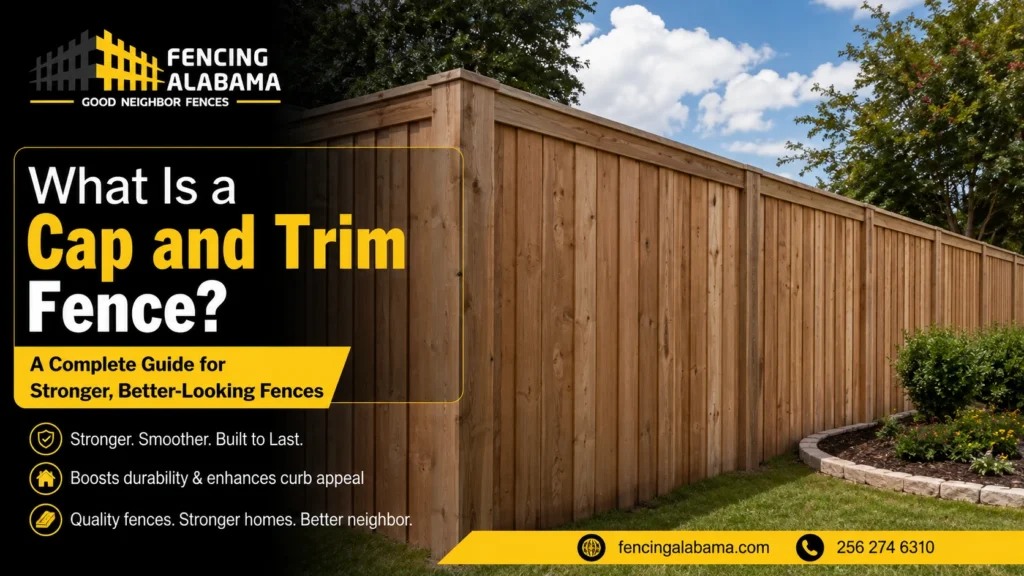
A cap-and-trim fence is a wood privacy fence with two extra boards added at the top: a trim board that runs horizontally across the picket tops, and a cap board laid flat on top of that trim. The cap hides the cut picket ends, gives the fence a dead straight top line, and sheds water off the end grain.
Quick points before you scroll:
- The cap is usually a 2×4 or 2×6 laid flat, and the trim is usually a 1×4 fastened across the picket tops just underneath it.
- Cap and trim goes on top of a standard privacy build, so it costs more per linear foot than plain dog-ear pickets in both material and labor.
- Most Huntsville-area architectural review committees are happier with a capped top than a raw picket top, because it reads as finished from the street.
- The cap board is the first part that needs sealing and the first part that shows a leaning post, which is useful information rather than a defect.
- On a steep lot, the cap has to be stepped in sections, and that changes how the finished fence looks along the bottom.
What Is a Cap and Trim Fence, Exactly?
A cap and trim fence is a solid privacy fence, usually six feet tall, built with pressure-treated pine or cedar pickets, then finished with a horizontal trim board across the picket tops and a flat cap board resting on top of the trim. The cap and trim assembly is purely a top treatment. Everything below it is a normal privacy fence.
Some builders call it a capped fence, some call it a cap and trim, and a few call it a top cap fence. This article uses cap and trim throughout so nothing gets confusing. If a contractor quotes you a “capped privacy fence,” that is the same thing.
The visual effect is the whole point. A plain privacy fence ends wherever each picket ends, and pickets are never perfectly identical, so the top line always has a little wobble in it. A cap and trim fence gives your eye one straight horizontal line running the length of the yard, and that single line is why the fence reads as more expensive from the road.
What Parts Make Up a Cap and Trim Fence?
A cap and trim fence uses the same frame as any wood privacy fence, plus two boards that a standard fence does not have. Here is the full parts list, top to bottom.
| Part | Typical size | What it does |
|---|---|---|
| Cap board | 2×4 or 2×6, laid flat | Runs along the very top, covers the trim, throws rainwater clear of the picket ends |
| Trim board | 1×4 or 1×6, on edge | Fastened across the picket tops, hides the cut ends and ties the run together |
| Pickets | 1×6, six feet tall | The privacy surface, butted tight or overlapped depending on style |
| Rails (stringers) | 2×4, two or three per section | Horizontal framing the pickets attach to |
| Posts | 4×4 or 6×6 pressure treated | Set in concrete, spaced six to eight feet apart |
| Post caps | Wood or metal, optional | Cover the post end grain where a post rises above the cap line |
Two terms worth defining before you read a quote. A stringer is the horizontal 2×4 the pickets nail into, which some contractors call a rail. End grain is the exposed cut end of a board, and it soaks up water far faster than the flat face does, which is exactly the problem the cap board solves.
Post placement changes the look more than people expect. If the posts are cut flush and the cap runs straight over them, the fence reads as one continuous line. If the posts are left tall with the cap running between them, you get a paneled look with a post cap on each one. Both are correct builds. Decide which one you want before the crew starts cutting posts, because it is not a change you make afterward.
What Do People Call This Fence When They Do Not Know the Name?
Most people who want a cap and trim fence do not search for “cap and trim fence.” They describe it, especially now that people type whole sentences into search engines and AI assistants instead of two-word keywords. These are the descriptions that land on this exact fence:
- “What is that fence called with the flat board across the top”
- “My HOA says the fence has to have a finished top, what does that mean”
- “How do I make my privacy fence look less like a plain wood wall”
- “Why does my neighbor’s fence have a perfectly straight top and mine is wavy”
- “Is a board on top of a fence worth the extra money”
If any of those is the sentence in your head, a cap and trim fence is the answer you were circling. The straight top board is the thing your eye noticed, and it has a name.
Why Homeowners Around Huntsville Choose Cap and Trim
Homeowners in this metro pick cap and trim for three reasons, and only one of them is looks. Appearance comes first, HOA approval comes second, and protecting the picket ends comes third.
Appearance is the honest leading reason. A cap and trim fence looks built rather than assembled, and on a front-facing run along a corner lot or a street-side property line, that difference is visible from a passing car. It is the fence equivalent of trim around a doorway: nothing structural, all finish.
HOA guidelines are the practical reason. A large share of Huntsville-area subdivisions run an architectural review committee with published rules on height, material, and which face of the fence points outward, and a finished top line clears those reviews with less back and forth. If your neighborhood has a committee, read the HOA fence approval process in Huntsville subdivisions before you pick a style, because approval timelines are set by the board and no contractor can shorten them.
Protection is the reason nobody thinks about until year eight. Rain sitting on an exposed picket end wicks straight down into the board, and in Alabama humidity that end grain is where rot starts. The cap board covers those ends and throws the water off the face instead.
What Does a Cap and Trim Fence Cost Compared to a Standard Privacy Fence?
A cap and trim fence costs more per linear foot than a plain privacy fence, because every eight-foot section needs two extra boards plus the labor to cut, level, and fasten them along the entire run. There is no way around that math, and any quote that says otherwise is hiding the cost somewhere else.
Four things move the number on a cap and trim quote:
- Cedar versus pressure-treated pine: Cedar costs more per board, and the cap is one of the most visible boards on the fence, so the upgrade shows up fast. The cedar or pressure treated decision changes the total more than the cap does.
- Run length and corner count: A long straight run caps efficiently. A yard with six corners and three gates means more cuts, more joints, and more labor per foot.
- Slope: A cap line on a sloped lot has to be stepped section by section, which is slower work than running a level cap across flat ground.
- Post treatment: Flush-cut posts with a continuous cap take longer to level than posts left tall with the cap running between them.
Ask for the cap and trim to appear as its own line on the written quote rather than folded into a single per-foot price. That way you can see what the upgrade actually costs and decide, instead of guessing. Material and labor for a full yard are broken down further on the fence cost page.
Cap and Trim vs Board on Board vs Shadow Box vs Plain Stockade
Cap and trim is a top treatment, not a picket layout, which means it can be added to most privacy styles rather than replacing them. This table sorts out what each style actually does.
| Style | Picket layout | Privacy | Looks from both sides | Cap can be added |
|---|---|---|---|---|
| Cap and trim | Any of the below, plus cap and trim boards on top | Same as the base style | Trim shows on the finished side | This is the cap |
| Board on board | Pickets overlapped so no gap opens as wood shrinks | Full, stays full over time | Similar both sides | Yes |
| Shadow box | Pickets alternate front and back of the rails | Partial, air passes through | Nearly identical both sides | Yes |
| Plain stockade | Pickets butted side by side, dog-ear tops | Full at install, gaps open as wood dries | Rails show on the back | Yes |
The practical takeaway: pick your picket layout first based on privacy and how much wind you want the fence to pass, then decide whether to cap it. A shadow box fence with a cap is common in this market for exactly that reason, because the shadow box handles storm wind better and the cap makes it look finished.
How Does a Cap and Trim Fence Hold Up in Alabama Weather?
A cap and trim fence handles North Alabama humidity better than an uncapped fence at the picket tops and slightly worse at the cap itself, because the cap is now the board taking the direct rain and sun. Pressure-treated pine typically gives 12 to 15 years in this climate and cedar runs 15 to 20 or more, and a cap does not change those numbers so much as move where the first repair happens.
Storm wind is the other consideration. A solid six-foot privacy panel catches wind like a sail, and the cap board adds a little more surface at the top of the run where leverage on the post is highest. Posts set in concrete below the frost line with six to eight foot spacing are what carry that load, and undersized posts are the reason fences go down in a bad night, not the cap.
North Alabama red clay is the third factor and the one that surprises people. Clay swells when it takes on water and shrinks back in a dry spell, and that cycle levers a shallow post loose a little more each season. Deeper hole, concrete on every post.
Here is the part nobody mentions at the quote stage: a cap line makes post movement obvious. A wavy picket top hides a post that has drifted half an inch, but a straight cap board shows it like a level. Homeowners with capped fences call about a leaning post a year or two earlier than homeowners with plain fences, and an early call is a cheaper repair. The full lifespan picture is covered in how long a wood fence lasts in Alabama humidity.
What Happens to the Cap Line on a Sloped Lot?
On a sloped lot, the cap board cannot run in one straight line from end to end, so it gets stepped: each eight-foot section sits level, and the cap drops at each post to follow the grade. The result looks like a staircase along the top, and triangular gaps open under the bottom of each section where the ground falls away.
That matters around Monte Sano, Hampton Cove, and Bailey Cove, where the ground rises sharply, and very few back yards are flat. The stepped look is not a mistake, it is the only way to keep a rigid cap board level, but you should see it drawn before you approve the build rather than discover it on install day.
If the gaps at the bottom concern you because of a dog, the usual fixes are a pressure-treated rot board along the bottom or grading fill at each low point. Sloped yards are quoted on the actual lot rather than a flat per-foot rate, which is why estimates for fence installation in Huntsville get measured on site instead of over the phone.
How Do You Maintain a Cap and Trim Fence?
Seal the cap board first and seal it well, because the cap is horizontal and horizontal boards hold water while vertical pickets shed it. On a cap and trim fence, the cap is the part that grays, cups, and eventually splits before anything else on the run.
A new pressure-treated fence needs time to dry before it will accept stain, and applying sealer to wet lumber wastes the product. Cedar can usually be sealed sooner. Timing is covered on the fence staining and sealing page, and it is worth getting right once rather than redoing it.
The second maintenance item is fasteners. The cap sits flat and takes the full freeze and thaw cycle, so nails can back out over the years. Walk the fence once a year, press on the cap at each post, and reset anything that has lifted. Five minutes of that beats replacing a warped cap board.
Who Should Skip a Cap and Trim Fence?
Skip the cap if the fence is a back property line nobody sees, if the budget is tight enough that the money is better spent on bigger posts or cedar pickets, or if your yard drops so steeply that the stepped cap line will bother you every time you look at it.
Post quality beats top treatment every single time. A capped fence on undersized posts set shallow in clay leans within three seasons and looks worse than a plain fence built properly. Spend on the posts first, then cap it if there is room left in the number.
Cap and Trim Fence FAQ
Is a cap and trim fence the same as a capped fence?
Yes. Cap and trim, capped fence, and top cap fence all describe a privacy fence with a horizontal board across the picket tops and a flat cap on top of it. Different contractors in the Huntsville area use different names for the same build, so ask what boards are included rather than relying on the name in the quote.
Does a cap and trim fence add privacy?
No. The cap and trim boards sit above the pickets and do not change how much you can see through the fence. Privacy comes from the picket layout underneath, so a board-on-board fence with no cap is more private than a shadow box fence with one.
Will my HOA approve a cap and trim fence?
Most Huntsville-area architectural review committees accept a capped top and several prefer it, but approval depends on your specific neighborhood’s published guidelines covering height, material, and which direction the finished side faces. Submit the drawing and material spec before ordering anything, because a fence built ahead of approval can be ordered down at your cost.
Can a cap be added to a fence that is already built?
Sometimes. Adding a cap to an existing fence requires picket tops that are cut level, posts that are still plumb, and framing sound enough to hold the fasteners. On a fence more than a few years old in clay soil, the posts usually need attention first, and at that point the cap is a small part of the job.
Does a cap and trim fence last longer than a plain privacy fence?
The pickets last longer because the cap keeps rain off their cut ends, which is where rot starts in Alabama humidity. The fence as a whole still lives or dies on post depth and concrete, so a cap extends the panels rather than the fence.
Do I need a permit to build a cap and trim fence?
Whether a permit applies depends on your parcel, its height, and whether it sits inside a city limit or in unincorporated county, and the cap does not change that answer. Confirm with the authority for your address before you build, and see the notes on fence permit rules in Madison County for how the two sets of rules differ.
Get a Cap and Trim Fence Quoted on Your Yard
Fencing Alabama builds cap and trim, board on board, shadow box, and stockade privacy fences across Huntsville, Madison, Harvest, Hazel Green, Toney, and the rest of North Alabama, and we handle the HOA drawing and material spec so the project does not stall at the review stage. See the full wood fence installation service for materials, post specs, and recent work.
Call (256) 900-8518 or schedule a free on-site estimate. We call back the same day during business hours, measure your lot, and leave you a written itemized quote with the cap and trim priced as its own line.
Fencing Alabama, 4741 Bakers Chapel Rd, Guntersville, AL 35976. Monday to Saturday, 9:00 AM to 5:00 PM. Based in Guntersville, serving Huntsville and North Alabama.