
Wireless vs Physical Pet Fence in Huntsville: Which One Actually Holds Your Dog?
Short answer
A physical fence is the better choice for most dogs in Huntsville, because it holds a dog that decides to run and keeps coyotes and loose dogs out. A wireless pet fence costs far less and works well for a calm, trained dog on an open lot. It fails with high-prey-drive dogs, storm-shy dogs, and small rectangular yards.
Key points
- A wireless pet fence kit runs about $100 to $325 and a GPS collar system about $450 to $1,300, according to HomeGuide’s 2026 cost data, against roughly $2,250 to $4,500 for 150 feet of installed chain link in the Huntsville area.
- The PetSafe Wireless Pet Containment System draws a circle up to 180 feet across, and a circle only covers about 52 percent of a typical 100-by-150-foot rectangular yard without spilling past the property line.
- An electronic boundary keeps your dog in but does nothing to keep a coyote out, and Outdoor Alabama lists coyotes as found statewide, including urban areas.
- A dog that bolts through an electronic boundary after a deer can get zapped again on the way home, so the dog sometimes stays out.
- A hybrid layout, a small physical fence near the house plus an electronic boundary on the open acreage, is the layout I suggest first on large lots around Toney and New Market.
I build physical fences for a living, so weigh my bias accordingly. I will still tell you where a wireless pet fence is the smarter buy, because on the right dog and the right lot it is.
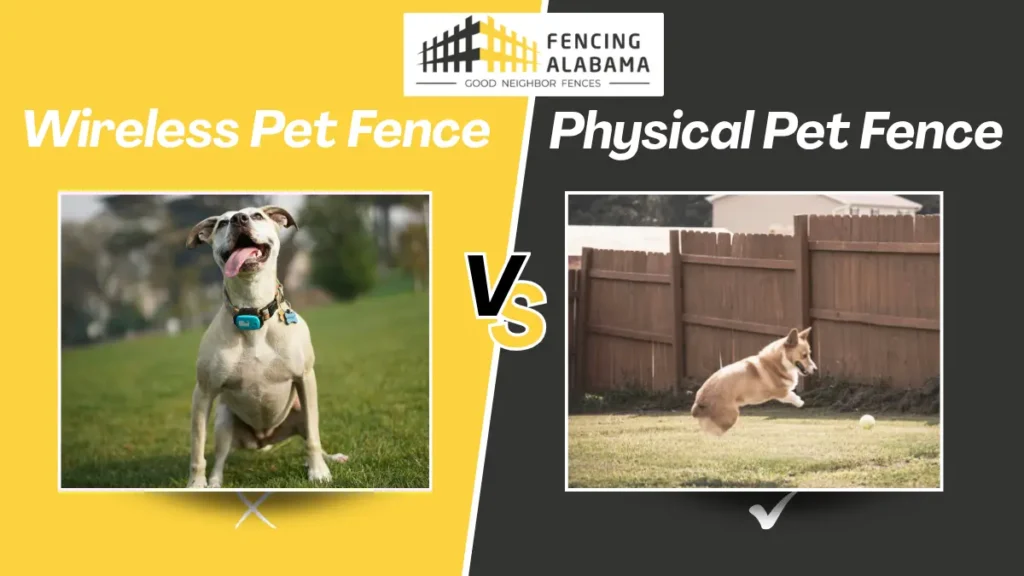
What Is a Wireless Pet Fence, Exactly?
A wireless pet fence is any containment system where a receiver collar, not a barrier, keeps the dog in the yard. The collar beeps as the dog nears the boundary and then delivers a static correction if the dog keeps going. People use the same phrase for three different products, and the difference between them matters more than most online reviews admit.
| Type | How the boundary is made | Typical coverage | What powers it |
| Radio wireless fence | A transmitter inside the house broadcasts a circle | Up to 180 feet across on the PetSafe model | Wall outlet plus a collar battery |
| GPS fence | The collar reads satellites and compares its position to a map you draw in an app | Any shape; SpotOn lists a 1/3 acre minimum, Halo a 900 square foot minimum | Rechargeable collar |
| Buried-wire fence | A wire in a shallow trench carries the signal around the perimeter | Any shape the wire follows | Wall transmitter plus a collar battery |
The buried-wire fence is the one most people call an “invisible fence.” Invisible Fence is actually a brand name, owned by the same parent company as PetSafe, Radio Systems Corporation. Strictly speaking, a buried-wire fence is not wireless, because the wire is the boundary. I include it here because almost everyone searching for a wireless pet fence in Huntsville is weighing all three.
A physical fence is the opposite approach: posts set in concrete, with wood, chain link, vinyl, or aluminum between them. The dog cannot cross it without climbing, digging, or finding a gap, and no collar, battery, or training is involved.
Wireless vs Physical Pet Fence: The Side-by-Side
A physical fence wins on containment and protection, and a wireless pet fence wins on price, speed, and how the yard looks. The table below is the short version of everything that follows.
| Factor | Radio wireless fence | GPS fence | Buried-wire fence | Physical fence |
| Upfront cost | About $100 to $325 per kit | About $450 to $1,300 | About $800 to $2,800 installed | About $15 to $60 per linear foot installed, by material |
| Boundary shape | Circle only | Any shape | Any shape | Any shape |
| Keeps other animals out | No | No | No | Yes |
| Stops a determined dog | No | No | No | Yes, if height and base are right |
| Works in a power outage | No, transmitter plugs into the wall | Yes, until the collar battery dies | No | Yes |
| Needs training | Yes | Yes | Yes | Rarely |
| HOA approval | Usually not needed | Usually not needed | Usually not needed | Usually needed |
| Ongoing cost | Collar batteries | Charging and a subscription on some brands | Collar batteries, wire repairs | Staining on wood every 2 to 3 years; almost nothing on chain link |
The electronic costs above come from HomeGuide’s 2026 invisible fence cost data. The physical fence ranges are Fencing Alabama’s typical installed prices for the Huntsville area, which you can run for your own footage on our fence cost calculator.
How Much Does Each Option Cost in Huntsville?
A wireless pet fence is cheaper on day one by a wide margin. On a 150-foot backyard run, installed chain link in the Huntsville area lands around $2,250 to $4,500, and wood around $3,300 to $6,750, while a radio wireless fence kit runs about $100 to $325 and a professionally installed buried-wire fence about $800 to $2,800, according to HomeGuide.
The electronic price climbs with every dog. Each dog needs its own receiver collar, and a household with two dogs is buying two collars and replacing batteries or charging two collars for as long as it uses the system.
GPS fence pricing depends on the brand’s business model. Reviewers at Petful and elsewhere report that Halo requires a paid plan for the fence to keep working, while SpotOn runs its fence with no subscription and charges only for extras like live tracking. Read the plan terms before you buy, because a lapsed subscription on some systems means no boundary.
A physical fence has the opposite cost curve. The money goes out at install, and after that chain link needs almost nothing, while a wood fence in Alabama humidity needs staining every two to three years. If a chain link fence is where your budget lands, our breakdown of chain link vs wood fence cost walks through both over twenty years, and cheaper alternatives to chain link covers welded wire and field fence for big lots.
Why the Circle Problem Catches Huntsville Homeowners Off Guard?
A radio wireless fence can only make a circle, and most Huntsville yards are rectangles. PetSafe states plainly on its product page that its wireless fence is circular and cannot be changed into a square or rectangle.
The math is where people get surprised. Take a 100-by-150-foot lot with the transmitter in the middle. A circle big enough to reach the back corners needs a radius of about 90 feet, which pushes the boundary roughly 40 feet past each side property line and into your neighbors’ yards or the street. Shrink the circle so it stays inside the lot, and it covers about 7,850 square feet of a 15,000 square foot yard, roughly 52 percent.
So a radio wireless fence on a typical subdivision lot in Madison or Harvest gives you one of two outcomes: your dog loses half the yard, or your dog gets access to half of the neighbor’s. Neither is what the box art showed you.
A GPS fence or a buried-wire fence solves the shape problem, because both follow whatever outline you draw or bury. A GPS fence brings its own catch on small lots, covered in the next section.
Do Wireless Dog Fences Work on Hills, Under Trees, and Near Metal?
Wireless pet fences lose accuracy in exactly the conditions a lot of Huntsville property has: slopes, tree canopy, and metal. How much accuracy you lose depends on the type.
PetSafe’s own listing warns that terrain, landscaping, metal objects, and environmental factors can affect the radio wireless fence, and tells owners to keep the transmitter at least 3 feet from metal objects. A house with metal siding, a metal carport, or a steel shed near the transmitter is a real consideration, and so is a lot that drops off sharply toward Monte Sano or Bailey Cove.
GPS fences drift. SpotOn’s own guidance plans for GPS drift of about 3 to 10 feet near tall structures or heavy forest, and asks that the fence be at least 80 feet wide at its narrowest point so the dog is not hearing warning tones all day. Independent testers have logged larger drift on some collars under dense trees. On a wooded half-acre in Big Cove, 10 feet of drift near the road is the whole safety margin.
Buried wire is the most precise of the three, because the wire sits exactly where you put it. The weak point is the wire itself. An edger, an aerator, a new flower bed, or a contractor digging a drainage line can cut it, and until someone finds the break, the boundary is gone. Alabama 811 wants a locate request before any digging, and that includes a boundary-wire trench.
A physical fence has no signal to lose. Slopes do change how a fence is built, and on a hill we rack or step the panels, which I explain in fencing a sloped yard.
Which Dogs Run Straight Through a Wireless Fence?
A wireless pet fence works by making the dog decide not to cross, so it fails on the dogs most likely to decide the other way. Here is the scene I describe to homeowners, and most dog owners recognize it instantly.
It is a Tuesday evening in Hampton Cove. Your beagle is doing a slow lap of the yard. A squirrel drops out of the oak by the road, lands on the lawn, and runs for the street. Your beagle’s brain has room for exactly one thought, and it is not “I should respect the tone.” One static pulse later, your beagle is across the boundary and three houses down.
VCA Animal Hospitals, in a veterinarian-written article on invisible fences, lists this exact failure: a dog that sees something it wants to chase, or gets frightened by thunder, may breach the fence and ignore the stimulus. The dogs I would not put on an electronic boundary are:
- A high-prey-drive dog, such as a beagle, a terrier, a husky, or any hound that follows its nose first and its owner second.
- A dog that panics in thunderstorms, which matters in North Alabama, where spring and summer storm fronts roll through regularly.
- A reactive dog that charges the edge of the yard at passing dogs, joggers, or mail carriers.
- A dog that has already learned the collar can be outrun, because a dog that crosses once tends to cross again.
A calm, food-motivated dog that likes staying near its people is the dog a wireless pet fence suits. Many Labradors and older dogs fit that profile, though temperament matters more than breed.
What Happens When Your Dog Wants to Come Back Home?
A dog that breaks through an electronic boundary faces the same boundary on the way back, and on some systems the collar corrects the dog for returning. VCA notes that some fences shock a dog on re-entry while others only correct on the way out.
That is the part nobody puts on the box. The dog crossed the line at full speed chasing a deer, calmed down two streets over, trotted home, and got corrected for doing the right thing. Some dogs then sit outside the boundary and wait. Some wander off.
If you buy an electronic system, check whether its collar corrects on re-entry. PetSafe advertises static-free re-entry on its wireless containment system, but not every system works the same way, and the answer should decide your purchase.
A physical fence has a gate. The dog cannot leave in the first place, and if a gate is left open, walking back in costs the dog nothing.
Does a Wireless Fence Keep Coyotes and Loose Dogs Out?
No electronic system keeps anything out of your yard. The collar only affects the dog wearing it. A stray dog, a coyote, or a neighbor’s kid can walk straight in.
That gap matters around Huntsville. Outdoor Alabama, the state’s Department of Conservation and Natural Resources site, lists the coyote as found statewide, including urban areas. A small dog on a wireless pet fence at dusk is contained in the worst possible way: it cannot leave, and it cannot be protected.
VCA’s article flags the same risk, noting that stray dogs and wild animals can still enter the yard and interact aggressively with a pet dog. On lots that back onto fields or woods around Toney, New Market, and Big Cove, I treat this as the deciding factor for anyone with a dog under 25 pounds.
A physical fence works in both directions. That is the one thing a wireless pet fence cannot match at any price.
Are Wireless Fences Cruel to Dogs?
A wireless pet fence depends on static correction, and veterinary behavior specialists have taken a clear position against training with it. The American Veterinary Society of Animal Behavior, in its 2021 Position Statement on Humane Dog Training, recommends that only reward-based methods be used for all dog training and names electronic shock collars among the tools to avoid.
Manufacturers see it differently. PetSafe describes its correction as static, offers a tone-only mode, and lets owners pick among five correction levels. VCA’s article says most dogs learn to respect the warning beep quickly, and that the stimulus startles rather than hurts when the equipment is set correctly.
My read as a fence builder is narrower than either side. A physical fence contains a dog without the dog having to feel anything, and if the correction question bothers you, that answer is already made. If it does not, the practical questions in the sections above matter more than the ethics debate.
Does Huntsville Allow Wireless Dog Fences?
Alabama has no statewide ban on wireless pet fences. The state’s running-at-large law, Code of Alabama Section 3-1-5, requires dogs to be kept on the owner’s premises where it applies, and it does not specify how. Cities and counties fill in the rest.
The City of Huntsville’s animal ordinance, Chapter 5 of the city code, requires a dog to be kept under effective restraint in the city, whether the dog is on or off the owner’s property. The code does not settle, in plain language, whether an electronic boundary counts as effective restraint for every situation, so call Huntsville Animal Services before you rely on one as your only containment.
Your parcel’s jurisdiction matters too. A home inside Huntsville or Madison city limits follows that city’s code, and a home in unincorporated Madison County, which covers parts of Toney and Harvest, follows county rules. Confirm with the authority for your address, because rules change.
Can My HOA Stop Me From Putting Up a Fence for My Dog?
An HOA can restrict a physical fence, and that restriction is the most common reason Huntsville homeowners look at a wireless pet fence in the first place. Many subdivisions in the Huntsville metro require written approval from an architectural review committee before a post goes in, and some limit height, material, or where the fence can sit.
A question I hear a lot goes something like this: “My HOA in Madison only allows a 4-foot aluminum fence behind the house, and my Lab can clear that. Is a wireless fence my only option?” Usually it is not. A 4-foot aluminum fence with a well-trained, non-jumping dog is often enough; a taller fence can sometimes be approved in the backyard, and a hybrid layout covers the rest.
Electronic boundaries generally do not need HOA approval because nothing is visible after the training flags come out, but read your covenants anyway. Our guide to HOA fence approval in Huntsville subdivisions covers how the review works, and how tall a privacy fence can be in Huntsville covers the height rules.
What Does a Physical Dog Fence Need to Actually Work?
A physical dog fence works when its height, bottom edge, gap spacing, and gate latches match the dog. A fence that holds a Labrador will not necessarily hold a Jack Russell, and a fence that holds a Jack Russell may not hold a husky.
- Height comes first. A 4-foot fence holds most small and medium dogs, and jumpers and large athletic breeds usually need 5 to 6 feet.
- The bottom edge stops diggers. Buried mesh, an L-shaped wire footer along the base, or a concrete curb gives a digger nothing to work with.
- Gap spacing stops squeezers. The gap between pickets has to be smaller than the dog’s head, which is why small breeds get closely spaced “puppy pickets” at the bottom of an aluminum fence.
- Gate latches stop the clever ones. A latch a dog can nose open undoes the whole fence.
- The view matters for reactive dogs. A solid wood privacy fence blocks the sightline to passing dogs and joggers, which helps a barker settle, while chain link is cheaper and lets you see the dog.
The posts carry all of this. North Alabama red clay swells when it is wet and shrinks back in a dry spell, and that cycle works a shallow post loose a little more each season. We set every post in concrete, so the fence you pay for stays straight long after the dog stops testing it. Our dog fence installation page covers sizing by breed in more detail.
The Hybrid Setup: A Physical Fence Plus a Wireless Boundary
A hybrid layout pairs a physical fence near the house with an electronic boundary across open acreage, and on large lots it often beats either option alone. The physical fence becomes the safe zone where the dog spends unsupervised time, and the electronic boundary covers supervised time on the rest of the property.
This setup fits the rural edges of our service area, where a 2-acre lot backing onto a working field in Toney or New Market would cost a lot to enclose completely. A 60-by-80-foot fenced area off the back door is a fraction of that footage, and it gives the dog a place that holds no matter what walks past.
A hybrid also covers the escape style a single system misses. Some owners run an electronic wire along the inside base of a physical fence to stop a digger or a climber, so the dog meets a physical barrier and a warning at the same line. Check whether a given system is compatible before you plan around it.
How to Decide in Five Questions
Your dog and your lot decide this. Answer these in order, and stop at the first one that settles it.
- Does your dog chase squirrels, deer, or cats with no regard for you? If yes, choose a physical fence.
- Is your dog under about 25 pounds, or does your yard back onto woods or fields? If yes, choose a physical fence, because the dog needs protection from what comes in.
- Does your HOA prohibit the fence your dog needs? If yes, look at an approvable physical fence first, then a hybrid, then a GPS or buried-wire fence.
- Is your lot a rectangle under an acre? If yes, skip the radio wireless fence and compare a buried-wire fence, a GPS fence, and a physical fence.
- Is your dog calm, trained, and happy to stay near home, on a large or odd-shaped lot? A wireless pet fence can be a reasonable, affordable choice.
If you answered yes to question 1 or 2, the cheaper option ends up costing more in vet bills, in a lost dog, or in the physical fence you buy a year later anyway.
Wireless Pet Fence Questions We Hear in Huntsville
Is an invisible fence better than a real fence for a dog in Huntsville?
A real fence is better for most dogs in Huntsville because it stops a dog that decides to run and keeps coyotes and stray dogs out. An invisible fence works for a calm, trained dog on a larger lot where a physical fence is too expensive or not allowed by the HOA. For high-prey-drive or small dogs, choose the physical fence.
Will a wireless dog fence work on my half-acre lot in Madison?
A radio wireless fence covers up to about half an acre, but only as a circle, so on a rectangular half-acre lot in Madison it will either leave corners uncovered or spill into neighboring yards. A GPS fence or a buried-wire fence follows the actual lot shape. A 4- to 6-foot physical fence holds the whole rectangle with no signal to manage.
My dog keeps running through the invisible fence. What should I do?
A dog that runs through an invisible fence has usually learned the chase is worth the correction, and turning the correction up rarely fixes that. Walk the boundary flags again with a trainer, check the collar battery and fit, and look at what the dog is chasing. If the dog keeps escaping, a physical fence around at least part of the yard is the reliable fix.
How much does it cost to fence a backyard for a dog in Huntsville?
A 150-foot backyard dog fence in the Huntsville area runs about $2,250 to $4,500 in chain link and about $3,300 to $6,750 in wood, installed. Height, gates, slope, and dig guards move that number. Fencing Alabama gives a free on-site written estimate, and the fence cost calculator gives a planning range before anyone visits.
Can a wireless fence be used in the front yard?
A wireless fence can cover a front yard, but a front-yard boundary near a road is where GPS drift and a dog’s momentum matter most. SpotOn plans for 3 to 10 feet of drift near structures and trees, so set any electronic boundary well back from the street. In Huntsville, check your HOA and city rules before installing a physical front-yard fence, since front yards usually carry lower height limits.
Do wireless dog fences work in power outages?
A radio wireless fence and a buried-wire fence both stop working when the power goes out, because the transmitter plugs into a wall outlet. That matters during North Alabama storm season, when the same storm that knocks out power can scare a dog into running. A GPS collar keeps working on its battery, and a physical fence does not need power at all.
Get a Straight Answer for Your Dog and Your Yard
Fencing Alabama is based in Guntersville and builds dog fences across Huntsville and North Alabama, sized to the dog in your yard rather than a generic height. We will look at your lot, ask how your dog escapes, and tell you honestly if an electronic boundary or a hybrid would serve you better than a full fence. You get a written, itemized estimate before anything is ordered.
Call (256) 900-8518 or schedule a free on-site estimate. We serve Huntsville, Madison, Toney, and the rest of North Alabama.