
Cheaper Alternatives to a Chain Link Fence
Short answer
Welded wire on wood posts, field fence on driven T-posts, and cattle panels are the three fences I can put up for less per linear foot than chain link in North Alabama. Vinyl, wood and bamboo panels are not cheaper, whatever the internet lists say. Installed chain link here runs about $15 to $30 per linear foot.
What this article covers
- Installed chain link costs about $15 to $30 per linear foot in the Huntsville area, and any honest alternative has to beat that number, not the price of a roll of mesh at the store.
- Welded wire fencing stretched on wood posts is the option I quote most often when somebody wants a yard enclosed for less than chain link money.
- Field fence in 330-foot rolls on driven T-posts is the cheapest fence per foot I install, and it is the right answer for acreage in Toney, New Market, and Hazel Green.
- Vinyl runs $25 to $45 per linear foot installed on our cost page, which puts it above chain link rather than below it, so the articles calling vinyl a budget alternative are comparing a panel price to an installed price.
- Cutting cost on post depth or concrete is the one saving that always comes back, because North Alabama red clay levers a shallow post loose within a couple of wet seasons.
What Does Chain Link Actually Cost in North Alabama?
Chain link runs about $15 to $30 per linear foot installed in the Huntsville area, which is the lowest of the four materials we quote. Wood sits at $22 to $45, vinyl at $25 to $45, and aluminum ornamental at $30 to $60. Those are the ranges on our fence cost page, and they include labor, concrete, hardware, and haul-off.
That number is the bar. A homeowner calls and says a neighbor told them there is something cheaper than chain link, and half the time what they read about is cheaper as a material and more expensive as a finished fence. The mesh is not the cost. The holes, the concrete, the corner posts, and the two people setting them are the cost.
Residential chain link here is usually 4 or 5 feet tall in 9-gauge mesh, and a typical backyard run goes up in one to two days. When I talk about a cheaper alternative in this article, I mean cheaper than that exact fence, installed on your lot, with the 811 utility locate called and the mark period waited out.
Why Are Most “Cheaper Than Chain Link” Lists Wrong?
Most articles ranking for this question list vinyl, wood picket, and bamboo as cheaper than chain link, and all three are wrong on installed price in this market. I checked the top results before writing this. One national lifestyle site calls vinyl “more affordable” than chain-link. Our own quoted vinyl range starts $10 per foot above where chain link starts.
The trick behind that mistake is a panel price compared against an installed price. A four-foot vinyl panel at a home center has a shelf price. Chain link gets quoted as a finished fence with posts in concrete. Put both on the same lot with the same crew, and the order flips every time.
Bamboo gets the same treatment. Rolled bamboo screening is cheap to buy because it is a screen, not a fence. It has no structural posts, it grays and splits through an Alabama summer, and it is usually zip-tied to something else that is already holding the line. Bamboo is an add-on to a fence, so it belongs in a different conversation than the one about replacing a fence.
So the honest list of things that beat chain link on price is short. It is wire in various forms, wood-framed wire, and living boundaries. Everything else on those listicles costs more.
Welded Wire Fence on Wood Posts
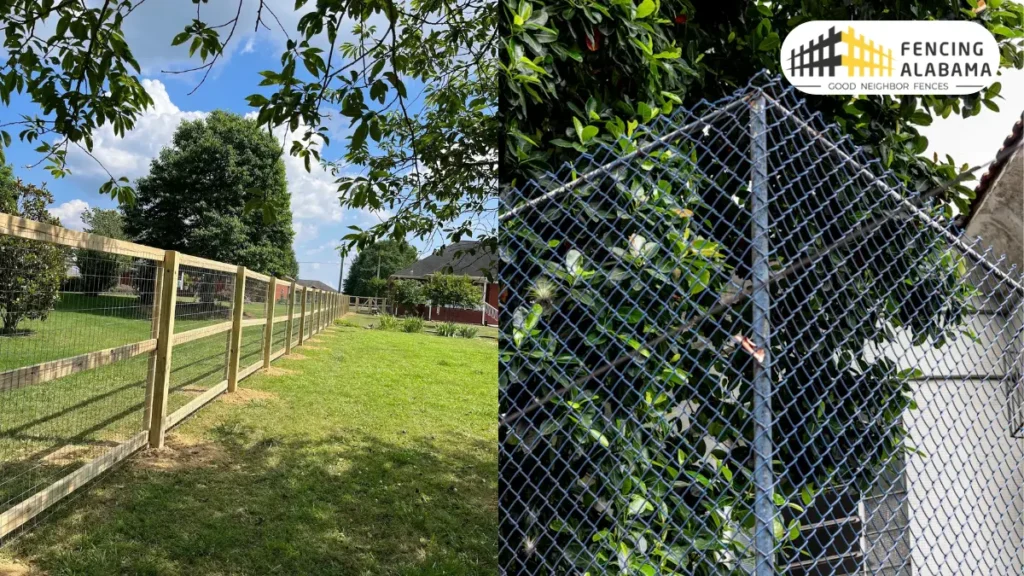
Welded wire fencing on 4×4 wood posts is the cheapest residential-looking fence I install, and it usually lands below the bottom of the chain link range on a straight run. The mesh is commonly 2 inches by 4 inches in 14 gauge, sold in 100-foot rolls, and it staples to the posts with a top and bottom rail of treated lumber to keep the line straight.
The savings come from the framework. Chain link needs terminal posts, tension bands, tension bars, a top rail, and stretcher work at every corner. Welded wire on wood needs posts, two rails, and staples. Less hardware and less labor per foot is the whole story.
What welded wire gives up is stiffness. A 14-gauge mesh will belly out if a large dog throws weight at the middle of a span, so I set posts at tighter spacing on dog runs than on a boundary line. It also looks utilitarian, which matters in a subdivision with an architectural review board and does not matter at all on five acres.
Welded wire suits a back boundary, a garden enclosure, a chicken run, or a yard where the fence has a job and no audience. Paired with a cedar privacy run across the visible side, it is how a lot of my customers get a fenced yard without paying wood fence prices for 400 feet of it.
Field Fence and High-Tensile Wire for Acreage
Field fence on driven T-posts is the lowest cost per foot of anything I build, which is why every working property around Toney and New Market has it. Rolls come in 330 feet, the posts drive rather than get set in concrete except at corners and gates, and one crew covers a lot of ground in a day.
Field fence is graduated mesh, meaning the openings are small near the ground and wider toward the top. That design keeps a goat or a calf in without spending money on tight spacing where nothing is going to push through. High-tensile smooth wire costs even less per foot and is a livestock fence rather than a yard fence, since it does nothing to stop a dog that wants to go under.
The corners are where the money goes on a field fence, and that is not the place to save it. A braced corner assembly, two posts set deep with a horizontal brace and a diagonal wire, is what holds tension across a 330-foot pull. Skip the brace and the corner walks out of plumb the first time the clay dries out, and the wire pulls.
For a rural parcel backing onto a working field, the answer I give most often is a wire line on the field side and a panel fence nearer the house. One fence rarely does both jobs well. Our farm and agricultural fencing page covers the acreage side of that in more detail, and the Toney service area page covers what changes when a parcel sits in unincorporated Madison County rather than inside a city limit.
Cattle Panels and Hog Wire in a Wood Frame
Cattle panels are 16 feet long and 50 inches tall in welded rod, and framing them between wood posts produces a fence that costs less than chain link and reads as intentional rather than agricultural. This is the look people mean when they search for hog wire fencing, and it has become common on newer builds around Hampton Cove and Big Cove.
The panel does the structural work, so the wood frame can be light. Two posts, a top cap, and the panel dropped between them cover 16 feet in one move with no stretching, no tensioning, and no mesh to hold square while you fasten it. Speed on site is exactly where the price drop comes from.
Cattle panel fencing is 50 inches tall as-is, which is roughly 4 feet 2 inches, and that is the honest limitation. It holds most dogs, it marks a boundary, and it does not give privacy or stop a determined climber. Stacking panels or raising them on a frame adds height and adds cost, and past a certain point you have rebuilt a more expensive fence than the chain link you were avoiding.
Chain Link With Privacy Slats Instead of a Privacy Fence
Privacy slats woven into chain link cost far less than building a wood privacy fence and are the cheapest way I know to turn an open boundary into a screen. Slats slide into the existing mesh, so the fence does not come down and no posts get reset, as long as the mesh and the posts are still sound.
This is not an alternative to chain link. It is chain link doing a second job, and I include it because the search that brings most people to this page is really “I want privacy, and I do not want to pay wood prices.” Slats answer that for a fraction of the $22 to $45 per foot a wood fence costs installed.
Slats do add wind load. A slatted six-foot run catches storm wind the way a solid panel does, and after a bad spring night the repair queue around Huntsville fills up fast with fences that were fine as open mesh. If slats go in, the posts underneath need to be sized for the fence the slats create, not the fence that was there before.
A Hedge or Screen Line Instead of a Fence
A planted screen line costs less than any fence per foot in year one and is the only option on this list that gets better with time instead of worse. Leyland cypress, arborvitae, and wax myrtle all grow fast in North Alabama, and a staggered double row reaches useful height in three to five years.
The catch is that a hedge holds nothing. It does not keep a dog in the yard, it does not satisfy a pool barrier requirement, and it does not mark a legal boundary in a way a survey pin does. If the reason for the fence is a dog or a pool, a hedge is landscaping with a fence still to buy.
Where a hedge does work is as the privacy half of a two-part solution. Run welded wire or chain link on the property line for containment, plant the screen inside it, and in a few seasons the wire disappears behind green. That combination costs less than a 6-foot wood privacy fence and outlasts it.
Cost and Performance Compared
| Option | Cost vs installed chain link | Privacy | Holds a dog | Best use |
| Welded wire on wood posts | Lower on most straight runs | None | Yes, with tighter post spacing | Back boundaries, gardens, dog yards |
| Field fence on T-posts | Lowest per foot | None | Small dogs can push under | Acreage, livestock, rural boundary lines |
| Cattle panel in wood frame | Lower to about equal | None | Yes, up to 50 inches of height | Modern yard boundary, front runs |
| Chain link plus privacy slats | Above bare chain link, well below wood | Partial screen | Yes | Existing chain link needing a screen |
| Planted hedge line | Lowest year one, slow to perform | Full after 3 to 5 years | No | Screening behind a containment fence |
| Vinyl, wood, aluminum | Higher, $22 to $60 per foot | Wood and vinyl yes | Yes | Not budget alternatives |
Which One Is Cheapest for Your Situation?
The cheapest fence is decided by what the fence has to do, so here is how I sort it on an estimate visit.
- If the job is containing a dog on a normal suburban lot, welded wire on wood posts is the cheapest fence that actually works, and our dog and pet fencing page covers height by breed and dig prevention.
- If the job is enclosing an acre or more, field fence on driven T-posts wins on price by a wide margin and nothing else comes close.
- If the job is a boundary that has to look deliberate from the street, cattle panels in a wood frame land below chain link and above it on appearance.
- If the job is privacy and a chain link fence already exists, slats cost a fraction of replacing it.
- If the neighborhood has an architectural review board, check the guidelines before pricing anything, because a board that only approves wood or vinyl removes every option on this list.
That last one decides more budgets around Huntsville than people expect. A large share of this metro sits under an HOA with its own rules on height, material and which way the finished face points. Boards take anywhere from a few days to several weeks to answer, and no contractor can speed that up, which is why we prepare the drawing and material spec and submit early rather than waiting for the build slot. Our privacy fencing page goes deeper on what boards in this area typically ask for.
Where Cutting Fence Cost Backfires?
Post depth and concrete are the two places where saving money always costs more later, and North Alabama red clay is the reason. Clay swells when it takes on water and shrinks back in a dry spell, and that cycle levers a shallow-set post a little further out of plumb each season until the line visibly bows.
Almost every leaning fence I get called to repair has a post problem underneath it, not a panel problem. The panels are usually fine. Somebody set the posts too shallow, skipped concrete, or drove them into clay and hoped. Replacing those posts later costs more than setting them right the first time, because now the panels have to come off and go back on.
Driven T-posts are the one honest exception, and only on a field fence where the load is spread across a long wire pull and braced corners carry the tension. On a panel fence, every post carries its own wind load, and that post belongs in concrete below the frost line. The same holds for gates: a gate post takes more abuse than any other post on the property, which is why gate installation gets deeper holes and more concrete on every job we do.
How to Spend Less Without Changing Material?
Footage is the biggest lever on any fence quote, so fencing part of the yard rather than all of it saves more money than switching materials ever will. A 100-foot run enclosing the back half of a lot costs less than 300 feet around the whole thing, and for a dog it does the same job.
Height is the second lever. Going from a 4-foot yard fence to a 6-foot privacy fence is more than a 50 percent material increase, because taller panels need heavier posts and deeper holes to carry the added wind load. If the fence exists to hold a dog rather than block a view, the 4-foot version is not a compromise.
Gate count is the third. Every gate adds hardware and labor beyond the per-foot rate, and drive gates cost more than walk gates. Two walk gates on a small yard is usually one more than anyone uses.
Phasing works too. We can build the back and side runs now and the street-facing run later, which spreads the cost across two seasons without leaving a half-finished fence. Financing is available if spreading payments suits you better than spreading the build.
Get a Written Price on the Cheapest Fence That Fits Your Yard
The only way to know which of these actually costs less on your property is to measure it. We come out, walk the line, talk through what the fence has to do, and leave you an itemized written quote with no charge and no pressure. If chain link turns out to be the right call, we will tell you that too, and our chain link fence installation page covers what that includes.
Call (256) 900-8518 or schedule a free on-site estimate. We are based in Guntersville and build fences across Huntsville and North Alabama, Monday through Saturday, 9:00 AM to 5:00 PM.
Fencing Alabama, 4741 Bakers Chapel Rd, Guntersville, AL 35976, (256) 900-8518
Common Questions
I want to fence my backyard in Huntsville for under $3,000; what are my actual options?
At chain link’s $15 to $30 per linear foot installed, a $3,000 budget buys roughly 100 to 200 feet of finished fence. Welded wire on wood posts stretches that further. The practical move is fencing the portion of the yard you use rather than the full property line, and we price both versions during the free on-site estimate so you can see the difference.
Is vinyl fencing really cheaper than chain link, like some websites claim?
No. Installed vinyl runs $25 to $45 per linear foot in the Huntsville area, and chain link runs $15 to $30, so vinyl costs more up front. The articles saying otherwise are comparing a vinyl panel’s shelf price against a chain link fence’s installed price. Vinyl earns its money back through low maintenance over twenty years, not on install day
What is the cheapest fence that will keep my dog in the yard?
Welded wire fencing on wood posts is the cheapest fence that reliably holds a dog on a suburban lot in North Alabama. Field fence costs less per foot, but the wider openings near the top and the gap at ground level let small breeds push through or dig under. Height matters by breed, and burying an apron of mesh at the base stops diggers.
Can I just add privacy slats to the chain link fence that came with my house?
Usually yes. Slats weave into existing mesh without removing the fence, as long as the mesh and posts are still in good condition. The one thing to check first is post strength, since a slatted fence catches storm wind like a solid panel and a post sized for open mesh may not hold through a spring front.
What is the cheapest way to fence five acres in Madison County?
Field fence on driven T-posts with braced corner assemblies is the lowest cost per foot for acreage, and rolls come in 330-foot lengths that cover ground quickly. Corners, gates, and any stretch you want stock-proof are where the budget belongs. Whether city or county rules apply depends on whether your parcel sits inside a city limit, so confirm with the authority for your address before you build.
Will my HOA let me install welded wire or cattle panel fencing?
That depends entirely on your community’s published guidelines, and many Huntsville-area boards approve only specific materials, heights, and finished-side orientations. Get the guidelines before you price the fence rather than after. We prepare the site drawing and material spec most boards ask for, and we build to whatever the board approves.