
Which Way Should the Finished Side of a Fence Face?
Short answer
The finished side of a fence faces out, toward your neighbor and the street, and the posts and rails stay on your side. That is the standard practice, a lot of city zoning codes and HOA covenants require it, and it puts the framing where you can reach it for repairs.
A few exceptions matter, and a pool fence or a climbing dog can change the answer.
- The finished side is the flat face of the fence with no posts or rails showing, and on most residential fences it faces the neighbor or the street.
- Alabama has no statewide statute I know of on fence orientation, so the rule for your yard comes from your city zoning code, Madison County if you sit outside city limits, or your HOA covenants.
- Keeping posts and rails on your side lets you stain, tighten, and replace boards without stepping into someone else’s yard.
- A pool barrier keeps its horizontal rails on the pool side when they sit closer than 45 inches apart, so a child cannot use them as a ladder.
- Shadow box and board-on-board fences look finished from both yards, which settles the question before anyone argues about it.
What Is the Finished Side of a Fence?
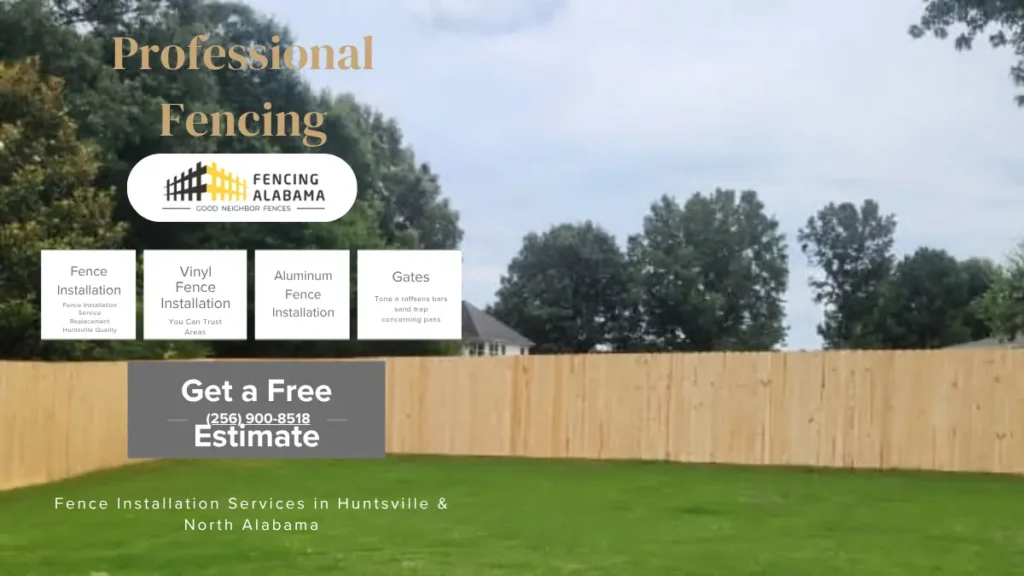
The finished side of a fence is the face covered by pickets with no framing in view. On a standard wood privacy fence, the pickets fasten to horizontal 2×4 boards called rails, and the rails run between 4×4 posts set in concrete. From the finished side, you see a flat wall of boards. From the other side, you see every post, two or three rails, and the back of every picket.
People call the finished side the good side, the pretty side, or the face. The framing side gets called the back side or the ugly side, which is a little unfair to a set of 2x4s that are holding the whole fence up. I use “finished side” and “framing side” through the rest of this article so nothing gets confusing.
A fence with a finished side and a framing side is called a single-sided fence. Stockade, dog ear, and flat top privacy fences are all single-sided. A fence built to look the same from both yards, like a shadow box fence or a board-on-board fence, is called a double-sided or good neighbor fence.
Which Way Should the Finished Side of a Fence Face?
The finished side of a fence should face out, away from the property that owns the fence, on almost every residential job I quote around Huntsville. The owner looks at the posts and rails. The neighbor and anyone driving by look at clean pickets. I get this question on estimates about once a week, usually from someone whose spouse has a strong opinion the other way.
Facing the finished side out comes with five practical advantages beyond good manners:
- A finished face toward the street and the neighbors meets the orientation rule in the zoning codes and HOA covenants that have one.
- Posts and rails on your side let you stain, reseal, re-nail, and swap a picket from your own yard, with no permission needed from next door.
- A push from the neighbor’s side presses each picket into its rail, which is the strongest direction a picket can take a load, while a push from your side has to pull the picket off its nails.
- Posts on your side keep the bulk of the fence on your property when the line is set just inside your survey pins.
- A consistent street face looks better on resale photos, and a buyer’s agent will notice a fence that shows its framing to the curb.
The third point deserves a straight answer instead of a sales pitch. Finished side out is the stronger choice against loads from outside, and the weaker choice against a 90-pound dog throwing itself at the pickets from inside. More on that below.
Is There a Law in Alabama About Which Side of a Fence Faces Out?
Alabama does not have a statewide law that I know of telling homeowners which way a fence must face. Orientation rules in this state, where they exist, live in city zoning ordinances and in subdivision covenants. That means two houses on the same road in Madison County can face two different sets of rules.
Cities outside Alabama show what these ordinances look like when a city writes one. The City of Rockford, Illinois requires the finished side to face the adjacent property or the public right-of-way, with posts on the inside, unless the fence looks the same on both sides. The Town of Whitestown, Indiana applies the same rule to opaque fences in its 2023 fence application and exempts lot-line fences where both owners share the cost. Some Alabama cities add front-yard rules requiring the decorative side to face the street.
The authority that decides your fence orientation depends on where your parcel sits:
- A parcel inside Huntsville or Madison city limits follows that city’s zoning ordinance, so check with the city planning or zoning office for your address.
- A parcel in unincorporated Madison County, which covers much of Toney and Harvest, follows county rules rather than a municipal code, so call the county before you build.
- A parcel inside a subdivision with recorded covenants also answers to the HOA architectural review board, and HOA rules often run stricter than the city’s.
Rules change, and I would rather send you to the right office than quote you a number that expires. Our article on fence permit rules in Madison County explains how the city and county split works, and the Huntsville fence company page covers local notes for addresses inside the city.
What Do Huntsville-Area HOAs Say About the Finished Side?
Huntsville-area HOAs that address fence orientation almost always require the finished side to face out toward the street and neighboring lots. Many architectural review boards also want the finished side toward any common area, walking trail, or retention pond, because those are the views the whole neighborhood shares.
An HOA fence orientation rule usually sits in the same covenant section as height, material, and color. The review board reads your submitted drawing, and if the drawing shows the framing facing a neighbor, expect a denial or a request for changes. Build first without approval, and the board can require you to remove the fence at your own cost.
Review boards around Huntsville take anywhere from a few days to several weeks to respond, and no contractor can speed that up. We prepare the site drawing and material spec, mark the finished side on it, and submit early. The HOA fence approval guide for Huntsville subdivisions walks through that process step by step.
When Should the Finished Side Face In?
The finished side of a fence can face in when no rule requires otherwise, and the owner is the only person who will ever look at it. Four situations come up often enough in North Alabama that they deserve their own answers.
Does a Pool Fence Change Which Way the Rails Go?
A pool fence puts safety ahead of looks. The International Swimming Pool and Spa Code, which replaced the pool barrier appendix in the International Residential Code, places horizontal rails on the pool side whenever the tops of those rails sit less than 45 inches apart. A child standing outside the fence then faces a flat surface with no footholds.
That pool barrier rule happens to line up with finished side out on most wood and vinyl privacy fences. The mistake I see is flipping a pool fence to show the good side to the pool deck, which hands a curious kid a ladder. Check the adopted code for your address, and read our pool fencing page before planning a barrier.
What If My Dog Climbs Fences?
A climbing dog on the framing side of a wood fence gets rails spaced roughly 24 inches apart, which works like a ladder with generous rungs. Most dogs never figure it out. The ones that do tend to teach themselves in a weekend while you are at work.
A dog-proof privacy fence with rules that require the finished side out has two good options: a double-sided style like shadow box or board on board, or a fence tall enough that the top rail sits out of reach. Our dog fencing page covers heights and dig-proofing for the rest of the problem.
What If My Yard Backs Onto Woods or a Field?
A fence line backing onto woods, a creek bank, or a working field around Toney, New Market, or Big Cove often has nobody on the other side to see it. If no HOA or zoning rule covers that line, some owners face the finished side in along the back and out along the sides. Confirm with the county first, since the Toney area mostly follows unincorporated Madison County rules.
What If I Care More About My View Than the Neighbor’s?
A homeowner who wants the finished side in, with no rule stopping it, can have it. Talk to the neighbor first, put the agreement in writing, and expect a future buyer to ask why the posts face next door. In my experience, a double-sided fence costs less than the awkward backyard conversations that follow a framing side facing a neighbor’s patio.
Who Gets the Good Side of a Shared Fence?
A shared fence on the property line, paid for by both neighbors, has no default owner of the good side in Alabama that I know of. The two owners decide. Whitestown, Indiana exempts cost-shared lot-line fences from its orientation rule for exactly this reason: when both people pay, neither one should get the view of the framing by default.
The cleanest answer on a shared line is a double-sided fence. A cap and trim fence built as board-on-board, or a shadow box fence, gives both yards a finished face. Write down the cost split, the style, and who handles maintenance on which side before the first hole gets dug.
Does the Finished Side Matter on Vinyl, Aluminum, and Chain Link?
The finished side matters most on a single-sided wood fence and least on metal fences. Most vinyl privacy fences slide the rails into routed posts, so both sides look nearly the same. Here is how each fence type compares:
| Fence type | Does it have a framing side? | Usual orientation |
| Wood privacy (stockade, dog ear, flat top) | Yes. Posts and rails show on one side. | Pickets out, framing in. |
| Wood shadow box or board-on-board | Nearly identical on both sides. | Either way, the question disappears. |
| Vinyl privacy | Most panels slide rails into routed posts and look the same both ways. | Check bracket-mounted panels, which do show hardware. |
| Aluminum ornamental | Rails show from both sides and pickets run through them. | Close to identical, so orientation rarely comes up. |
| Chain link | Fabric sits on one face of the posts. | Fabric usually outside, posts and ties inside. |
Material-specific details sit on our vinyl fencing, aluminum fencing and chain link fencing service pages.
Does Facing the Finished Side In Change How Long a Wood Fence Lasts?
A wood fence with its rails facing the weather side takes more rain on the top edge of each rail, and water that sits on a rail in Alabama humidity shortens its life. The finished side itself is only picket faces, which shed water better. Either orientation lasts 12 to 15 years in pressure-treated pine when the posts are set deep in concrete and the wood gets sealed.
Sealing matters more than orientation here. A framing side facing a neighbor is a framing side you cannot reach with a sprayer without asking, so the rails there tend to go unsealed. Our article on how long a wood fence lasts in Alabama humidity covers the rest.
What Should You Do If a Neighbor’s Fence Faces the Wrong Way?
A neighbor’s fence with the framing side toward your yard is legal unless a city code or HOA covenant says otherwise. Start with the paperwork, not the doorbell.
- Pull your subdivision covenants and look for a fence section that mentions the finished side.
- Call the city zoning office, or Madison County if the property sits outside city limits, and ask whether an orientation rule applies to that parcel.
- Talk to the neighbor with whatever you found, and bring an offer: a coat of stain on your side of their rails costs you a Saturday and keeps the peace.
- Leave their fence alone. Screwing a panel or trellis to a fence you do not own creates a second problem.
How I Handle Fence Orientation on an Estimate
On every free estimate, I mark the finished side on the site drawing before anything gets priced, so nobody finds out which way the fence faces on install day. The drawing goes into the HOA packet where one is required, and the written quote lists the fence style, so a double-sided fence is priced as one from the start.
Once approval comes back, we submit an 811 utility locate, wait out the mark period, and most residential installs finish in one to three days after materials arrive. At the end, we walk the finished line with you, from both sides.
Frequently Asked Questions
My neighbor built a fence with the ugly side facing my yard. Can they do that in Alabama?
Maybe. I know of no statewide Alabama law that dictates fence orientation, so the answer sits in your city zoning ordinance or your subdivision covenants. If your neighbor is under an HOA or a city code that requires the finished side out, report it to that body. If neither has a rule, the fence can legally face either way.
Do I have to give my neighbor the good side of the fence?
Only if your city zoning code or HOA covenants say so, and many do. Where no rule applies, facing the finished side out is still the standard practice, because it keeps the posts and rails on your side where you can stain and repair them without asking a neighbor for access to their yard.
I am putting in a fence for my dog who climbs. Should the rails face inside or outside?
Rails on the dog side give a climbing dog a set of steps roughly 24 inches apart. If your rules allow it along a line with no neighbor, rails outside help. Where the finished side must face out, a shadow box or board-on-board fence gives the dog a flat face on both sides and keeps the neighbors happy.
Which side of a chain link fence faces out?
On a residential chain link fence in North Alabama, the fabric usually goes on the outside face of the posts, with the posts, rails, and ties on your side. Chain link looks close to the same from both yards, so orientation matters less for looks than for how the fabric is tensioned and tied to the framework.
We are splitting the cost of a new fence with the neighbor. Who gets the finished side?
Whoever you both agree on in writing before the build. On a shared line, I usually suggest a shadow box or board-on-board fence in Huntsville and Madison, because both sides look finished and nobody loses the argument. Put the cost split and the style in a short signed agreement.
Does a pool fence in Alabama have to face a certain way?
Pool barriers follow a safety rule, not a looks rule. The model language in the International Swimming Pool and Spa Code puts horizontal rails closer than 45 inches apart on the pool side, so a child outside cannot climb them. Confirm the adopted code for your address with your city or Madison County before you build.
Get the Orientation Right Before the First Post Goes In
Fencing Alabama builds privacy fencing and wood fencing across Huntsville, Madison and North Alabama from our base in Guntersville. We check the zoning and HOA rules for your parcel, mark the finished side on the drawing, and leave you a written, itemized quote. Call (256) 900-8518 or schedule a free on-site estimate.