
Shadow Box Fence Explained: How It Is Built, What It Costs, and How It Holds Up in North Alabama?
Short answer
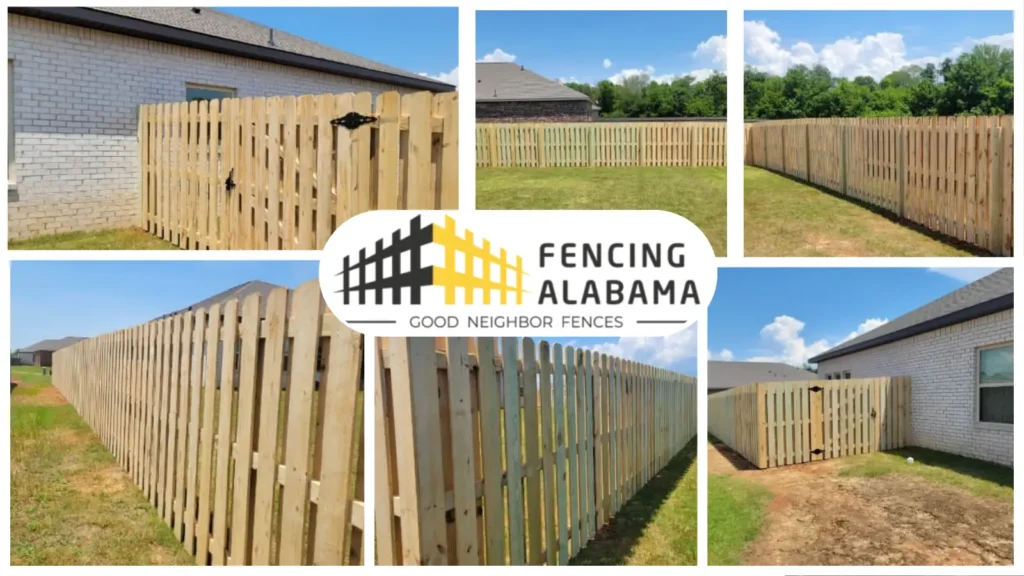
A shadow box fence is a wood fence with the pickets fastened to alternating sides of the rails instead of all on one face. Each picket overlaps the two beside it by roughly an inch, so the fence blocks the view when you look at it straight on, looks close to identical from both yards, and lets wind pass through the gaps rather than fighting it.
Quick points before you scroll:
- Shadow box is a picket layout, not a material. It is built with the same pressure-treated pine or cedar as any other wood privacy fence.
- Pickets on the same face sit about 2 to 3 inches apart, and the pickets on the opposite face cover those openings with roughly an inch of overlap on each side.
- Shadow box is semi-private, not private. Walk past at a sharp angle, and you can see through it, which is the single fact most articles about this fence style bury.
- The wind passes through instead of pushing on the panel, which matters on a six-foot run in North Alabama storm season.
- Both faces look the same, so the HOA rule about which way the finished side points usually stops being an argument.
How a Shadow Box Fence Is Actually Built
A shadow box fence is built on the same frame as any wood privacy fence: posts set in concrete, two or three horizontal rails spanning between them, and pickets fastened to those rails. The one difference is that the pickets alternate. One picket goes on the yard side of the rail, the next goes on the neighbor side, the next comes back to the yard side, and that pattern runs the length of the fence.
Two trade terms are worth defining before you read a quote for one. A rail, which some contractors call a stringer, is the horizontal 2×4 that spans between posts and carries the pickets. A picket is the vertical board, usually a 1×6, that makes up the surface you look at.
The spacing is where the style lives or dies. On a standard six-foot shadow box built with 1×6 pickets, the boards on each face are set roughly 2 to 3 inches apart, and the opposite face is offset so its pickets land over those openings with about an inch of overlap on each edge. Too little overlap and you have a picket fence with extra steps. Too much, and you have paid for boards you did not need.
Most shadow box runs use three rails rather than two, because the pickets are only anchored on one side of the rail, and the extra rail keeps the boards from twisting away from the frame. If a quote for a six-foot shadow box shows two rails, ask why.
Board count is the part homeowners get wrong when they price a DIY build. A shadow box fence uses close to the same number of pickets as a solid fence covering the same footage, because every gap on one face needs a board on the other face to close it. The gaps do not save you lumber. They only change where the lumber goes.
Why Both Sides of a Shadow Box Fence Look the Same
A shadow box fence looks nearly identical from both properties because half the pickets face each yard and the rails sit hidden between them. The only visible difference from one side to the other is the posts, and on most runs, even that is subtle.
This is why the style gets sold as a good neighbor fence. On a standard stockade or dog-ear fence, one household gets a flat wall of pickets, and the other gets a view of the rails and the fastener heads. Somebody is getting the back of the fence, and in a lot of Huntsville subdivisions, the covenant decides who, which is a conversation nobody enjoys having across a property line.
Shadow box removes the argument by refusing to have a back. Neither neighbor is looking at framing, so the finished-side question that comes up on almost every privacy fence quote in Madison and Harvest becomes a non-issue on this style. That alone is worth something on a shared line, particularly if the fence replacement is being split two ways.
How Private Is a Shadow Box Fence, Honestly?
A shadow box fence blocks the view head-on and leaks it at an angle. Stand square to the fence, and you see boards. Stand off to one side, the way anyone walking a sidewalk or driving past a corner lot naturally does, and the overlaps open into sightlines you can see straight through.
That is the honest answer, and it is the one to weigh before the material order goes in. If the reason for the fence is a hot tub, a pool deck, a bedroom window facing a road, or a neighbor whose kitchen looks directly into your yard, shadow box is the wrong pick, and a board-on-board or solid stockade fence is the right one.
If the reason for the fence is a boundary, a dog, kids, and not wanting to feel sealed inside a wooden box, shadow box does that job well and does it while still letting light and air into the yard. A six-foot solid privacy fence around a small backyard in July can turn the space into a still, hot pocket. Shadow box does not.
Here is a useful test that costs nothing. Stand where you actually sit in your yard, the patio chair or the back steps, and look toward the line where the fence will go. If the thing you want hidden is straight ahead of you, shadow box works. If it is off at forty-five degrees, it does not.
What People Are Actually Searching When They Land Here?
Very few homeowners search the phrase shadow box fence. They describe the fence, especially now that people type a whole situation into a search box or an AI assistant instead of two keywords. These are the descriptions that lead to this exact style:
- What is the fence called where the boards are on both sides and it looks the same from my neighbor’s yard
- I want privacy, but I do not want to feel closed in. What fence should I build
- My HOA says the good side of the fence has to face the street. Is there a fence with two good sides
- Which wood fence handles wind the best in Alabama
- Why can I see through my fence when I walk past it at an angle
- Is a shadow box fence actually private, or is that just marketing
If one of those sentences is roughly the one in your head, shadow box is the style you were circling. The last two are the ones worth reading the rest of this page for, because the answers are yes it handles wind well, and no, it is not fully private.
Why Shadow Box Handles North Alabama Storm Wind Better?
A shadow box fence passes air through the gaps between its pickets, so a gust pushes on less panel surface than it would on a solid privacy fence of the same height. Wind load on a six-foot solid run is real, and the force of it lands on the posts, which is where a fence fails.
North Alabama gets front after front through spring, and the repair calls that come in after a bad night are usually the same story: a solid six-foot fence on undersized posts set shallow. The panel caught the wind like a sail, and the posts gave up. Shadow box is not stormproof, and no fence is, but it reduces the sail.
The soil under this metro makes that difference matter more than it would somewhere else. North Alabama red clay takes on water and swells, then dries out and shrinks back, and every one of those cycles works a post a little looser in its hole. A post that is already being levered by clay does not need a wind load on top of it. Deeper holes, concrete on every post, and a layout that passes air is a stack of small advantages that add up over fifteen years.
Nothing about a shadow box layout rescues a badly set post. Posts spaced six to eight feet apart and set in concrete below the frost line are what carry the fence, on this style and on every other one. The picket layout only decides how hard the wind pushes on them.
What a Shadow Box Fence Cost Compared to a Standard Privacy Fence?
A shadow box fence costs more per linear foot than a plain dog-ear stockade fence of the same height and material, and the reason is labor and rails rather than pickets. Installed wood fencing in the Huntsville area typically runs about $22 to $45 per linear foot, depending on material, height, and site conditions, and shadow box sits in the upper half of that band rather than the bottom of it.
Three things drive the difference. The third rail adds material on every section. The alternating pattern takes longer to set out and fasten than nailing a row of boards flat across a frame. And the spacing has to stay consistent along the whole run, because an inconsistent shadow box is obvious from thirty feet away in a way an inconsistent stockade fence is not.
Wood choice moves the number more than the layout does. Cedar costs more per board than pressure-treated pine, and on a shadow box fence every board is a visible board, so the upgrade shows up across the whole run. The cedar or pressure treated decision for an Alabama fence is the bigger lever on your total, and it is worth settling before the style question.
Ask for the style to appear as its own line on the written quote instead of buried in a single per-foot number. That way, you can see what shadow box costs against a plain build on your actual footage and decide with real figures. Material ranges and the factors that move them are broken out further on the fence cost page.
Shadow Box vs Board on Board vs Stockade vs Picket
Four wood fence layouts get compared against each other constantly, and the differences come down to privacy, wind, and which side gets the pretty face.
| Style | How the pickets sit | Privacy | Wind | Looks from both sides |
| Shadow box | Alternating on both faces of the rails, overlapping about an inch | Semi-private, open at an angle | Passes air, less load on posts | Nearly identical |
| Board on board | All on one face, each picket overlapping the last | Full, and stays full as wood shrinks | Solid, full wind load | Rails show on the back |
| Stockade or dog-ear | All on one face, butted side by side | Full at install, gaps open as wood dries | Solid, full wind load | Rails show on the back |
| Picket | All on one face, spaced with open gaps | None, and none intended | Passes air freely | Rails show on the back |
Board on board is the closest competitor to shadow box, and the choice between them is simple once it is framed correctly. Board on board buys full privacy and gives up wind performance and the second good side. Shadow box buys airflow and a matching pair of faces and gives up privacy at an angle. Neither is better. They answer different questions.
What Your HOA Is Likely to Say About a Shadow Box Fence?
A shadow box fence usually clears architectural review more easily than a stockade fence, because the guideline that trips people up most often is the one about which direction the finished side has to face, and shadow box has two finished sides.
That said, approval depends entirely on your neighborhood’s published guidelines, not on the style being popular. Committees in this metro set their own rules on height, material, picket spacing, and stain color, and some specifically address semi-private fences because of sightlines to a street or a common area. Read the covenant before you pick, not after.
Timing is the part homeowners underestimate. Boards in the Huntsville area take anywhere from a few days to several weeks to respond, and no contractor can shorten that, including this one. What we can do is prepare the site drawing and material spec and get it submitted early so the review runs while materials are being scheduled instead of after. The full process is walked through in HOA fence approval in Huntsville subdivisions.
Build ahead of approval, and you can be told to take the fence down at your own cost. That happens here. It is a bad week for everybody involved.
Will a Shadow Box Fence Keep a Dog In?
A shadow box fence contains a dog as well as any six-foot wood fence, because the overlapping pickets leave no gap wide enough for an animal to pass through. The complication is not the fence face. It is the bottom edge, and the fact that your dog can partly see what is happening on the other side.
A dog that reacts to movement will react more at a shadow box fence than at a solid one, because the angled sightlines give it something to see. For a barker with a busy sidewalk out front, a solid layout is the calmer choice. For most yards, this is a non-issue.
The bottom gap matters more than the style. On sloped ground, the panels get stepped, and each step leaves a triangular opening at the low end where a determined digger will start. A pressure-treated rot board along the bottom, or grading fill at each low point, closes that up. Options for containment layouts are covered on the dog and pet fencing service page.
What Changes About a Shadow Box Fence After Five Alabama Summers?
A shadow box fence gets more see-through as it ages because pressure-treated pine shrinks across its width as it dries, and every picket pulling in a quarter inch widens every gap on the run. On a solid stockade fence, the same shrinkage opens visible slots. On shadow box, it thins the overlap that was doing the privacy work in the first place.
That is the trade-off to know going in, and it is an argument for cedar on this particular style. Cedar is more dimensionally stable than pine and holds its width better through the humidity swing here, which means the overlap you paid for is closer to the overlap you still have in year eight. Pressure-treated pine typically gives 12 to 15 years in this climate, and cedar 15 to 20 or more, and the full lifespan picture for wood fences in Alabama humidity covers what drives those numbers.
Airflow works in the fence’s favor on maintenance. A shadow box fence dries faster after rain than a solid panel does, because both faces of every picket get moving air instead of one face trapping damp against the frame. In a climate that grays and cups unsealed wood inside a single summer, that is a genuine advantage.
Sealing is still the job that decides the outcome. Every face of every picket needs coverage, and there are more faces on a shadow box fence than on a solid one, which makes it slower to stain and slower to reseal. Budget for that in time or in money before you commit to the style.
Can You Add a Cap and Trim to a Shadow Box Fence?
A cap and trim can be added to a shadow box fence, and in this market, it is a common combination. The cap is a flat board laid across the top of the run, and the trim sits under it across the picket tops, which gives the fence one straight horizontal line and covers the cut ends of the pickets.
The pairing works because the two features solve different problems. Shadow box handles wind and gives both sides a finished face, and the cap handles the appearance of the top line and keeps rain off the end grain where rot starts. Details on the boards, sizes, and cost of that top treatment are in what a cap and trim fence is.
One build note. On a shadow box run, the pickets sit on two different planes, so the trim board has to be wide enough to land on both faces, or the cap assembly has to be built to span them. Ask how it will be detailed before the crew starts cutting, because it is a design decision rather than an afterthought.
Who Should Skip a Shadow Box Fence?
Skip the shadow box if full privacy is the actual goal, if the fence is going around a pool or hot tub, or if the budget is tight enough that the extra rail and labor money would do more good buying bigger posts or cedar pickets.
Post quality beats picket layout every time. A shadow box fence on undersized posts set shallow in red clay leans inside three seasons, and no amount of clever board arrangement fixes it. Spend on what goes in the ground first, then pick the style with what is left.
Shadow Box Fence FAQ
Is a shadow box fence the same as a good neighbor fence? Not exactly. Good neighbor is a loose term for any fence that looks acceptable from both sides, and it gets applied to shadow box, board on board, and alternating panel fences depending on who is using it. Shadow box is one specific build: pickets alternating on both faces of the rails with an overlap. Ask a contractor which boards go where rather than relying on the name on the quote.
Is a shadow box fence more expensive than a regular privacy fence? Yes, usually. A shadow box fence costs more than a plain dog-ear stockade fence of the same height because it typically uses three rails instead of two and takes longer to lay out and fasten. Installed wood fencing in the Huntsville area generally runs about $22 to $45 per linear foot, and shadow box sits in the upper half of that range depending on wood choice and site conditions.
Can you see through a shadow box fence? Yes, at an angle. A shadow box fence blocks the view when you look at it straight on, but the overlaps open into visible sightlines from off to one side. It is a semi-private fence, and anyone who tells you otherwise has not walked past one on a sidewalk.
Does a shadow box fence hold up better in wind? It performs better than a solid privacy fence of the same height because air passes through the gaps rather than pushing on a closed panel, which reduces the load transferred to the posts. The posts still decide the outcome. Six-to-eight-foot spacing, concrete on every post, and holes set below the frost line are what keep a fence standing through North Alabama storm season.
Which is better, shadow box or board on board? Board-on-board is better where full privacy is the requirement, because the overlapping pickets stay closed even as the wood shrinks. Shadow box is better where airflow, a matching appearance from both yards, and wind performance matter more than blocking every sightline. On a shared property line in a Huntsville subdivision, shadow box also avoids the argument about who gets the finished side.
Do I need a permit for a shadow box fence in Madison County? Whether a permit applies depends on your parcel, the height of the fence, and whether the address sits inside a city limit or in an unincorporated county, and the picket layout does not change that answer. Confirm with the authority for your address before you build, and see fence permit rules in Madison County for how the two sets of rules differ.
Get a Shadow Box Fence Priced on Your Actual Yard
Fencing Alabama builds shadow box, board on board, cap and trim, and stockade fences across Huntsville, Madison, Harvest, Hazel Green, Toney, and the rest of North Alabama, and we prepare the HOA drawing and material spec so the project does not stall at the review stage. Sloped lots around Monte Sano and Hampton Cove are quoted on the actual ground rather than a flat per-foot rate, which is why every estimate starts with a site visit. See the wood fence installation service for materials and post specs, or the fence company in Huntsville page for local permitting notes.
Call (256) 900-8518 or schedule a free on-site estimate. We call back the same day during business hours, measure your line, and leave you a written itemized quote with the picket layout priced as its own line.
Fencing Alabama, 4741 Bakers Chapel Rd, Guntersville, AL 35976. Monday to Saturday, 9:00 AM to 5:00 PM. Based in Guntersville, serving Huntsville and North Alabama.