
When a Fence Is Past Repairing: How to Know When to Replace a Fence
Short answer
A fence is past repairing when the posts have failed, not when the boards look bad. If roughly a third or more of the posts in a run wobble at the base or crumble when you push a screwdriver into them, or the repair quote lands near half the price of a new fence, replacing is the cheaper spend. Boards, rails and gates are almost always fixable.
The short version, before you read the rest:
- Posts decide the answer. Rotted or loose posts mean replacement, and failing boards on sound posts mean a repair.
- A 150-foot wood fence runs about $3,300 to $6,750 installed in the Huntsville area, so a repair quote over roughly $1,650 to $3,375 on that same run is money spent on borrowed time.
- Pressure-treated pine lasts 12 to 15 years in North Alabama, and cedar runs 15 to 20 or more, so age alone tells you a lot before anyone walks the line.
- New boards will not match weathered boards for about two years, which is a real cost of patching that nobody prices.
- Replacing in the same style still needs HOA approval in most Huntsville metro subdivisions.
Most people call me about the one panel that fell over. The panel is rarely the problem. The panel is the thing that finally reported the problem, like a smoke alarm going off three rooms from the fire. I walk the line, push on six posts, and about half the time the homeowner already knows what I am about to say before I say it.
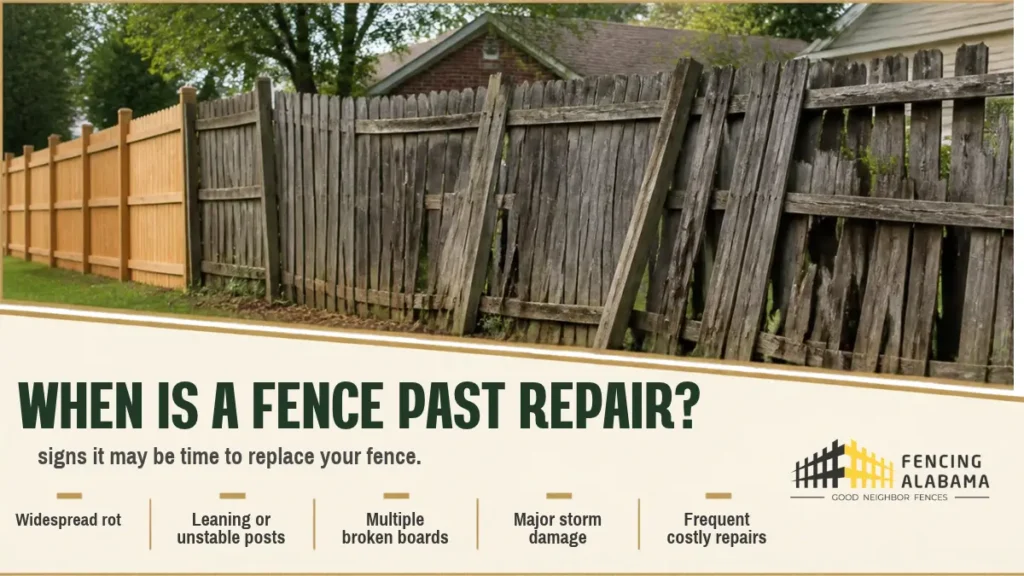
What “Past Repairing” Actually Means on a Fence
A fence is past repairing when the structure underneath it has failed across most of its length, rather than in one spot. The structure of a fence is the posts and the rails bolted to them. The pickets, the gate hardware, and the cap board are surface parts, and surface parts come off and go back on for a few hundred dollars.
“Past repairing” is a math problem more than a condition. A fence is past repairing the moment fixing it costs more than the fence has life left to give you. A 6-year-old cedar fence with one snapped rail has 10 or more good years ahead, so you fix the rail. A 16-year-old pine fence with four soft posts has maybe two, so you do not.
I use three words on site, and I use them the same way every time. A repair replaces damaged parts on sound posts. A section replacement rebuilds a stretch of fence between two good posts. A full replacement takes out every post and starts over. The question in this article is which of those three your fence needs.
Why I Check the Posts Before Anything Else
Fence posts carry the entire load of a fence, which is why I check them before I look at a single board. Every lean, every gap at the bottom of a gate, and every panel that pulled loose in a storm traces back to a post that moved. A fence with sound posts and ugly boards is a cosmetic job. A fence with pretty boards and soft posts is on a timer.
Wood posts fail at the ground line, not at the top and not underground. The band of wood from about 2 inches below grade to 2 inches above grade stays damp and gets oxygen at the same time, and that combination is what rots timber. You can have a post that looks perfect at eye level and has the consistency of a wet sponge at your ankle.
Steel posts and chain link line posts fail the same way for a different reason. Galvanized coating wears thinnest right at the soil line where water sits, and that is where the rust eats through the wall of the pipe. A chain link post that rings when you tap it at chest height can be paper at the base.
Why North Alabama Fences Fail at the Posts
North Alabama red clay is the reason fences here fail at the posts earlier than the material rating suggests. Clay swells when it takes on water and shrinks back in a dry spell, and that cycle levers a shallow set post a little looser every season. The post does not snap. It gets walked out of the ground by the dirt around it, one wet spring at a time.
Humidity finishes what the clay starts. Through an Alabama summer, unsealed wood at the ground line stays wet long enough for rot to work year-round, which is why pressure-treated pine gives 12 to 15 years here and cedar 15 to 20 or more rather than the longer numbers you read on national sites.
Storm season is the event that turns a slow problem into a Saturday phone call. A 6-foot solid privacy panel catches wind like a sail, and a post that was already 70 percent rotted holds fine until the night it does not. After a bad front, the repair queue in the Huntsville metro fills within days, so a section that has started to lean is worth a call before the next storm rather than after it.
Posts set in concrete below the frost line and backfilled properly beat all three of those. That is the difference between a fence that hits its rated life and one that fails at seven years, and it is the single thing I check first on any fence I am asked to price.
The Five Minute Test You Can Run Yourself This Afternoon
You can tell whether your fence is past repairing with a screwdriver and five minutes, and you do not need me in the yard to do it. Walk the fence line and run these three checks on every post, not just the ones near the damage. The posts you can see leaning are never the only ones in trouble.
- The push test: Grab each post at shoulder height and push it hard, front to back and side to side. A sound post does not move. A post that rocks in the ground, or one where you can see the soil lift on the far side, has lost its footing.
- The screwdriver test: Push a flathead screwdriver into the post at the ground line and again 2 inches below grade. If it sinks a quarter inch or more into the wood with hand pressure, that post is rotted through its working section even if the surface looks fine.
- The count: Write down how many posts failed either test and divide by the total number of posts in the run. Under a third means repair territory. A third or more means you are looking at a replacement, and the rest of the posts are not far behind.
The count is the part people skip, and it is the part that decides the money. One bad post out of twelve is a 45-minute job. Four bad posts out of twelve means you are going to be back out there every spring replacing the next one, paying mobilization and concrete each time, and the fence will still be a 16-year-old fence at the end of it.
For chain link, swap the screwdriver for a tap. Rap each line post at the base with a wrench. A solid post gives a sharp ring, and a rusted-through post gives a dull thud or flexes under the tap.
When to Replace a Fence Instead of Repairing It: Where the Cost Line Sits
Replace a fence rather than repair it when the written repair quote reaches about half the cost of a new fence on the same run. That threshold is the one I use on estimates, and it holds because a repair at that price buys you a few years on a fence already near the end of its rated life, while the full amount buys 12 to 20 years on a new one.
Run the numbers on your own fence before anyone quotes you. Installed wood fencing in the Huntsville area runs roughly $22 to $45 per linear foot, and chain link runs roughly $15 to $30. On a 150-foot backyard, that is about $3,300 to $6,750 for wood and $2,250 to $4,500 for chain link, which puts the repair ceiling somewhere near $1,650 to $3,375 for wood and $1,125 to $2,250 for chain link.
The half rule bends in two directions, and it is worth knowing which way yours bends. If you are selling the house in under two years, repair almost always wins because you are buying time, not life. If you are staying 10 years or more, the line moves down toward a third, because every repair dollar on a fence that will not last the decade is a dollar you spend twice.
Post count beats the cost rule when the two disagree. I have quoted fences where the repair came in at 30 percent of replacement, and I still told the homeowner to replace, because six of the fourteen posts were soft and the other eight were the same age, in the same clay, cut from the same stack of lumber. Those eight posts are not a surprise waiting to happen. They are a schedule.
What Age Alone Tells You, by Material
Age tells you how much life a fence has left to buy before anyone touches it, which is why I ask when it went in before I ask what is wrong. A fence in the last quarter of its rated life rarely justifies a structural repair, because the repair outlives the fence around it.
| Material | Typical life in North Alabama | Repair usually worth it until | What fails first |
| Pressure treated pine | 12 to 15 years | Year 10 | Posts at the ground line |
| Cedar | 15 to 20 or more | Year 14 | Pickets cup and gray before posts go |
| Vinyl | 25 or more | Year 20 | Posts and rails at the brackets, not the panels |
| Aluminum | 30 or more | Year 25 | Powder coat and fasteners, rarely the pickets |
| Chain link, galvanized | 15 to 20 | Year 14 | Line posts rust through at the soil line |
Those ranges assume posts set in concrete and wood that has been sealed. A pine fence nobody ever sealed can hit the bottom of that range or fall under it, and I have pulled 7-year-old posts out of Huntsville backyards that came apart in my hands. The longer version of that story is in the post on how long a wood fence lasts in Alabama humidity.
Signs of a Fence Past Repairing, by Material
Each fence material announces the end of its life differently, and reading the wrong sign on the wrong material gets expensive. A warped picket on a wood fence means almost nothing. A cracked rail at the bracket on a vinyl fence means a lot.
Wood fences are past repairing when posts fail at the ground line across the run, when rails have pulled loose from more than a third of the posts, or when the pickets have cupped and split badly enough that fasteners no longer hold. Gray color on its own is not a reason to replace anything. Gray is sun, and a wash and a stain fixes gray.
Vinyl fences are past repairing when the posts have cracked at the bracket routes,or the rails have gone brittle enough to snap under hand pressure. Individual panels and pickets slide out and replace cleanly if you can source the profile, and the real problem with an old vinyl fence is usually that the manufacturer discontinued the exact profile you need.
Aluminum fences almost never reach the point of replacement, which is why I tell people the aluminum question is nearly always a repair. Bent pickets straighten or swap out, and powder coat failure is a refinish job. An aluminum fence gets replaced when a vehicle takes out a long run of it or when the owner wants a different height.
Chain link fences are past repairing when line posts have rusted through at the base, or the top rail has collapsed along a long stretch. Stretched or sagging mesh on sound posts is a tension job, not a replacement, and a patched section of mesh costs a fraction of a new fence. The cost comparison between the two materials is laid out in chain link vs wood fence cost.
Repairs Still Worth Making on an Older Fence
Several repairs are worth making on a fence close to the end of its life, as long as the posts holding that section are sound. Repair is the right call far more often than replacement, and I would rather tell you that on an estimate than sell you a rebuild you do not need.
- A sagging gate on sound posts is usually a hinge, a missing anti-sag brace, or a gate post that needs resetting, and it is often a same-visit fix.
- One or two snapped rails after a storm bolt back on for a fraction of what a new run costs, and storm damage is sometimes covered by a homeowners policy.
- A single rotted post in a sound run comes out and goes back in concrete in under an hour, and the panels on either side usually come off and go back on intact.
- A section of cut or sagging chain link mesh patches and restretches without touching a post.
One repair I will not talk anybody into is matching new wood to old wood. You can patch a 14-year-old pine fence with fresh pine, and for about two years it will look like a brand new tooth in an old smile. Stain narrows the gap but does not close it. If the mismatch is going to bother you every time you pull into the driveway, factor that in before you choose the repair.
What Replacement Involves That a Repair Does Not
A full fence replacement is two jobs stacked on one another: tear-out and new build, and that is why it takes longer and costs more than the per-foot price of a new fence suggests. Old posts, panels, and hardware come out and get hauled off, then the new fence goes in. Most residential replacements in the Huntsville metro finish in one to three days once materials are on site.
New post holes are part of the job that surprises people. Old concrete footings left in the ground are difficult to break out, so we often set the new posts beside the old footing rather than fight it, which shifts the fence line by an inch or two. That is normal and worth knowing before you see it happen in your yard.
Replacing a fence in the same style still needs HOA approval in most Huntsville metro subdivisions. Architectural review boards take anywhere from a few days to several weeks, and no contractor can shorten that window, which is why I prepare the drawing and material list and submit early instead of waiting for the build slot. The process is covered in detail in HOA fence approval in Huntsville subdivisions.
Permits are a smaller hurdle here than most people expect. The City of Huntsville states on its residential construction FAQ that fences do not require a permit, and the City of Madison states it has not issued fence permits since 2017. Zoning, easement, and Historic District rules still apply, and a parcel in unincorporated Madison County near Toney or Harvest follows county rules rather than a city code, so confirm what governs your address before you order materials.
A replacement is also the one moment when switching material costs you nothing extra in labor, because the tear-out happens either way. Moving from pine to cedar, or from wood to vinyl, is cheapest at exactly this point. The 20-year math on that decision is in vinyl vs wood fence cost.
Can You Replace Part of a Fence and Leave the Rest?
You can replace one side of a fence and leave the rest standing, and it is the right answer more often than people assume. Backyards fail unevenly, because the run that faces afternoon sun and the run that sits under a downspout age at completely different rates. A section replacement between two sound posts is a normal job.
Partial replacement works when the posts bordering the new section are sound, and the materials still match closely enough to live with. It stops working when the old sections are within two or three years of their own end, at which point you are paying mobilization, concrete, and a crew visit twice to get the same fence you could have had once.
Reusing existing posts for a new fence is possible and rarely a good trade. A post that has been in North Alabama clay for 12 years has spent most of its service life, and hanging new 15-year panels on it means the panels outlive their support by several years. I will quote it either way and show you both numbers, but I will tell you which one I would pick.
Fence Replacement Questions I Get Asked Frequently
My fence leans but the boards look fine. Do I need a whole new fence?
A leaning fence with sound boards is a post problem, and whether you need a full replacement depends on how many posts moved. Push every post in the run, not just the ones near the lean. One or two loose posts in a twelve-post run is a repair. A third or more means the clay has worked the whole line loose, and resetting them one at a time costs more over two years than replacing.
Is it cheaper to repair or replace a fence?
Repairing is cheaper in almost every case where the posts are sound, and that covers most calls I take. Replacement becomes cheaper when the repair quote reaches about half the cost of a new fence on the same run, or when several posts have rotted at the ground line. On a 150-foot wood fence in the Huntsville area, that crossover usually sits somewhere between $1,650 and $3,375 in repair cost.
How many rotted posts does it take before I should replace the whole fence?
Roughly a third of the posts in a run is the threshold I use. Below that, replacing the bad posts individually is the better spend. At or above a third, the remaining posts are the same age, in the same soil, and usually within a season or two of failing themselves, so you end up paying for repeat visits on a fence that is already at the end of its rated life.
Will homeowners insurance pay to replace a fence that is just old?
Homeowners insurance generally covers sudden damage such as wind or a fallen tree, not gradual rot or normal wear, so an old fence that failed from age is usually not a claim. Storm damage often is. Photograph the damage before anything is moved, get a written estimate, and ask your insurer what your specific policy covers before you authorize any work.
Do I need HOA approval to replace a fence with exactly the same fence?
In most Huntsville metro subdivisions, yes, even for an identical replacement. Architectural review boards usually want a drawing and a material list on file, and some have changed their standard since your original fence went in, which means the old style may no longer be approved. Boards take a few days to several weeks, so submit before you schedule the build.
What happens to my old fence when you replace it?
Tear-out and haul-away are part of a replacement job, so you do not arrange separate disposal or rent a dumpster. Old posts, panels, and hardware come out and leave with us, the line gets raked, and the new fence goes up to the approved plan. Removal shows as its own line on the written estimate so you can see what that portion costs.
Get an Honest Repair or Replace Answer on Your Fence
I will give you both numbers in writing, the repair and the replacement, and tell you which one I would spend my own money on. That is the same answer whether the job turns into fence replacement in Huntsville or a fence repair that costs a tenth as much, and we schedule on-site estimates across Huntsville, Madison and the rest of North Alabama within the week you call.
Call (256) 900-8518 or schedule a free on-site estimate. If you want a planning range before we talk, the fence cost calculator will get you close.