
Storm Damage Fence Repair and Insurance Claims in North Alabama
Short answer
Storm damage fence repair starts at the posts, not the panels. Wind pushes a solid privacy fence like a sail, and the post gives way before the boards do. Your homeowners policy usually pays for wind damage to a fence under Other Structures coverage, minus a deductible that in Alabama is often a percentage of your dwelling limit rather than a flat amount.
The short version
- Wind, hail, fire, falling trees, and vehicle impact are covered causes on a standard homeowners policy; rot, rust, termites, and a post that has been leaning for three years are not.
- Fences sit under Other Structures, also called Coverage B, which is commonly about 10 percent of your dwelling limit and shared with the shed and the detached garage.
- Most Alabama policies apply a separate percentage wind and hail deductible of roughly 1 to 5 percent of the dwelling limit, which is often larger than the whole repair.
- Alabama Administrative Code rule 482-1-125 gives your insurer 15 days to acknowledge the claim and 30 days after proof of loss to accept or deny it.
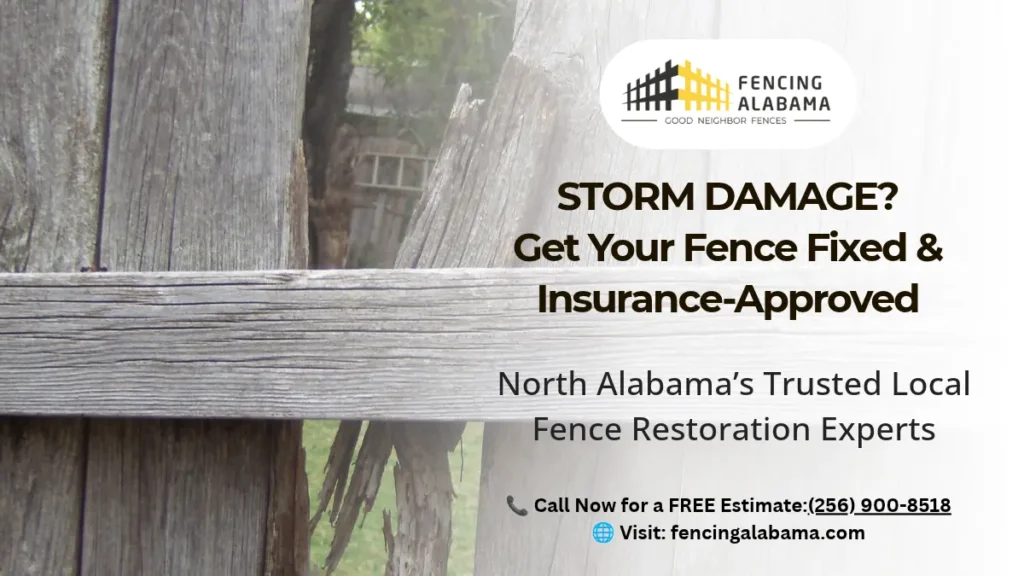
What Counts as Storm Damage to a Fence?
Storm damage to a fence is damage traceable to one weather event: wind that snapped or leaned posts, a limb that broke through a panel, hail that cracked vinyl, or runoff that scoured the soil out from a post line. The National Weather Service calls a thunderstorm severe once it produces winds of 58 mph or hail an inch across, and a six-foot privacy fence feels both of those.
An adjuster is looking for one thing above all: did this happen suddenly, or has it been happening for years? Sudden is covered. Gradual is not. A post that has leaned a little further every spring since 2021 is wear, and no amount of storm on the calendar turns it into a covered loss.
North Alabama red clay is the reason so many of these calls are closer to wear than the homeowner expects. Clay swells when it takes on water and shrinks back in a dry spell, and that cycle levers a post loose a fraction at a time. The storm finishes work the soil started three or four seasons ago.
Hail damage to a fence reads differently from wind damage. Hail cracks and stars vinyl panels and dents aluminum pickets without moving a single post, while wind leaves posts out of plumb and rails pulled off their fasteners. Tell the adjuster which one you have, because they are separate conversations.
What to Do in the First 48 Hours After the Storm?
Photograph the fence before you touch it. Every adjuster wants to see the mess, and every homeowner’s instinct is to tidy the mess before anyone sees it. Shoot wide first so the whole run is in frame, then close on each broken post and panel, and lay a tape measure beside at least one break so scale is in the photo.
Six things are worth doing before the crew gets there:
- Write down the date and the approximate time of the storm, because the claim will be matched against weather data for your address.
- Keep the broken boards and posts stacked on site rather than hauled off, since they are the physical evidence of the loss.
- Secure the dog another way, with a run line or a temporary pen, before anything else gets decided.
- Brace any panel still standing but leaning over a sidewalk, a driveway, or a pool, since a half-fallen panel is the one that hurts somebody.
- Check whether a downed limb is resting on a service line, and call the utility rather than a fence company if it is.
- Call for a written estimate before you call the insurer, so you walk into the claim knowing the actual number.
Storm-chasing crews work North Alabama hard after a bad front. A contractor who knocks on your door the morning after, quotes a price on the spot, and wants a large deposit in cash is a risk worth skipping. Ask for a local address, proof of liability insurance, and a written itemized quote, and be comfortable waiting a few days for a company that still answers the phone next spring.
How to Tell Whether the Posts Failed or the Panels Failed?
Grab a post at the top and push. Movement down at the soil line means the post or the concrete failed, which is the expensive version. Movement up at the rail while the post stays put means the fasteners or the rail let go, which is a half-day repair on most runs.
Pull on the fallen post and look at what came up with it. A post that lifted with a lump of concrete still attached tells you the hole was too shallow or too narrow for the load. We set posts in concrete below the frost line, and on a six-foot privacy run that works out to roughly a third of the post buried, which is where the 24-inch depth on an eight-foot post comes from.
Push a screwdriver into the post at ground level before you decide anything. If the blade sinks a quarter inch into soft wood, that post was already failing from rot, and the wind simply collected on an overdue repair. Pressure-treated pine gives 12 to 15 years in Alabama humidity and cedar 15 to 20, so the age of the fence tells you how likely that is.
Check the rest of the line even where nothing fell. After a hard front, I find posts that moved an inch and sprang back, and those are the ones that go over during the next storm while the insurance file on this one is already closed. Our fence repair estimates cover the whole run for that reason, not only the section on the ground.
Does Homeowners Insurance Cover Fence Damage from Wind?
Homeowners insurance generally covers fence damage from wind, because wind is a named covered cause of loss on a standard policy. GEICO’s 2026 homeowner guidance lists fire, wind, hail, lightning, falling trees, vandalism, and vehicle impact among covered causes for fences, and excludes wear and tear, wood rot, rust, termites, mold, improper installation, and neglect.
Your fence does not sit under the dwelling portion of the policy. It sits under Other Structures, also called Coverage B, which GEICO describes as commonly about 10 percent of the dwelling limit and shared with every other detached structure on the lot. A home insured at $300,000 on the dwelling would have around $30,000 available for the fence, the shed, and the detached garage combined.
Flood is the exclusion that catches people on creek lots and low ground around Owens Cross Roads and New Hope. Water that rises off the ground is flood, which a standard homeowners policy excludes and only separate flood coverage handles, while rain driven sideways by a thunderstorm is wind. The same storm can produce both on the same property.
Read your own declarations page rather than trusting any general article, including this one. Policy forms differ by carrier; some exclude or limit windstorm coverage outright, and the only document that governs your claim is the one with your name on it.
How Your Deductible Decides Whether the Claim Is Worth Filing
Your deductible usually settles the question before coverage does. Most Alabama insurers apply a separate percentage-based deductible for wind and hail rather than the flat dollar deductible used for other losses, and Kin’s 2026 Alabama hail guidance puts that percentage at roughly 1 to 5 percent of the dwelling limit.
Run the arithmetic before you call anyone. Find the declarations page, find the line reading windstorm or hail deductible, and multiply that percentage by your Coverage A dwelling limit. A home insured at $350,000 with a 2 percent wind and hail deductible carries $7,000 of exposure before the policy pays a dollar.
Three snapped posts and four panels on a residential run will not reach $7,000 in North Alabama. If your deductible is $7,000 and your written quote is $2,200, you have a fence bill rather than an insurance claim, and the honest answer is to pay it and keep the claim off your record.
A claim that pays nothing can still cost you. Carriers price renewals partly on claim history, so a denied or under-deductible claim can show on your record without a check ever arriving. Ask your agent what a filed claim does to your renewal before you file, not after.
Actual Cash Value or Replacement Cost: Why the Check Is Smaller Than the Quote
Actual cash value pays what the fence was worth on the day it fell, with age subtracted. Replacement cost pays what it costs to build the same fence today. GEICO notes that insurers may factor the fence’s age and condition into the payment, and that the settlement is typically the approved repair cost minus the deductible and any depreciation.
Depreciation hits fences harder than roofs because the service life is shorter. A nine-year-old pressure-treated pine fence sitting in a 12- to 15-year service life has spent most of its paper value, so an actual cash value settlement on it can land well under the quote to rebuild it.
Look for the words replacement cost on the Other Structures line of your declarations page. Where the policy carries replacement cost on Coverage B, many carriers release the depreciated amount first and the remainder once the work is finished and you send the final invoice, which means the repair has to actually happen for you to see the full amount.
How to File a Fence Damage Claim in Alabama, Step by Step
File in writing and keep every document, because Alabama’s claim-handling rules run on written communication and dates. Alabama Administrative Code rule 482-1-125 sets the clock your insurer runs on, and knowing those numbers changes how a slow claim goes.
- Report the loss to your carrier in writing, naming the date of the storm and the sections affected.
- Send the photographs you took before cleanup, along with any older photos showing the fence standing and sound.
- Get a written itemized quote from a fence contractor, broken out by post, panel, concrete, hardware, and debris removal, rather than one lump figure.
- Complete and return the proof of loss forms, since the 30-day clock on acceptance or denial starts from the insurer receiving properly executed proofs of loss.
- Meet the adjuster on site and walk the whole run with them, including the posts that moved but did not fall.
- Ask for the adjuster’s estimate worksheet in writing and compare it line by line against your contractor’s quote.
Under rule 482-1-125-.06, your insurer has 15 days to acknowledge the claim and 15 days to reply to written questions you send about it. Rule 482-1-125-.07 gives 30 days after properly executed proofs of loss to tell you whether the claim is accepted or denied, requires an update every 45 days while an investigation stays open, and allows 30 days to pay once liability and amount are agreed, unless the policy specifies a different period.
The Alabama Department of Insurance takes consumer complaints at aldoi.gov when a carrier runs past those timelines without explanation. Citing the rule number in your written follow-up tends to shorten the wait on its own.
When a Neighbor’s Tree or a Car Takes Out Your Fence?
A tree that blows out of your neighbor’s yard and lands on your fence is normally your own claim, because the fence is your property and the wind was an act of weather rather than an act of your neighbor. The exception is a tree already dead or obviously failing that the neighbor was warned about and ignored, which moves the loss toward their liability coverage.
A vehicle through the fence is the driver’s problem, not yours. Auto liability covers property damage the driver causes, so get the driver’s insurer, policy number, and the police report number at the scene, and send your fence quote to that carrier rather than your own.
A fence sitting on the property line between two yards is usually handled by each owner filing with their own carrier for their own side. GEICO’s guidance describes that same split for shared fences. Settle who owns what before the quotes get written, because a full fence replacement on a shared line is a conversation with the neighbor as much as with the adjuster.
Repair or Replace After a Storm?
Count the posts, not the panels. A run with sound posts and three or four broken panels is a repair, and we can swap boards and rails in a morning. A run where several posts snapped at grade, or where the whole line is out of plumb, is a replacement, because new panels bolted to tired posts fail on the next front.
Matching is the other half of the decision and the part homeowners underestimate. New pressure-treated boards next to eight-year-old grayed pine do not match, and they will not match for a couple of seasons even after staining, so a long repair in a front-facing run sometimes looks worse than it performs. Our article on how long a wood fence lasts in Alabama humidity covers how fast that color gap closes.
Age settles the close calls. A fence past 12 years in this climate that loses several posts in one storm is telling you what the next three years look like, and spending the claim money on a repair that buys two seasons is money spent twice.
What Storm Fence Repair Costs in North Alabama
Storm fence repair is quoted per post and per panel rather than per job, which is why two houses on the same street get different numbers for what looks like the same damage. We put a written itemized quote in your hands before anything is ordered, and for an insurance claim, that itemization is what the adjuster works from.
Five things move the number on a storm repair:
- How many posts have to come out, because removing a concrete footing is the slowest part of the job.
- Whether a truck and auger can reach the fence line, since backyard access through a narrow gate turns machine work into hand work.
- How much debris has to be hauled, especially when a limb came down with the fence.
- Whether matching material is still stocked, since a discontinued vinyl profile or picket spacing can force a longer run to be replaced.
- Whether a gate is involved, because a bent gate frame and a sagging hinge post are their own repair on top of the fence.
Ask any contractor to split the quote into labor, material, concrete, hardware, and haul-off. A lump sum is harder for an adjuster to approve and harder for you to compare against the second quote, and a contractor who will not itemize is telling you something.
How to Rebuild So the Next Front Does Less Damage
No wood fence carries a wind rating stamped on it, so anyone quoting you a mph number for a privacy fence is guessing. What actually decides whether a fence stands is post size, post depth, post spacing, and whether air can get through the panel, and all four are choices made on quote day.
Air gaps do more than heavy boards. A shadow box fence alternates boards on either side of the rails so wind passes through while the sightline stays blocked, and it takes a straight-line gust far better than a solid stockade panel of the same height.
Posts are where the money belongs. Upsizing posts, tightening the spacing, and setting every post in concrete below the frost line costs more on the quote and less over 15 years, and wood panels on steel posts is the version I recommend for exposed runs with nothing upwind of them. Material choice matters too, and cedar or pressure treated changes how the posts age at the soil line.
Check your HOA before the rebuild, not after. A storm does not suspend an architectural review board, and swapping a stockade panel for a shadow box or changing height can need approval that takes anywhere from a few days to several weeks, which our guide to HOA fence approval in Huntsville subdivisions walks through.
Why the Repair Queue Fills Up the Morning After a Front
The phone starts at daylight after a bad night, and the calls arrive in the order the damage did. We return calls the same day during business hours and schedule on-site estimates within the week you call, and after a widespread front that week is working harder than usual.
Call about a leaning section before the next storm rather than after it. A post that moved an inch is a one-post repair on a normal week and a full run replacement after the front that finishes it, and the second version costs several times the first.
North Alabama gets two busy stretches, spring and late fall, so the quiet window for a planned repair is summer and midwinter. Storm work goes to the front of the queue when something is unsafe, but a fence that is merely leaning will wait behind a fence lying across a driveway.
Questions Homeowners Ask After a Storm
My fence blew down last night in Huntsville. Do I call my insurance company or a fence company first? Call a fence company first for a written itemized quote, then call your insurer. Walking into the claim with a real number tells you whether the repair even clears your wind and hail deductible, which on many Alabama policies is a percentage of the dwelling limit rather than a flat amount. Photograph everything before any cleanup starts.
Is it worth filing a homeowners claim for a fence? It is worth filing when the written repair quote clearly exceeds your wind and hail deductible. On a $350,000 dwelling limit with a 2 percent wind deductible, nothing under $7,000 pays out, and most residential fence repairs in Madison County land well below that. Carriers also price renewals partly on claim history, so ask your agent before filing.
How much wind can a wood privacy fence withstand? No wood fence carries a certified wind rating, and the honest answer is that it depends on post size, post depth, post spacing, and whether air passes through the panel. The National Weather Service calls a storm severe at 58 mph, and a six-foot solid panel on undersized posts will not reliably hold at that speed in North Alabama clay.
My neighbor’s tree fell on my fence. Who pays for the repair? Your own homeowners policy normally covers it, because the fence is yours and the wind brought the tree down. If the tree was already dead and your neighbor was told about it and did nothing, the loss can shift to their liability coverage, so put the warning in writing at the time rather than afterward.
How long does my insurance company have to respond to a fence claim in Alabama? Alabama Administrative Code rule 482-1-125 gives your insurer 15 days to acknowledge the claim, 15 days to reply to your written questions, and 30 days after properly executed proofs of loss to accept or deny it, with an update every 45 days while an investigation continues and 30 days to pay once the amount is agreed.
Can I replace just the broken panels, or does the whole fence have to go? Panels can be replaced on their own when the posts are still sound and plumb, which is the common outcome after a limb strike. When several posts snapped at grade, or the run is leaning along its length, panel-only work fails on the next storm. Matching aged wood is the other limit, since new boards stay lighter for a couple of seasons.
Get the Fence Back Up
We repair storm-damaged fences across Huntsville, Madison, Athens, Decatur, Harvest, Hazel Green, Meridianville, Moores Mill, New Hope, New Market, Owens Cross Roads, Toney, and Guntersville, and we give you the written itemized quote your adjuster needs. If you are in the metro, our fence company in Huntsville page covers the neighborhoods we cover, and county parcels around Toney have their own page.
Call (256) 900-8518 or schedule a free on-site estimate, and we will walk the whole run with you, not only the part on the ground.
Fencing Alabama, 4741 Bakers Chapel Rd, Guntersville, AL 35976, (256) 900-8518, Monday to Saturday, 9:00 AM to 5:00 PM