
Security Fence Height and Anti-Climb Design
Short answer
A security fence starts at 7 feet of fabric and goes up from there. The U.S. Department of Defense standard UFC 4-022-03 specifies 7 feet of chain link fabric plus a barbed outrigger for 8 feet total on its baseline perimeter fence. Height buys you time. Anti-climb design is what takes the handholds away so that time actually costs the climber something.
What this comes down to:
- UFC 4-022-03 sets 7 feet of 9-gauge fabric with 2-inch mesh as the DoD baseline, and 8 feet with six strands of barbed wire on a Y-outrigger for the hardened version.
- Standard 2-inch chain link mesh is a ladder. A fit adult clears a 6-foot run of it in under ten seconds because the diamond takes a whole toe.
- 358 mesh closes that off with a 3-inch by 0.5-inch aperture on 8-gauge wire, which is too tight for fingers or toes and too thick for bolt cutters.
- The top rail is the single biggest gift you can give a climber, and the Chain Link Fence Manufacturers Institute recommends leaving it off a security fence entirely.
- Height limits in the Huntsville metro depend on whether your parcel sits inside a city limit, in unincorporated Madison County, or under an architectural review board, so confirm for your address before you order steel.
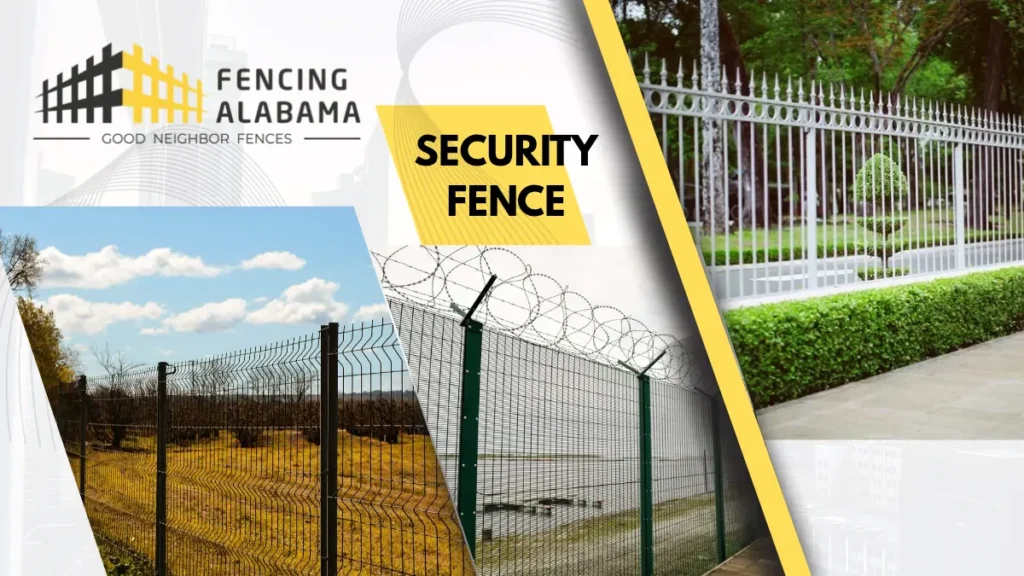
How Tall Does a Security Fence Need to Be?
Security fencing runs 7 to 10 feet in almost every commercial job I quote in North Alabama, and 8 feet is the number most property managers land on. A 6-foot fence is a privacy fence with ambitions. It marks the boundary, and it stops a casual walk-in, but it does not stop anyone who came to the property on purpose. The jump from 6 feet to 8 feet is the single biggest change in difficulty you can buy, because at 8 feet a climber can no longer reach the top rail from a standing position.
Here is how the heights sort out by what the fence is protecting.
| Height | What it realistically does | Typical use |
| 6 ft | Blocks sightlines and deters a casual trespasser. Climbable in seconds. | Residential privacy, light screening |
| 7 ft | Baseline for perimeter security under UFC 4-022-03. Requires a deliberate climb. | Utility yards, small equipment lots |
| 8 ft | Cannot be topped from a standing reach. Standard commercial security height. | Contractor yards, warehouses, self storage |
| 8 ft plus outrigger | 8 ft of fabric with barbed arms adds a hostile top the climber has to solve. | Industrial, fuel, substations |
| 10 ft and above | Pushes a climb into two-person or equipment territory. | High value inventory, restricted sites |
Anything above 8 feet usually triggers a jurisdiction conversation before it triggers a materials order, which is covered further down.
Why Height Alone Does Not Stop a Climber
Height delays a climber, and delay is the whole point of a perimeter fence. A fence does not stop an intruder. It buys the seconds or minutes your camera, your lights, your dog, or your alarm need to matter. I have watched a teenager go over a 6-foot chain link fence in about four seconds using the diamond mesh as rungs and the top rail as a pull-up bar. The fence was 6 feet tall, and it may as well have been a stepladder.
The climbing time on a fence is set by the four things a climber can grab, not by the number on the tape. A 7-foot fence with no footholds, no top rail, and a hostile top beats a 10-foot fence with a 2-inch mesh and a nice round pipe to grab. Design decides difficulty. Height decides how long that difficulty lasts.
What Makes a Fence Anti-Climb?
An anti-climb fence removes the four things a climber uses: footholds in the fabric, horizontal rails to stand on, a grippable top, and a gap at the bottom. Take all four away and a person has nothing to work with except tools, which are slower and noisier, and noise is a security feature.
Those four, in the order a climber meets them:
- The bottom gap: A fence that lifts 5 inches off grade is a fence nobody has to climb at all.
- The fabric: A 2-inch chain link diamond accepts a toe. A 0.5-inch aperture does not accept a fingertip.
- The mid-height rails: A horizontal rail at 30 or 40 inches is a step. Ornamental fences hand these out for free unless the design moves them.
- The top: A round top rail is a pull-up bar. A barbed outrigger, a rotating roller, or a spear picket top is not.
Every genuine anti-climb product on the market is solving one of those four. If a salesman is pitching you something that solves none of them, he is selling you height.
Mesh Aperture and Wire Gauge: Why 358 Mesh Costs What It Costs
358 mesh is a welded security panel with a 3-inch by 0.5-inch aperture on 8-gauge wire, which is where the name comes from: 3, 5, and 8 read off the imperial spec. Metric sizing is 76.2 mm by 12.7 mm on 4 mm wire. The half-inch aperture is too narrow for fingers or toes, and the 8 gauge wire is thick enough that bolt cutter jaws cannot close on a single strand, which forces an intruder to an angle grinder. An angle grinder throws sparks, makes noise, and takes time.
Against the alternatives, the aperture is the number that matters more than the height.
| Fabric | Aperture | Wire | Climbable by hand? | Cut resistance |
| Standard chain link | 2 in diamond | 11 or 9 gauge | Yes, easily | Low, bolt cutters |
| Heavy chain link | 2 in diamond | 6 gauge | Yes | Moderate |
| Micromesh chain link | 1 in or 3/8 in diamond | 9 gauge | Difficult | Moderate to high |
| 358 welded mesh | 3 in x 0.5 in | 8 gauge | No practical holds | High, grinder required |
| Welded wire panel | 2 in x 4 in | 10 to 12 gauge | Yes | Low |
Most North Alabama commercial sites do not need 358 panels. A yard holding skid steers and copper wire does. The honest line is that 358 mesh runs well above chain link per linear foot, and on a long perimeter the cost difference is real money, so it earns its place where the contents justify it and not everywhere else.
How to Take the Handholds Off a Chain Link Security Fence
Chain link becomes a security fence through four changes to a standard install, and the Chain Link Fence Manufacturers Institute publishes all four in its security fencing guidelines. None of them involve making the fence taller.
The top rail comes off first. CLFMI recommends omitting the top rail on a security fence specifically because it removes a handhold, and a 7-gauge coil spring wire gets installed in its place to hold line tension without giving anyone something to grab. That one change does more for climb resistance than adding a foot of height.
The bottom gets locked down next. CLFMI calls for the fabric to sit no greater than 2 inches above grade, and for the fabric to be buried 12 inches or more where lifting is a concern, which closes off the easier option of going under instead of over. UFC 4-022-03 holds the same line from a different direction, requiring the fabric to be within 2 inches of firm ground with anchoring that stops the fabric from being lifted more than 5 inches.
Gauge and mesh come third. UFC 4-022-03 specifies 9 gauge fabric at 2-inch mesh for its baseline Type A fence, and the Navy and Marine Corps version holds to 9 gauge with openings no larger than 2 inches per side. If a quote you are reading says 11 gauge, that is residential fabric wearing a commercial label.
The top treatment comes last, and only after the first three are done. Barbed wire over a fence that still has a top rail and a 5-inch ground gap is decoration.
Anti-Climb Toppers Compared
A topper makes the last 12 inches of a fence hostile, and the four common options trade off cost, appearance, and liability very differently. Barbed outriggers are the standard commercial answer, and UFC 4-022-03 uses six strands of barbed wire on a Y-shaped outrigger, three per side, to take a 7-foot fence to 8 feet of total height.
| Topper | How it works | Where it fits | Watch out for |
| Barbed wire on a Y outrigger | Three strands per side, angled out over both faces | Industrial yards, utility sites | Reads as hostile, often restricted in residential zones |
| Stainless barbed tape | A continuous barbed ribbon, added at the top and sometimes the bottom | Restricted sites, high value storage | Serious injury risk, usually the wrong call near the public |
| Rotating roller | A tube that spins when gripped, so a hand cannot hold the top | Walls, residential and light commercial | Needs clean mounting and does nothing for the fabric below |
| Spear or finial picket top | Pickets run past the top rail to a point | Ornamental steel, visible frontages | Height from grade matters for liability near children |
Barbed tape is the one I talk clients out of most often. It is effective, and it is also the fastest way to turn a trespass into a lawsuit on a property where a child or a delivery driver can reach it.
Anti-Climb Design on Ornamental Steel and Aluminum
Ornamental steel becomes anti-climb by moving the rails, not by adding height. A standard three-rail panel puts a horizontal rail somewhere around mid-height, and that rail is a step. Security grade ornamental fencing solves it by pairing the rails close together near the top and near the bottom, leaving a long clear span in the middle with nothing to stand on, and by running pickets past the top rail to a spear point so the top is not a flat bar.
The bottom rail matters as much as the top. A flush bottom rail sits at grade rather than 4 inches above it, which closes the gap a dog, a raccoon, or a person would otherwise use. Picket spacing on ornamental panels is normally held under 4 inches of clear opening, which is the figure that keeps a panel usable around children and pools, and it also happens to be narrow enough that a boot does not wedge in.
Ornamental steel is the right choice when the fence has to look like it belongs on a frontage rather than around a substation. Our aluminum and wrought iron fencing comparison covers how the two materials differ on strength and upkeep, which matters more on a security run than on a garden fence.
How to Stop the Dig-Under
Most perimeter breaches I get called about went under the fence, not over it. North Alabama red clay makes this easy in both directions: the clay swells when it takes on water and shrinks back in a dry spell, and that cycle opens a void along the fence line at the same time it works a shallow post loose. Then one wet February and there is a 6-inch channel under a fence somebody paid for 8 feet of height on.
Three fixes, in order of how much they cost.
- Bury the chain link fabric 12 inches or more, which CLFMI recommends outright, and tension the bottom so it cannot be pushed up.
- Run a tension wire or a bottom rail along the entire base so there is no slack to lift.
- Pour a concrete sill or set a buried mow strip under the fence line on sites where someone is genuinely motivated.
Post depth carries the whole thing. A 10-foot fence on shallow posts is not a security fence; it is a sail waiting for a storm.
Gates Are the Weakest Point in a Security Fence
The gate is where almost every security fence fails, because a gate has moving parts, a frame with horizontal members, a gap at the latch, and a hinge side that gives a climber something square to stand on. I have seen 8-foot perimeters with a 6-foot gate in them, which means the whole perimeter is now 6 feet tall.
A security gate has to match the fence on height, on fabric, and on top treatment, and the gap under the leaf has to stay tight enough that nobody rolls under it. Drop rods, keeper posts, and a gate stop keep a double leaf from being levered. On gates wide enough to need an opener, the hardware and the safety requirements change again, and our chain link gate sizes, types and costs guide covers the sizing side of that decision before you get into automation.
Are Anti-Climb Spikes and Razor Wire Legal in Alabama?
Whether you can put spikes or razor wire on a fence depends on your zoning district and, separately, on the duty of care you owe to anyone who might reach it, and those are two different questions with two different answers. Zoning is local: many municipal codes restrict barbed and razor wire to industrial districts or require a minimum height from grade, while unincorporated county land is often less restrictive. Confirm what applies to your parcel with the authority for your address before you order anything with a point on it.
The liability question is the one people skip. A deterrent a child, a delivery driver, or a utility meter reader can reach is a different legal exposure than the same deterrent at 8 feet on a fenced industrial yard. I am a fence contractor and not a lawyer, so on anything with real exposure, I tell clients to have their own attorney look at it. What I will say from the install side is that a rotating roller and a spear top solve most residential climb problems without the sharp edge at hand height.
Who Sets the Height Limit for Your Property
The height limit on your fence is set by whichever authority your parcel actually sits under, and in the Huntsville metro that is one of three. Inside a city limit, the municipal zoning ordinance governs, and front, side, and rear yards often carry different limits. On unincorporated Madison County land, which includes Toney, Harvest, and a good deal of the surrounding area, county requirements apply rather than a city code. On top of either, a subdivision under an architectural review board has its own rules on height, material, and which way the finished face points.
Requirements change, and they vary parcel to parcel, so the number matters less than knowing who to ask. Our write-up on fence permit rules in Madison County explains how the permit side works, and the HOA fence approval process in Huntsville subdivisions covers the review board timeline, which runs from a few days to several weeks and which no contractor can shorten. We prepare the site drawing and the material spec and submit early rather than waiting for a build slot, because a security fence at 8 or 10 feet is exactly the kind of application a board wants to look at twice.
Build first and get told to take it down, and the removal is at your cost. On a 10-foot steel perimeter, that is an expensive way to learn a zoning boundary.
What an 8 Foot Fence Has to Survive in North Alabama
A tall fence in North Alabama is a wind load problem before it is a security problem. Storm season puts real pressure on any solid or near-solid panel, and the taller the run, the more leverage the wind has on every post. An 8-foot privacy run on undersized posts will not hold through a bad spring night, and a 358 panel or a solid steel slat infill catches even more.
That changes the install rather than the design. Security runs get larger diameter posts, heavier wall pipe, deeper holes, concrete on every post, and tighter post spacing than a residential fence of the same material. On sloped ground, and the ground rises hard toward Monte Sano and Bailey Cove, panels get stepped or racked instead of run level, which adds labor and is quoted on the actual lot. Our guide to fencing a sloped yard with racked or stepped panels walks through how that works.
One more North Alabama-specific: this market has a large federal contractor corridor around the Redstone Arsenal area, and tenants in that world often inherit a written fencing spec from a prime contract rather than choosing one. If your spec sheet cites UFC 4-022-03 or a Navy or Marine Corps fabric requirement, bring it to the estimate. It decides the gauge, the mesh, the height, and the top treatment before anyone talks about appearance, and we would rather price the spec than price a guess.
What Drives the Cost of a Security Fence Up
The price of a security fence moves on five things, and height is only one of them. Fabric choice is usually the biggest single lever, because 358 welded panel costs multiples of chain link per linear foot. Post schedule is second, since heavier pipe and tighter spacing on a tall run adds posts and concrete to every hundred feet.
The rest of the cost sits in the details: gates, because a wide security gate with matched fabric and a drop rod assembly costs far more than the same width of fence; site access and terrain, because a sloped or wooded perimeter is slower to lay out and dig; and removal of whatever is there now.
What you should expect to see on paper is an itemized written quote: linear footage by fabric type, post size and spacing, gate sizes and hardware, top treatment, removal and haul-off, and the 811 utility locate. We submit the 811 locate on every job and wait the mark period out before any digging starts. A single bottom-line number on a security fence hides exactly the line items that decide whether the fence works.
FAQ
Someone climbed over my 6-foot wood fence into my backyard. What is the cheapest way to make it harder to climb without replacing the whole thing?
Add a rotating roller along the top of the existing run and close any gap at the bottom. The roller spins when a hand grips it, so the climber cannot hold the top long enough to pull up, and it mounts to the existing posts without touching the panels. Burying or blocking the base is the other half, because a 6-foot fence with a 4-inch gap underneath invites the easier route. That combination costs a fraction of a new 8-foot fence.
What height security fence do I need for a commercial lot with equipment parked on it?
Eight feet of fabric is the working standard for a contractor yard or an equipment lot in the Huntsville area, because 8 feet cannot be topped from a standing reach. Pair it with 9-gauge fabric at 2-inch mesh or tighter, no top rail, and a barbed outrigger if the zoning district allows one. Confirm the height limit for your parcel with the authority for your address before ordering, since the limit differs inside a city limit and in unincorporated Madison County.
Is 358 mesh worth the extra cost over heavy gauge chain link?
358 mesh is worth it when the contents justify a forced-entry delay, and it is hard to justify on a long, low-risk perimeter. The 3-inch by 0.5-inch aperture gives no finger or toe holds, and the 8-gauge wire defeats bolt cutters, which pushes an intruder to an angle grinder. For a yard holding copper, tools, or small machines, that is the right trade. For a 1,200-foot boundary around a storage lot, 6-gauge chain link with the top rail omitted gets you most of the way for far less.
Will an 8-foot security fence hold up in Alabama storms?
An 8-foot fence holds up in North Alabama storms when the post schedule is sized for it, and fails when it is not. Wind load rises with height and with how solid the panel is, so a tall run needs larger diameter posts, heavier wall pipe, deeper holes, concrete on every post, and closer post spacing than a 6-foot residential fence. Red clay makes post depth more important here, not less, because the swell and shrink cycle works a shallow post loose over a few seasons.
Should a security fence block the view or should you be able to see through it?
See-through is usually the better security choice, which surprises people. A solid 8-foot privacy fence hides an intruder from the street, from a passing patrol, and from your own cameras once he is over it. Open fabric like 358 mesh or ornamental steel keeps the sightline, and a camera covering a clear perimeter is worth more than opacity. Where privacy and security both matter, the usual answer is open fabric on the perimeter and privacy screening closer to the building.
Can I put razor wire on my fence in Alabama?
Whether razor wire is allowed depends on your zoning district, and whether it is wise depends on who can reach it. Many municipal codes confine barbed and razor wire to industrial districts or set a minimum height above grade, and unincorporated county land is often treated differently from land inside a city limit, so confirm with the authority for your address. Separately, anything sharp within reach of a child or a delivery driver carries real liability, and a rotating roller or a spear top solves most climb problems without it.
Talk to Us About a Security Fence Perimeter
Security fencing is one of those jobs where the spec decides everything and appearance decides almost nothing, so the right place to start is on the property with a tape measure and your actual risk in front of us. We walk the perimeter, look at where the ground falls away, find the spots where a dumpster or a transformer pad already gives someone a leg up, and put a written itemized quote in your hand before anything is ordered.
Fencing Alabama is based in Guntersville and serves Huntsville and North Alabama, including the Redstone Arsenal area and the wider Huntsville metro. See what we cover under security fence installation and commercial fencing.
Call (256) 900-8518 or schedule a free on-site estimate.
Fencing Alabama
4741 Bakers Chapel Rd, Guntersville, AL 35976
(256) 900-8518
Monday to Saturday, 9:00 AM to 5:00 PM