
Chain Link Gates: Sizes, Types and Costs
Short answer
A chain link gate is the single most-used part of any chain link fence, and it is the part most likely to fail first. Most residential walk gates run 3 or 4 feet wide at the same height as the fence, double drive gates open 10 to 20 feet, and installed prices typically land between $150 and $350 for a walk gate and $400 to $900 for a double drive gate. Everything after that comes down to post size, frame gauge, and hinge quality
The short version,
- A walk gate leaf is not the same as the opening. On a residential frame, I allow roughly 2 inches between gate posts for hinge and latch hardware, so a 4-foot gate needs about a 4-foot 2-inch clear opening.
- Gate posts carry the whole load. A 2 3/8-inch post handles a leaf up to about 6 feet wide, 2 7/8-inch for leaves in the 6- to 12-foot range, and 4-inch for wide commercial leaves.
- Double drive gates split the opening into two leaves and use a drop rod into a ground sleeve at the center, which is the part homeowners forget to set in concrete.
- Rolling and cantilever gates buy you a wide opening without a swing arc, but they need clear run-back space alongside the opening.
- A sagging gate is almost always a post problem, not a gate problem, and in North Alabama red clay, that post problem shows up after the first wet spring.
I have set gates that swung true for years next to gates that dragged within a season, and the difference was never the gate itself. It was the hole under the post.
What Is a Chain Link Gate Made Of?
A chain link gate is a welded or bolted tubular steel frame with chain link mesh stretched inside it, hung on a gate post with hinges and closed with a latch. The frame is the structural part. The mesh just fills it.
The frame on a residential gate is usually 1 3/8 inch outside diameter tubing. Commercial and wide gates move up to 1 5/8 or 2-inch frames, because a longer leaf puts more twist into the top corner every time someone pulls it open.
Mesh inside the frame matches the fence it sits in. Residential chain link is commonly 11 or 11.5 gauge, commercial jobs step up to 9 gauge, and industrial sites use 6 gauge, where the lower number means thicker wire. We install galvanized and black vinyl-coated mesh on chain link fence installation jobs across the Huntsville metro, and the gate mesh should always match the run so the fence does not look patched.
The hardware list on a single swing gate is short and worth knowing by name: two hinges (a male post hinge and a female gate hinge), a fork latch or a self-closing latch, tension bands, and carriage bolts. Ask for that list itemized on your quote. A gate quoted as “gate and hardware” with no detail is a gate you cannot compare against another bid.
Terms worth defining before the next section: a leaf is one swinging panel, the opening is the clear distance between the two gate posts, and a drop rod is the vertical pin on a double gate that drops into a ground sleeve to hold the inactive leaf still.
What Are the Standard Chain Link Gate Sizes?
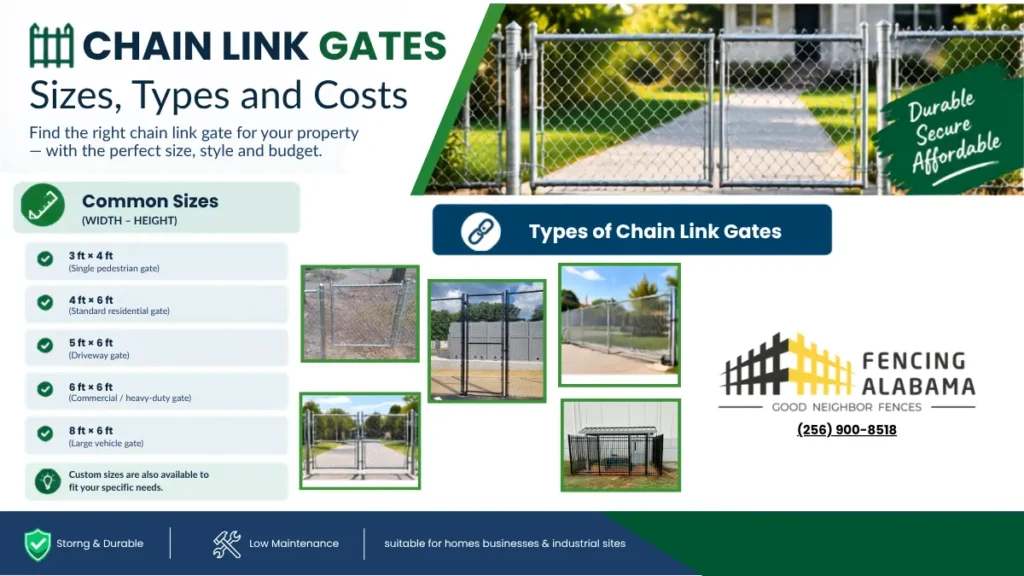
Standard residential chain link gate widths are 3 feet and 4 feet for walk gates, with heights of 4, 5, and 6 feet to match the fence. Those two widths cover most Huntsville and Madison backyards, and 4 feet is the width I recommend when a mower, a wheelbarrow, or a trash can has to get through.
Search data backs up how specific people get about this. “4ft x 6ft chain link gate” pulls around 590 searches a month nationally, “6ft x 12ft chain link gate” and “4ft x 12ft chain link gate” around 110 each, and “12 foot chain link swing gate” around 390. Homeowners are shopping by exact dimensions, which is a good instinct as long as you measure the opening and not the leaf.
| Gate type | Common width | Common height | Typical use |
| Single walk gate | 3 ft or 4 ft | 4 to 6 ft | Backyard access, side yard, trash cans |
| Wide walk gate | 5 ft or 6 ft | 4 to 6 ft | Mower, small trailer, riding mower |
| Double drive gate | 10, 12, 16 or 20 ft total | 4 to 6 ft | Driveway, side lot, boat or RV access |
| Rolling or cantilever gate | 12 to 30 ft | 6 ft and up | Commercial yards, shops, equipment lots |
| Farm and field gate | 10 to 16 ft | 4 to 5 ft | Pasture access, tractor and hay equipment |
Measure the opening between the gate posts, not the fence line and not the driveway apron. Order or build the leaf to fit that measurement with a hardware allowance, because a gate leaf that matches the opening exactly will not close once the hinges are on it.
Height matters more than people expect on a dog yard. A 4-foot gate is fine for a Lab that has never thought about jumping, and it is a suggestion for a husky. If the gate is holding a dog, match it to the fence height you chose for your dog and pet fence rather than saving forty dollars on a shorter leaf.
Single Swing, Double Drive, Rolling or Cantilever: Which Gate Type Do You Need?
Pick the gate type by opening width and by what is standing behind the gate. A single swing leaf is right up to about 6 feet, a double drive gate covers 10 to 20 feet, and a rolling or cantilever gate is the answer when you have the width but not the swing room.
A single swing gate hangs on one post and swings through an arc equal to its own width. At 4 feet wide, that arc is easy to live with. At 8 feet wide on one leaf, the gate becomes a lever: the same wind that rattles the fence puts real torque on the top hinge, and the post starts to lean.
A double drive gate splits a wide opening into two leaves, which halves the load on each post. A 12-foot driveway opening becomes two 6-foot leaves. The inactive leaf is held by a drop rod dropping into a ground sleeve, and that sleeve belongs in concrete. A drop rod jammed into bare dirt lasts until the first Alabama downpour fills the hole with clay.
A rolling gate rides on wheels along the ground or on a track, so it needs a clear, level run-back beside the opening roughly equal to the gate width. A 20-foot rolling gate needs about 20 feet of clear space to roll into, which rules it out on a lot of tight residential lots.
A cantilever gate hangs from rollers on posts and never touches the ground, which suits gravel yards, sloped approaches, and anywhere snow or mud would jam a wheel. It needs an overhang counterbalance of roughly 50 percent of the opening, so a 20-foot opening wants about 30 feet of total gate length and run-back. Cantilever slide gates are covered by ASTM F1184, and swing gates for commercial and industrial use by ASTM F900, which is worth naming when you compare commercial fencing bids.
If you already know you want the gate to open from your truck, read the type question alongside the opener question, because not every leaf suits automation. Our automatic and electric gate page covers the swing versus slide decision with the operator in mind.
How Much Does a Chain Link Gate Cost?
A residential chain link walk gate typically runs $150 to $350 installed, a double drive gate $400 to $900, and a commercial rolling or cantilever gate $1,200 to $3,500 or more depending on width and hardware. Those are installed ranges for this market, not catalog prices for a gate kit in a box.
| Gate | Typical installed range | Main cost driver |
| 4 ft walk gate | $150 to $350 | Frame size and latch type |
| 6 ft wide walk gate | $250 to $450 | Heavier frame, larger gate post |
| 10 to 12 ft double drive gate | $400 to $900 | Two leaves, drop rod, larger posts |
| 16 to 20 ft double drive gate | $700 to $1,400 | 2 7/8 in or 4 in. posts, deeper footings |
| Rolling or cantilever gate | $1,200 to $3,500+ | Track or cantilever hardware, concrete work |
| Automation added to a gate | Priced separately | Operator, power, safety loops |
Five things move a gate price up, and none of them are the mesh. Post diameter and footing depth come first, because a wider leaf needs a bigger post and more concrete. Frame gauge is second. Hardware grade is third, and the gap between a stamped residential latch and a heavy-duty hinge set is real money that pays back in years of not sagging.
Access is the fourth driver. If the truck cannot get near the gate line, the concrete, posts, and panels get carried, and carrying is labor. The fifth is ground condition. A driveway gate post going in beside an existing concrete apron sometimes means cutting and patching, which is a separate line on the quote.
A written quote for a gate should itemize the leaf size, the frame diameter, the post diameter, the hinge and latch model, the footing depth, and whether a drop rod and ground sleeve are included. When two bids on the same driveway differ by four hundred dollars, that list is where the difference is hiding. Our fence cost page walks through the same itemization for a full fence run.
Why Do Chain Link Gates Sag, and How Do I Stop It?
A chain link gate sags because the hinge post moved or the frame racked out of square, and in North Alabama the post moves first. Red clay swells when it takes on water and shrinks back in a dry stretch, and each cycle levers a shallow post a little further out of plumb until the latch stops lining up.
The diagnostic takes thirty seconds. Close the gate and look at the gap along the latch post: if the gap is wide at the top and tight at the bottom, the hinge post is leaning, and the post is your problem. If the gap is even but the corner of the frame droops, the frame itself has racked and needs a diagonal truss rod.
Set the hinge post deeper and wider than a line post, in concrete, and the problem mostly disappears. On a driveway gate, I want a footing sized to the leaf, not a one-size hole, because the hinge post on a 6-foot leaf is carrying a load a line post never sees. This is the same soil behavior that shows up in every leaning fence we repair around Toney and unincorporated Madison County.
Two habits keep a gate square for years. Grease the hinge pins once a year, which takes five minutes and stops the slow wear that turns a tight hinge into a wobbling one. And do not hang anything off the gate: a chain link leaf is a frame under tension, and a bag of feed hanging on the top rail is a lever with all day to do its work.
If a gate is already dragging and the post is loose, that is a repair rather than a replacement in most cases. We reset gate posts and rehang leaves as part of fence repair work across Huntsville and Madison.
What Latch and Lock Should I Put on a Chain Link Gate?
Match the latch to what the gate is holding back. A fork latch is fine on a boundary gate, a self-closing spring hinge with a gravity latch is the right call where children or a pool are involved, and a padlock hasp or keypad-ready hardware belongs on a commercial gate.
Pool gates are the one place where this is not a preference. The U.S. Consumer Product Safety Commission’s pool barrier guidelines (CPSC Publication 362) call for a pool gate to be self-closing and self-latching, to open outward away from the pool, and for the latch release to sit high enough that a small child cannot reach it. Pool barrier requirements are enforced locally and can vary by jurisdiction, so confirm what applies to your address before you build, and see our pool fencing page for how we handle those gates.
Dogs beat latches. A dog-proof latch, a latch mounted on the outside of the gate, or a simple spring-loaded carabiner through the fork stops the smart ones. Search volume around “chain link gate latch dog proof” is small but consistent, which tells you plenty of people learned this the hard way, usually at 6 a.m. in the rain.
For a gate that needs to lock, the hasp matters more than the padlock. A hasp bolted through the frame with carriage bolts and the nuts on the inside is not coming off with a wrench from the street side, which is the whole point.
How Long Does a Chain Link Gate Last in Alabama Weather?
A galvanized chain link gate frame typically lasts 20 years or more in North Alabama, and the hardware wears out long before the steel does. Humidity here works on the moving parts: hinges, latch springs, and the roller bearings on a rolling gate.
Black vinyl-coated mesh and frames hold up better where a gate sits in constant shade or takes runoff, because the coating adds a second barrier over the galvanizing. Shaded fence lines in Jones Valley and low spots that stay damp after a storm are where I see bare galvanized surface rust first.
Storm season is the real test for wide gates. A 16-foot double drive gate with privacy slats woven in becomes a sail, and wind load that a mesh gate shrugs off will push a slatted one hard enough to bend a hinge. If you want privacy and a wide gate, expect heavier posts and a heavier frame as part of the price.
Annual maintenance is genuinely small. Grease the hinges, check that the drop rod still drops cleanly into its sleeve, tighten the carriage bolts on the tension bands, and look at the latch alignment. Four things, once a year, and the gate outlives the fence around it.
Frequently Asked Questions
What is the standard size of a chain link gate?
The standard residential chain link walk gate is 3 or 4 feet wide, in a height matching the fence, most often 4, 5, or 6 feet. Double drive gates for driveways are commonly built at 10, 12, 16, or 20 feet total opening, split into two equal leaves. Measure the clear distance between your gate posts before ordering anything.
How much does a chain link gate cost installed?
A residential walk gate typically costs $150 to $350 installed, and a 10 to 12-foot double drive gate costs $400 to $900. Commercial rolling and cantilever gates start around $1,200 and climb with width and hardware. Post size, footing depth, and hinge grade drive the number more than the mesh does. We give a written, itemized price at the free on-site estimate.
Is a rolling gate better than a swing gate?
A rolling or cantilever gate is better where the opening is wide, the ground slopes in the swing direction, or there is no room for the gate to arc. A swing gate is simpler, cheaper, and right for openings up to about 12 feet on two leaves. Rolling gates need clear run-back space beside the opening, which most tight residential lots do not have.
Can I put a chain link gate in a wood fence?
Yes, and it is common on budget-conscious jobs where the driveway gate takes abuse. A chain link frame is lighter than a solid wood leaf of the same width and sags less over a wide opening. The two materials meet at a post, so the post sizing follows the chain link gate rules, not the wood fence rules.
Why will my chain link gate not close anymore?
The hinge post has usually shifted, which happens in North Alabama clay after repeated wet and dry cycles lever a shallow-set post out of plumb. Check the gap along the latch post: uneven top to bottom means the post moved, while an even gap with a drooping frame corner means the leaf racked and needs a truss rod.
Do I need a permit for a driveway gate in Madison County?
Whether a permit applies depends on your parcel, because requirements differ between property inside a city limit and property in unincorporated county, and an HOA review is a separate step from any permit. Confirm with the authority for your address before you build. We check both during the estimate.
I need a gate wide enough to get my riding mower and a small trailer into the backyard. What size should I go with?
A 6-foot single-leaf or a 10-foot double-drive gate. A standard riding mower clears a 4-foot gate, but a mower with a trailer needs turning room, and the tight turn through a 4-foot opening is how gate posts get hit.
Can I add a gate to a chain link fence that is already up?
Yes. The fence gets cut at the new opening, a gate post and a terminal post go in with concrete, the mesh is re-tensioned back to the new terminal post, and the leaf hangs on the gate post. It is a half-day job on most residential runs. The same question comes up for wood fences, and we cover retrofits on the gate installation page.
My driveway is on a slope, will a swing gate work?
Not well, if the ground rises in the direction the gate swings. A gate needs clearance under the leaf through its whole arc, and a rising driveway eats that clearance. On sloped lots around Big Cove and the Monte Sano side of Huntsville, a rolling or cantilever gate usually solves what a swing gate cannot.
How do I keep people from lifting the gate off its hinges?
Install the top hinge inverted so the pin points down, or add a hinge with a set screw. A gate with both pins pointing up lifts straight off, and anyone who has lost a gate that way only learns it once.
Get a Written Quote on Your Gate
If you are sizing a gate for a driveway in Huntsville, a side yard in Madison, or a pasture opening out toward New Market, I will come measure the opening, check the ground the posts have to go in, and leave you a written itemized price. No charge for the visit and no pressure at the end of it.
Call (256) 900-8518 or schedule a free on-site estimate. We are based in Guntersville and serve Huntsville and North Alabama, Monday through Saturday, 9:00 AM to 5:00 PM.
Fencing Alabama, 4741 Bakers Chapel Rd, Guntersville, AL 35976, (256) 900-8518