
Fence Repair or Replace, How to Decide
Short answer
Go outside and push on a fence post. Not the boards, the post, and push it low down where the wood meets the dirt. Then take a screwdriver and press the tip into that same spot. If the post holds firm and the screwdriver stops at the surface, you are looking at a repair. If the post rocks, or the screwdriver sinks in like the wood has turned to cork, that section needs rebuilding no matter how good the boards look from your kitchen window.
That one test settles about seven out of every ten estimates I walk. I own Fencing Alabama and I have been setting and pulling posts around Huntsville since 2019. The other three estimates take more thought, so let me show you how I work through them.
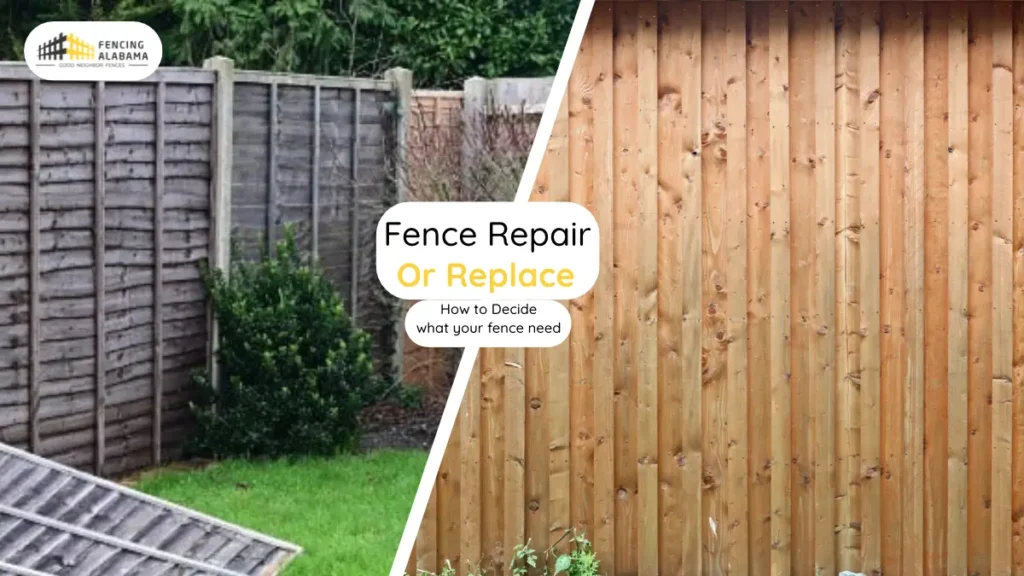
Posts decide this, boards do not
Homeowners judge a fence by its boards, and I understand why. Boards are the part you see. They go gray, they cup, they split along the grain, and a run of silver boards next to a neighbor’s new cedar looks like a fence that has given up.
Gray is a finish problem. A picket costs a few dollars and takes ten minutes to swap out.
The post is a different animal. It sits two feet or more down in concrete, it carries the weight of every panel hanging off it, and when it fails everything attached to it fails too. Replacing a single post means breaking out the old footing, digging, setting the new post plumb, pouring concrete and waiting on the cure before anything gets screwed back on. That is most of a day for one post.
So the real question was never how rough the fence looks. It is how many posts are still doing their job.
Posts rot at the ground line, where wet soil meets open air, and that strip of wood stays damp for weeks at a time in our climate. The part above ground looks fine. The part below ground looks fine. The inch and a half in between turns to pulp. I have pulled posts that looked perfect from six feet away and came out of the hole in two pieces.
The 60 second test, do this before you call anybody
You can run this yourself in less time than it takes to make coffee, and it will tell you more than any photo I could look at.
- Push four or five posts, not one: Grab each one at shoulder height and shove. Watch the base, not your hand. Rot is never uniform along a run, so one good post proves nothing.
- Press a screwdriver into the wood right at the soil line: More than a quarter inch of give means that post is compromised.
- Write down the ratio: How many posts moved, out of how many you tested. This number does the deciding later.
- Check the bottom rail on a few panels: Soft bottom rails across several panels usually mean the whole run has been sitting wet, not just one spot.
- Test the gate on its own: A sagging gate is its own problem and often a cheap one. Loose hinges, a missing brace or a shifted post will each do it, and the fix lives with the gate itself rather than the fence.
Now you have a ratio, and a ratio is something you can decide with. One bad post out of twelve is a repair. Four out of twelve means the other eight are on the same clock, because they went into the same ground on the same day, cut from the same bundle of lumber.
The math almost nobody runs
Here is where good people lose money. They compare two numbers, the repair quote and the replacement quote. The repair quote is smaller, so they take the repair. Eighteen months later they pay for another repair, and the cycle continues until the fence falls over anyway.
Divide each quote by the years it buys you. That is the only comparison worth making.
| What you pay | Years it buys | Cost per year | Verdict | |
| Scenario A Repair, 9 year old posts | $1,400 | 3 | $467 | |
| Scenario A Full replacement | $6,000 | 15 | $400 | Replace |
| Scenario B Repair, 4 year old posts | $600 | 8 | $75 | Repair |
| Scenario B Full replacement | $6,000 | 15 | $400 |
The figures above are an illustration of the method, not a price list. Use your own two written quotes and your own post ages. For local ranges, see what fencing costs here.
The years column is the part people guess at, so anchor it against something real. A new fence in this climate gives you twelve to fifteen years from treated pine and fifteen to twenty from cedar, as long as the posts went in deep and somebody is willing to seal it every two to three years.
A repair buys you whatever life is left in the posts standing on either side of it. If those posts are nine years old, you are buying three to six more years, not fifteen. Run that through the division and the cheap option stops looking cheap.
When repairing is the clear call
- One or two posts failed and the rest of the run passes the push test
- A storm took out a section while the posts either side stayed plumb
- The damage is boards, rails, mesh or hardware, with no post involvement
- The fence is under about seven years old
- The gate is the only thing misbehaving
- You are selling inside a year and need the inspection flag cleared
In every one of those cases, fence repair is the right spend and anybody telling you otherwise is selling you a fence you do not need yet.
When replacing is the clear call
- Roughly a third or more of the posts move when you push them
- You can rock any post with one hand
- You have paid for the same kind of repair twice already
- The fence is past twelve years and the bottom rails are going soft
- The original posts were set shallow or set in dirt instead of concrete
- You want a different height, a different style or a different material anyway
At that point replacing the whole run costs less over five years than patching it, and you stop losing a Saturday every spring to the same argument with the same post.
How to break a genuine tie
Sometimes the ratio lands right in the middle and the math comes out close. Four things usually tip it.
Matching: New wood next to ten year old wood looks exactly like what it is. The new boards will stand out for a season or two until they weather down, and staining both helps but will not erase the difference. If the repaired section faces the patio where you sit every evening, that matters more than it does on a back line nobody looks at.
Your timeline in the house: Selling within twelve months pushes hard toward repair. A buyer’s inspection flags a broken or leaning fence, a tidy repair clears the flag, and a full replacement rarely earns its cost back on a sale that soon.
Paperwork: A repair almost never triggers anything. A replacement can bring in permit rules in Madison County and, in a lot of neighborhoods out this way, an HOA approval step that takes a few weeks on its own. Factor the calendar, not just the quote.
What a rebuild lets you fix: A replacement is the only moment you get to change what failed in the first place. You can go cedar or treated pine on a different budget, set posts deeper, or put steel posts under wood panels so the rot problem never comes back. A repair can only restore what was there.
Storm damage changes the math, and your policy has opinions
Worth knowing before you call anyone. Your fence is not covered under the part of your policy that covers your house. It falls under Coverage B, other structures, which standard homeowners policies set at around ten percent of your dwelling limit. On a $350,000 dwelling limit that is $35,000 covering your fence, your shed, a detached garage and everything else standing loose on the property, combined.
Wind and fallen trees are the kind of sudden event Coverage B pays for. Rot is not. Age is not. Standard policies file those under wear and tear and exclude them, which is why the fence that finally gave up after twelve wet summers is your bill and nobody else’s.
So photograph everything before you move a single board, and get the written estimate before the cleanup. An adjuster cannot pay for damage that is already in a trailer heading to the dump.
What North Alabama does to a fence that the national guides skip
National cost guides average a fence in Phoenix with a fence in Portland and hand you a number. Our ground has its own opinion about that number.
Red clay holds water against a post, shrinks away from it through a dry August, then swells back around it in October. A post that went in plumb walks a degree at a time through that cycle, year after year, until the lean shows up all at once and you assume a storm did it. Add humidity that keeps wood damp for weeks and the rot starts exactly where you cannot inspect it.
Termites come next. Subterranean termites reach wood by traveling through soil, and Alabama’s own treatment rule requires breaking wood to ground contacts around a structure for exactly that reason. A fence post is a wood to ground contact by design. You cannot engineer it away, so the treatment in that post is the only thing standing between it and a colony.
Which brings up the detail that costs homeowners the most money and shows up on no estimate. The American Wood Protection Association rates lumber by where it is allowed to live. Ground contact lumber carries a UC4A rating, and fence posts are the textbook example. Above ground lumber carries UC3B, looks identical stacked at the store, and costs less. Put UC3B in a post hole and it fails years early.
If your fence started leaning at eight years old and nobody can explain why, the lumber grade is usually the explanation.
What I would do if it were my fence
Three posts or fewer moving out of a dozen, with the rest of the run solid, I repair it. Then I put the money I saved into sealing the whole fence so the good posts stay good.
A third of the posts moving, or any post I can rock with one hand, I replace the run. Patching a fence in that condition means buying the same repair twice and calling it savings.
Anywhere in between, I look at age. Past ten years in this climate, a repair is a stay of execution and you should treat it as one. Under ten years, it is usually money well spent.
And if you are standing in your yard right now not sure what you just felt when you pushed that post, that is a normal place to be. It is the reason I walk properties for free.
Get a straight answer on your fence. We check the posts first, give you the repair number and the replacement number side by side, and tell you which one we would spend. If you went looking for fence repair near me and ended up here, we handle fence repair across Huntsville, Madison, Athens, Decatur, Harvest, Hazel Green, Owens Cross Roads and Guntersville, usually within the same week.
Call (256) 900-8518 or book a free written estimate. No charge, no pressure, and we will tell you when the honest answer is to leave it alone for another year.
Common Questions
My fence is leaning after a storm but the boards look fine, do I need a whole new fence?
Probably not. Push the leaning post at the ground line. If that post is firm and the lean traces back to a snapped rail or a pulled bracket, you have a repair. If the post moves or a screwdriver sinks into it, the post failed and the wind only revealed it.
Is it cheaper to repair or replace a fence?
A repair is always cheaper today. Whether it is cheaper over time depends on your posts. Divide each quote by the years it realistically buys you. A repair that buys three more years can cost more per year than a replacement that lasts fifteen.
How much of a fence has to be damaged before replacing makes more sense?
Count failing posts, not damaged boards. One or two bad posts in a long run is a repair. Once about a third of the posts move when you push them, the rest are usually within a season or two of the same condition, and patching around them buys very little.
Will homeowners insurance pay to replace my old rotted fence?
Almost never. Fences sit under Coverage B, other structures, usually capped at about ten percent of your dwelling limit. That covers sudden events such as wind damage or a fallen tree. Rot and age are classed as wear and tear and excluded from standard policies. Check your own declarations page, since limits and endorsements vary.
Can you replace just a few fence panels without redoing the whole fence?
Yes, as long as the posts on either side of those panels are sound. The catch is cosmetic. New boards will not match weathered boards until they age down or get stained to match, and on a front facing run that gap is noticeable for a year or two.
How do I tell if my fence posts are rotted without digging them up?
Push the post hard at shoulder height and watch the base rather than your hand. Then press a screwdriver into the wood right at the soil line. More than a quarter inch of give means that post is compromised. Test four or five along the run, because rot almost never spreads evenly.
I am selling my house in six months, should I repair the fence or replace it?
Repair, in most cases. A buyer’s inspection flags a leaning or broken fence, and a clean repair clears that flag for a fraction of the cost. A full replacement rarely returns its price on a sale inside a year, and most buyers do not pay a premium for a new fence the way they do for a new roof.
My neighbor and I share the fence and only my side is rotting, who pays?
Posts and rails are shared structure, so a failed post affects both yards and the conversation is worth having before anyone books work. Alabama has no statewide rule splitting the cost, so it comes down to your agreement, your deed and any HOA covenant that governs the line. Most of the shared jobs we do get settled with a conversation and two signatures.