
Field Fence vs Barbed Wire vs High Tensile: Which Wire Fence Actually Holds in North Alabama
Short answer
Field fence contains every species and costs the most in posts. Barbed wire holds cattle on open acreage for the least money. High tensile smooth wire costs the least per foot of wire and needs the best corner bracing of the three. On most North Alabama properties I end up installing two of them, not one.
What decides it for your property:
- Field fence, sold as woven wire field fence, is the only one of the three that holds goats, sheep, hogs, and small calves because the mesh closes the gaps a strand fence leaves open.
- Barbed wire runs about $0.64 per linear foot in wire for a five-strand fence, based on a 1,320-foot roll of 12.5 gauge Class 1 at $169.99 at Tractor Supply in September 2026.
- High tensile smooth wire runs about $0.22 per linear foot in wire for five strands, and it lets line posts sit 24 to 48 feet apart on pasture instead of 10 to 12.
- Post count, not wire, is what moves a farm fence quote, and high tensile cuts the post count on a one-acre perimeter from roughly 70 down to 28.
- Alabama has no open range counties under Alabama Code Section 3-5-2, which puts the legal burden of containment on the livestock owner in every county in the state.
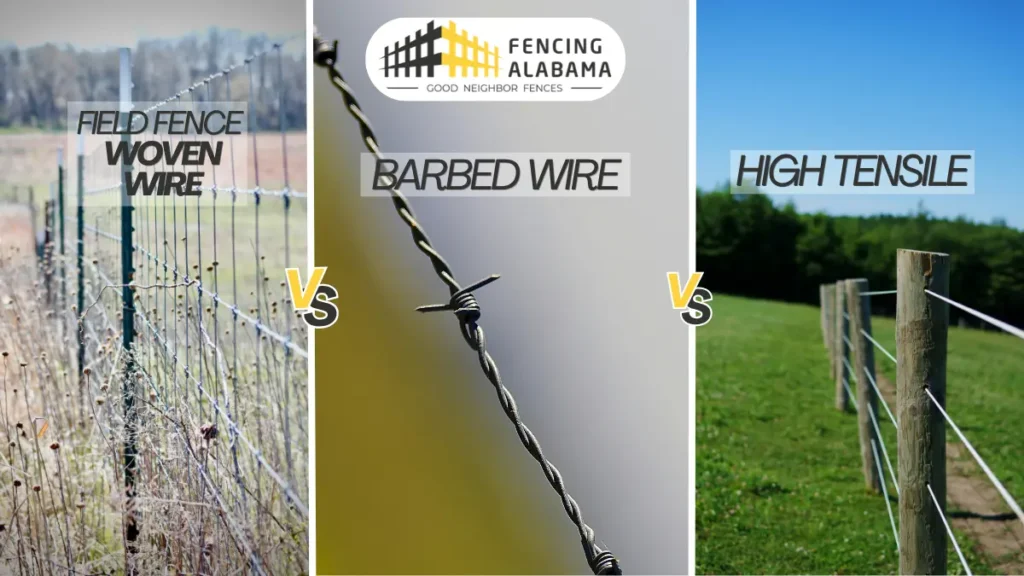
Field Fence vs Barbed Wire vs High Tensile Side by Side
Field fence, barbed wire, and high tensile smooth wire differ most in what they contain and in how far apart the posts go. The table below is the version I sketch on the back of an estimate sheet when a landowner asks me to just tell them the difference.
| Field fence (woven wire) | Barbed wire | High tensile smooth wire | |
| What it is | Horizontal and vertical wires joined into a mesh | 12.5 gauge twisted strands with 2- or 4-point barbs | Single smooth 12.5 gauge strands under 150 to 250 lbs tension |
| Holds | Cattle, horses, goats, sheep, hogs, dogs | Cattle and large stock | Cattle, horses, and goats when electrified |
| Line post spacing | 10 to 12 ft | 10 to 12 ft standard | 24 to 48 ft on pasture |
| Strands or height | 26 to 48 in tall, 6 or 12 in stays | 3 to 5 strands typical | 5 to 8 strands typical |
| Wire cost per foot | About $0.77 | About $0.64 at 5 strands | About $0.22 at 5 strands |
| Corner bracing | Standard H brace | Standard H brace | Heaviest of the three, 6 in. posts set 42 in. deep |
| Repair after a tree falls | Hardest, often a full panel | Easiest, splice and restretch | Easy, re-tension the run |
| Biggest weakness here | Hinge joints loosen as clay heaves | Sags every summer, unsafe for horses | Fails at the corner rather than the wire |
Post spacing figures for barbed wire and woven wire come from University of Georgia Extension publication C774, Fences for the Farm. High tensile spacing and tension figures come from the Kencove high tensile installation guide.
What a Field Fence Is, and What the Numbers on the Tag Mean
A field fence is woven wire: horizontal line wires held apart by vertical stay wires, sold in rolls and stretched between posts as a single mesh panel. Homeowners around Guntersville call it field fence, feed stores call it woven wire, and both names point at the same product. I use field fence throughout this article.
The number stamped on a field fence tag tells you everything about the roll before you unspool it. University of Georgia Extension publication C774 reads the designation 949-12-11 as nine horizontal wires, 49 inches high, 12-inch stay spacing, and 11-gauge stay and intermediate wires. Learn to read that, and you stop buying the wrong roll.
Field fence graduates its wire spacing from the bottom up, which is the part that matters for small livestock. UGA Extension C774 gives the range as 1.5 inches at the bottom for small animals out to 9 inches at the top for large ones. A goat gets through a 9-inch gap at the ankle and not through a 1.5-inch one.
Stay spacing on a field fence is either 6 inches or 12 inches, and the choice is about what you are keeping in. UGA Extension C774 puts 6-inch stays with small animals and 12-inch stays with large ones. The 330-foot, 39-inch roll of 12.5-gauge field fence at Tractor Supply carries 6-inch stays and 10-gauge top and bottom wires, listed at $254.99 in September 2026.
Field fence comes in two knot styles, and the knot decides how long the fence stays tight. A hinge joint knot, which is what most rolls sold as general-purpose field fence use, flexes under pressure and rides uneven ground better. A fixed knot locks every crossover, holds tension, and, per Kencove, reaches a 30 to 40 year service life with Class 3 galvanizing.
What Barbed Wire Is, and Why the Gauge and Barb Count Matter
Barbed wire is two smooth wires twisted together with sharp barbs crimped in at intervals, strung as separate strands rather than a mesh. A standard cattle fence uses three to five strands on line posts spaced 10 to 12 feet apart, per University of Georgia Extension publication C774. Barbed wire does not physically contain an animal. It teaches the animal to stay back, which works on cattle and fails on anything smaller.
Barb count changes what the fence does to an animal that tests it. Two-point barbed wire discourages contact, four-point barbed wire punishes it, and I specify two-point anywhere horses share a line. Tractor Supply listed 1,320 feet of 12.5 gauge two-point Class 1 at $169.99 and the four-point version at a similar price in September 2026.
A roll of barbed wire is sold in a unit that confuses first-time buyers. One roll is 1,320 feet, which is 80 rods and exactly a quarter mile. Multiply by your strand count before you order, because a five-strand fence around a single square acre needs slightly more than three full rolls.
Barbed wire has one build style most landowners here have never been offered, and it saves real money on long open runs. UGA Extension C774 describes a suspension fence as four to six strands with line posts 50 to 60 feet apart, stays every 10 to 12 feet, and each strand stretched so there is no more than 3 inches of sag between posts. The tradeoff is that a suspension fence needs flat, clear ground and disciplined tensioning.
Barbed wire is the wrong fence for horses, and I say so on site even when it costs me the job. University of Georgia Extension publication B1192, Fences for Horses, does not list barbed wire among its recommended horse fences at all, and recommends 12.5 gauge mesh with 2 inch by 4 inch openings as one of the safest options instead. A horse that runs a barbed wire line opens a vet bill, not a gate.
What High Tensile Smooth Wire Is, and Why Tension Does the Work
High tensile smooth wire is a single 12.5 gauge steel strand with no barbs and no mesh, drawn at 170,000 or 200,000 psi and held between end assemblies at 150 to 250 pounds of tension. Tension is what turns those strands into a fence, and that changes everything about how the system gets built.
The strength difference between high tensile and ordinary low carbon wire of the same thickness is the whole reason the system works. Per 50 Year Fence, a 12.5 gauge low carbon smooth strand breaks at roughly 500 pounds while a 12.5 gauge high tensile strand breaks at 1,500 to 1,600 pounds. Same diameter, same weight per foot, triple the load before it lets go.
Tension on a high tensile fence is set to a number, not to feel. The Kencove installation guide has the installer tighten until the first notch on the strainer shows 150 pounds and stop at the second notch, which is 250 pounds. A fence tightened by hand and eye either sags by August or snaps a strainer in January.
High tensile line posts sit far enough apart to change the economics of a pasture fence. The Kencove guide gives 48 feet for light pasture pressure, 40 to 36 feet for medium, and 30 to 24 feet for heavy, with poly spacers about every 10 feet in between. Compare that to the 10 to 12 feet a barbed wire fence needs, and the post savings are the point.
Everything high tensile saves in line posts, it spends at the ends and corners. The Kencove guide calls for end anchor and corner posts at least 8 feet long, generally 6 inches in diameter, buried at least 42 inches deep and set with a 2 to 3 inch preloaded lean. A high tensile run on an undersized corner is a very long, very expensive slingshot.
Bekaert lists 12.5 gauge 200,000 psi Class 3 high tensile smooth wire at $175 for a 4,000-foot coil as of September 2026. That is $0.04 per foot per strand, which is where the low wire cost in the table comes from.
How Far Apart the Posts Go for Each One
Post spacing separates these three fences more than the wire does. Field fence and barbed wire both want line posts 10 to 12 feet apart per University of Georgia Extension publication C774, while high tensile pasture fence runs 24 to 48 feet per the Kencove installation guide. That single difference reshapes the material list.
A square acre has a perimeter of about 835 feet, since an acre is 43,560 square feet and a square acre measures 208.7 feet on a side. At 12-foot spacing, that perimeter takes roughly 70 line posts. At 30-foot spacing, it takes roughly 28. High tensile removes about 60 percent of the posts from the same fence line.
Post spacing tightens on curves, and none of the three is exempt. UGA Extension C774 puts curved sections at 8 to 12 feet depending on how sharp the curve is. On the rolling ground between Guntersville and New Hope, a fence line that looks straight on a plat has three or four curves in it once you walk it. Slope adds the same problem vertically, and the way we handle grade on a panel fence is covered in our guide to fencing a sloped yard with racked or stepped panels.
Brace assembly spacing follows fence length rather than post spacing, and this is where most do-it-yourself farm fences go wrong. UGA Extension C774 calls for single span end construction up to 160 feet, double span end construction from 200 to 700 feet, and a brace line post assembly beyond 700 feet. A 900-foot run on a single H brace will pull that brace out of the ground.
What the Wire Actually Costs per Linear Foot
Wire is the cheapest part of all three fences, and the spread between them is smaller than most landowners expect. The figures below come from current listed prices at Tractor Supply and Bekaert in September 2026, divided by roll length, for wire only. No posts, no braces, no gates, no labor.
| System | Roll or coil | Listed price | Wire cost per linear foot |
| Field fence, 39 in, 6 in stays, 12.5 ga filler | 330 ft | $254.99 | $0.77 |
| Barbed wire, 12.5 ga Class 1, one strand | 1,320 ft | $169.99 | $0.13 |
| Barbed wire, five strands | 5 x 1,320 ft | $849.95 | $0.64 |
| High tensile, 12.5 ga 200k psi Class 3, one strand | 4,000 ft | $175.00 | $0.04 |
| High tensile, five strands | 5 x 4,000 ft | $875.00 | $0.22 |
Run those numbers around a single square acre, and the gap between the three narrows to pocket change. Wire for 835 feet works out to about $645 in field fence, $538 in five-strand barbed wire, and $183 in five-strand high tensile. Nobody makes or loses a farm fence budget on a $460 spread.
Galvanizing class costs a little more and buys real years, which is the one upgrade I push on every farm quote. UGA Extension C774 states that Class 3 galvanizing carries two to three times the zinc of Class 1 and can add 5 to 10 years of wire life in a humid climate like Georgia’s. North Alabama summers are the same humidity problem with a different state line.
Why Post Count, Not Wire, Decides Your Quote
Posts, corner assemblies, and labor are where a farm fence quote actually lives, and that is why the cheapest wire does not produce the cheapest fence. A barbed wire fence and a high tensile fence can carry nearly identical wire costs and differ by 42 posts on a single-acre perimeter. Every one of those posts is a hole, a post, concrete or tamped backfill, and crew time.
Terrain moves a farm fence quote more than material choice does on most North Alabama parcels. Rocky ground slows a post hole to a crawl, and a stream crossing needs its own bracing and a water gap before a single strand goes up. We walk the entire line during the estimate for exactly this reason, and we quote the property rather than a flat per-foot rate.
Gate openings carry a cost the linear footage never shows. Every gate needs two braced posts rather than two line posts, and equipment gates wide enough for a tractor and implement need heavier posts again. A 400-foot fence with four gates costs more than a 600-foot fence with one.
Corner count is the hidden line item on high tensile. A rectangular pasture has four corners, and a pasture that follows a creek can have eleven, and each one needs an 8-foot, 6-inch diameter post set 42 inches deep per the Kencove guide. High tensile stops being the cheap option on a parcel with a lot of direction changes.
How Each One Holds Up in North Alabama Red Clay and Humidity
North Alabama red clay swells when it takes on water and shrinks back in a dry spell, and that cycle works a fence post loose a little more every season. All three of these fences sit in the same soil, and all three are punished differently by it. This is the part generic farm fencing advice written for Iowa gets wrong for anyone in Marshall or Madison County.
Field fence loses its shape first when clay heaves, because a hinge joint knot slips under load rather than locking. Once the knots at the bottom of a run have walked sideways an inch or two, the graduated spacing at the bottom opens up and the mesh stops holding the small stock it was bought for. Fixed knot field fence resists this, which is the case for paying more for it here.
Barbed wire tells you about the clay by sagging, usually in the second or third summer after a wet spring. The strands did not stretch, the posts moved, and the fix is restretching rather than replacing. I would rather hand a landowner a sagging barbed wire fence than a sprung field fence panel, because one is an afternoon and the other is a material order.
High tensile handles clay movement better than either of the other two, as long as the end assemblies were built right. A tensioned strand just loses tension when a post shifts, and a strainer takes it back up in minutes. An undersized corner post in swelling clay leans, and a leaning corner drops every strand in the run at once.
Humidity does the slow damage nobody sees until year twelve. Galvanized coating is the only thing between fence wire and Alabama air, and the Class 3 upgrade UGA Extension C774 credits with 5 to 10 extra years costs a fraction of a reinstall.
Wood posts hold up better than steel T posts under heavy livestock pressure in North Alabama clay, which is why our farm fencing installation crews set wood at corners without being asked. Treated wood here runs on the same clock as a wood privacy fence, and the numbers behind that sit in our breakdown of how long a wood fence lasts in Alabama humidity.
Which Livestock Each Fence Holds
Livestock type rules out fences faster than budget does, so this is the question I ask first on a farm estimate. Cattle work with all three systems, horses need mesh or smooth wire, and goats need field fence or an electrified high tensile line. Picking wire before you name the animal is how properties end up refenced twice.
Cattle lean on a fence the way a teenager leans on a doorframe, constantly and without thinking about it. Three to five strands of barbed wire on posts 10 to 12 feet apart handles that per UGA Extension C774, and five to eight strands of electrified high tensile handles it for less money in wire. Field fence with a barbed top strand is the premium answer for a cattle line along a road.
Horses need 2-inch by 4-inch mesh at 12.5 gauge minimum and a perimeter fence at least 5 feet tall, per University of Georgia Extension publication B1192, Fences for Horses. Barbed wire does not appear in that publication’s recommended fences. Smooth high tensile with a top sight board or a poly top rail is the workable compromise on a horse pasture budget.
Goats and sheep go through or under a strand fence, and only field fence reliably stops them. A goat treats barbed wire as a suggestion. Field fence with 6-inch stays and 1.5-inch bottom spacing per UGA Extension C774 is the answer, and a hot wire six inches off the ground on the outside stops the digging.
Hogs push under rather than climb, so the bottom of the fence is the whole job. Field fence with tight bottom spacing, staked down or run with a bottom tension wire, holds them where a five-strand barbed fence does not. Dogs behave more like goats than cattle, which is why our dog fence installation uses mesh rather than strands.
Deer exclusion needs height; no farm fence in this comparison reaches on its own. A 47-inch field fence is a deer ramp. Landowners around New Market who want deer out of an orchard end up at an 8-foot fixed knot or a high tensile fence with offset outriggers, which is a different build and a different budget.
Which One Fails First, and How Hard It Is to Fix
Repair difficulty is the thing nobody asks about on the estimate, and everybody calls about in year six. Barbed wire is the easiest of the three to repair, high tensile is close behind, and field fence is the hardest by a wide margin. That ranking has decided more of my recommendations than cost ever has.
Every February I take the same phone call. A pine came down across a fence line in a storm, the landowner walks out with wire cutters and good intentions, and what they find depends entirely on which fence they bought. Barbed wire gets spliced and restretched before lunch, and field fence gets a new panel ordered.
Field fence fails as a panel because it is a panel, and a tree across a woven wire run deforms mesh that will not come back. The graduated bottom spacing that made the fence worth buying is exactly what a bent run loses. On a long field fence line, I tell landowners to expect panel replacement rather than repair, and to keep one spare roll in the barn.
Barbed wire fails one strand at a time, and that is its quiet advantage. A broken strand splices, a sagging strand restretches, and the other four keep working while you get to it. The tools cost under a hundred dollars, and most landowners here already own them.
High tensile fails at the end assembly, almost never in the middle of a run. A slipped strainer or a leaning corner post drops tension across every strand at once, which looks like a catastrophic failure and is usually a two-hour fix. The wire itself, at 1,500 to 1,600 pounds of breaking strength per 50 Year Fence, outlasts the hardware holding it.
Which One to Pick for Your Property
Fence choice comes down to the animal you are containing and how many corners the line has. Below are the three cases I see most often across Madison and Marshall counties, written the way I would say them standing on the property line.
When field fence is the right call
Field fence is the right call when small livestock are on the property or will be within five years. Goats, sheep, hogs, calves, and dogs all defeat strand fences, and refencing later costs more than building mesh once. Field fence is also right along a road frontage where a loose animal becomes a liability problem rather than an inconvenience.
Field fence suits short runs and irregular boundaries better than high tensile does. A 300-foot line with five direction changes needs bracing at every corner regardless of system, and field fence at 10 to 12 foot post spacing absorbs that without the heavy end assemblies tension demands.
When barbed wire is the right call
Barbed wire is the right call for cattle-only boundaries on open acreage where the budget is fixed, and the line is long. Five strands at $0.64 per foot in wire, on posts 10 to 12 feet apart, is the cheapest fence in this comparison that a cow respects. It is also the easiest for a landowner to maintain without specialty tools.
Barbed wire is the wrong call anywhere horses, goats, or children reach the fence. It is also the wrong call inside or near a city limit, where residential zoning commonly restricts barbed wire, and the rule depends on whether your parcel sits inside the municipal boundary or in unincorporated county. Confirm that with the authority for your address before you buy wire, because the answer changes by parcel and it changes over time.
When high tensile is the right call
High tensile is the right call on long, relatively straight pasture runs where post count is the dominant cost. Cutting a one-acre perimeter from 70 posts to 28 scales up fast across 40 acres, and the wire itself is the cheapest of the three at $0.22 per foot for five strands. Add electrification, and it holds cattle, horses, and goats.
High tensile is the wrong call for a landowner who will not maintain tension. The system depends on 150 to 250 pounds of tension per the Kencove installation guide, and a fence nobody re-tensions is a fence with slack strands in it. It is also the wrong call on a parcel with many corners, where the 6-inch, 42-inch deep-end assemblies stack up in cost.
Why Most North Alabama Properties End Up With Two of the Three
Most acreage I fence around Toney, New Market, and Big Cove ends up with two systems on the same property, because the property has two different jobs. A residential lot backing onto a working field needs one fence that keeps a dog in near the house and another that keeps something larger out at the field line. One fence rarely does both jobs well.
The usual answer is high-tensile or barbed wire on the field side and a field fence nearer the house. Wire on the long open run keeps the post count and the cost down, mesh near the house handles the dog and the kids, and the two meet at a braced corner. The split build is the pattern we run most often as the fence company in New Market landowners call for acreage work.
Cross fencing inside a pasture rarely needs the same fence as the perimeter. A perimeter that carries field fence with a barbed top strand can run interior paddock divisions in two strands of electrified high tensile at $0.09 per foot in wire. Spending perimeter money on interior lines is the most common overbuild I take out of other people’s plans.
Property lines that touch a neighbor’s fence deserve a conversation before a build. A shared line where the neighbor already has four strands of barbed wire and you need goat fence means you are building a second fence a few feet inside your line, not replacing theirs. That is a survey question and a courtesy call, and both are cheaper than a dispute.
What Alabama Law Expects Your Fence to Do
Alabama law puts the burden of containment on the livestock owner in every county in the state. Alabama Code Section 3-5-2 makes it unlawful for an owner to knowingly, voluntarily, negligently, or willfully permit livestock to run at large upon the premises of another or upon public lands, highways, roads, or streets. The same section states plainly that there shall be no open range counties in this state and that it applies to all counties.
That statute changes how I read a fence line. A fence that marks a boundary and a fence that contains an animal are two different builds, and only the second one satisfies what the law expects. Three sagging strands along a county road are a boundary marker and nothing more.
Alabama Code Section 3-5-3 attaches liability for damage done by animals running at large to the owner of the animal. Read that alongside Section 3-5-2, and the cheapest fence stops looking cheap on a parcel fronting a paved road. I point at the statute rather than at my price sheet when a landowner asks why I want a heavier build on the road side.
Local rules layer on top of state law, and they vary by parcel. Whether your address falls inside a city limit or in unincorporated county decides which set of requirements applies to fence height, material, and in some places barbed wire itself. The fence permit rules in Madison County work the same way, so confirm your parcel with the authority for your address before materials are ordered.
Questions Landowners Ask Me Before They Buy Wire
I have 12 acres in New Market with cattle on one side and a neighbor’s backyard on the other. What fence do I put where?
Run barbed wire or electrified high tensile along the open cattle line and a field fence along the boundary the neighbor sees and uses. The cattle line is long and needs to be cheap per foot, and the shared boundary needs mesh because dogs and children reach it. The two systems meet at a braced corner post, which is a standard detail on farm fence installation in this area.
Is field fence strong enough to hold cattle by itself, or do I need barbed wire on top?
Field fence holds cattle by itself, and a single barbed top strand makes it last longer. Cattle lean and reach over a fence, and a barbed strand at the top keeps their weight off the mesh so the hinge joints do not walk sideways. On a 47-inch field fence line with cattle, the top strand adds about $0.13 per linear foot in wire and buys years of shape.
How much does it cost to fence one acre with barbed wire compared to high tensile?
Wire for a square acre perimeter of about 835 feet runs roughly $538 in five-strand barbed wire and $183 in five-strand high tensile, using September 2026 listed prices at Tractor Supply and Bekaert. The real difference is posts, since barbed wire needs about 70 line posts at 12-foot spacing and high tensile needs about 28 at 30-foot spacing. Installed cost depends on terrain, clearing, and gate count, which is why we walk the line before quoting.
My barbed wire fence sags every summer. Will high tensile do the same thing?
High tensile slackens instead of sagging, and it takes tension back in minutes rather than needing a full restretch. Barbed wire sag in North Alabama is usually post movement in red clay rather than stretched wire, and high tensile responds to the same soil movement by losing tension at the strainer. Tightening back to the 150 to 250 pound range per the Kencove installation guide restores the whole run.
Can I run barbed wire on a property just outside Huntsville city limits?
Whether barbed wire is allowed depends on whether your parcel sits inside a municipal boundary or in unincorporated county, and residential zoning near a city limit commonly restricts it. Parts of Toney and Harvest sit in unincorporated Madison County and follow county rules rather than a city code. Confirm your specific parcel with the authority for your address before you order wire, because the requirement varies by location and changes over time.
Which of these three is safest for horses?
Field fence with 2-inch by 4-inch mesh at 12.5 gauge is the safest of the three for horses, per University of Georgia Extension publication B1192, Fences for Horses, which recommends mesh and a minimum perimeter height of 5 feet. Barbed wire does not appear among that publication’s recommended horse fences. Smooth high tensile with a visible top rail is the usual compromise when mesh for the whole perimeter is out of budget.
Get a Written Number for Your Fence Line
Farm fence quotes here are decided by the walk. Terrain, tree lines, stream crossings, corner count, and gate widths change a farm fencing number more than the choice between field fence, barbed wire, and high tensile does, and no honest per-foot rate survives a sloped pasture. We walk the full line with you, mark the corners, and put an itemized number in writing before anything is ordered.
Fencing Alabama has installed farm fence across North Alabama since 2019, from Guntersville out through Madison, Athens, Decatur, Toney, and New Market. Call (256) 900-8518 during business hours and you will get a callback the same day, or schedule a free on-site estimate and we will get out to walk your property line within the week.
Fencing Alabama
4741 Bakers Chapel Rd, Guntersville, AL 35976
(256) 900-8518
Monday to Saturday, 9:00 AM to 5:00 PM