
Aluminum vs Wrought Iron Fencing: Which One Actually Survives North Alabama?
Short answer
Aluminum wins for almost every yard I quote in the Huntsville metro, because aluminum contains no iron and cannot rust, while the "wrought iron" fence you are being quoted today is almost certainly mild steel that will. True wrought iron stopped being produced commercially when the last works in Bolton, England closed in 1973. Steel still wins on raw strength, and that matters for a handful of jobs.
The Short Version
- Modern “wrought iron” fencing is mild steel, usually hollow tube welded into panels and painted black. The Tampa Steel & Supply metallurgy write-up and every ornamental supplier I buy from say the same thing: the name survived, the metal did not.
- Aluminum cannot rust because there is no iron in the alloy. Steel can only resist rust as long as its coating is intact, and a rock chip at the base of a post is all it takes.
- Steel is about three times heavier than aluminum, since steel runs near 7.85 grams per cubic centimeter and aluminum near 2.70. That weight is why a steel fence takes bigger posts, more concrete, and more labor.
- Aluminum panels rack to follow a slope, which matters on the grades running up toward Monte Sano and Bailey Cove. Welded steel panels usually have to be stepped instead.
- For a pool barrier, aluminum is what I install nine times out of ten, because the finish survives chlorine splash and constant wet grass without a rust bloom at the bottom rail.
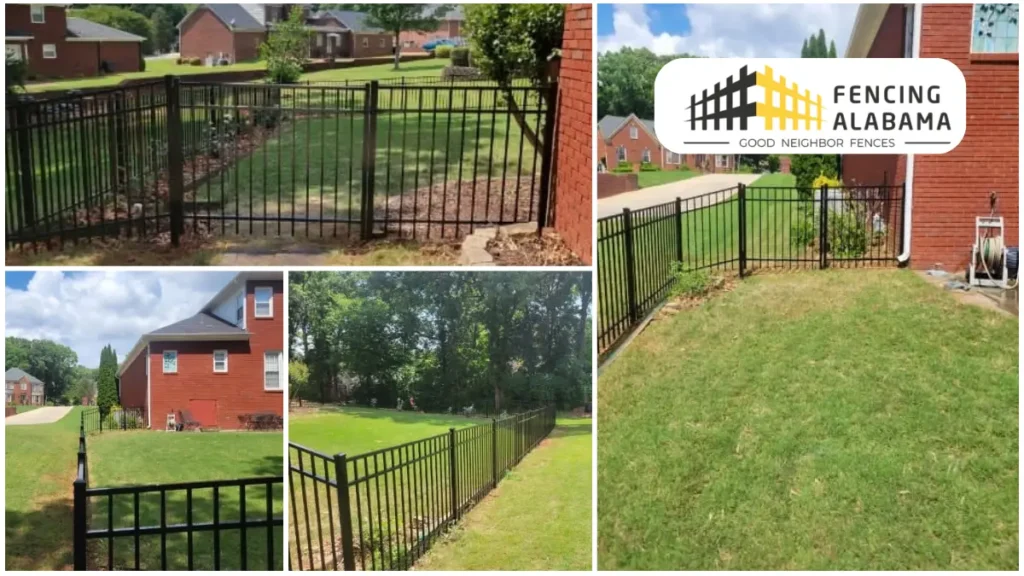
What People Actually Mean When They Say Wrought Iron?
Wrought iron is a low-carbon iron worked by hand while hot, with a fibrous slag structure running through it, and the last commercial plant producing it closed in Bolton, England in 1973. Anything sold as a wrought iron fence since then is mild steel, usually A36 or 1018, bent and welded by machine into pickets and rails, then painted or powder-coated black.
That is not a scam, and I am not trying to get anybody in trouble. The phrase “wrought iron” became a style name, the way people say Kleenex when they mean tissue. What matters is that you know the comparison in front of you is aluminum against steel, because steel and iron rust, and aluminum does not.
I get calls that start with a version of this: “I asked ChatGPT whether a wrought iron fence would rust in Alabama, and it said yes, so now I do not know what I am even shopping for.” That is a reasonable place to be confused. The fence in the brochure photo and the fence in the metallurgy textbook stopped being the same object fifty years ago.
One exception worth naming. If your house is a genuine Victorian with original ironwork, or you are restoring a cemetery fence or a French Quarter-style balcony rail, real wrought iron still exists through blacksmiths doing restoration work. That is a custom forge job with a lead time measured in months, not a fence company order.
What an Aluminum Fence Is Made Of?
An aluminum fence is built from extruded hollow aluminum pickets and rails, screwed or routed into posts, then finished with a baked powder coat rather than paint. The pickets are hollow, which is why an aluminum panel that looks identical to a steel one weighs so much less and can be carried to the backyard by one person instead of two.
Powder coat is the part most homeowners never ask about and should. The coating is applied as a dry powder and baked on, so it bonds to the aluminum instead of sitting on top of it the way brush paint sits on steel. A quality residential powder coat holds its color for years in Alabama sun, and when it finally chalks, it fades evenly rather than flaking off in sheets.
Aluminum also protects itself. Bare aluminum forms a thin aluminum oxide layer within seconds of meeting air, and that layer is what stops corrosion from going deeper. Steel does the opposite: iron oxide flakes away and exposes fresh metal underneath, which is why rust spreads rather than sealing.
Hardware is where a cheap aluminum install goes wrong. Steel screws in an aluminum rail set up a galvanic reaction in wet conditions, and the fastener corrodes and streaks the panel. We use stainless or coated hardware for that reason, and it is a fair question to ask any contractor who quotes you.
Why Rust Is the Entire Argument in Alabama Humidity?
North Alabama humidity keeps metal damp for long stretches of the summer, and a steel fence only resists that for as long as its coating holds. The failure point is almost never the middle of a picket. It is the six inches of post right at grade, where a string trimmer nicks the paint, mud splashes up, and water sits against bare steel after every afternoon storm.
Red clay makes that worse than it sounds. Clay holds water against a post long after sandy soil would have drained, and our clay swells wet and shrinks dry through the season. On a steel post that means a damp collar at the ground line for weeks at a time, which is exactly the condition rust needs.
Once rust starts under a painted steel surface, it keeps going sideways underneath the coating, which is why a steel fence that looks fine from the street can have a post you could put a screwdriver through. I have pulled steel posts in Hazel Green that were solid at eye level and hollow at the bottom.
Aluminum sidesteps all of it. There is no iron in the alloy, so a scratch in the powder coat on an aluminum picket is a cosmetic problem and stays a cosmetic problem. That is why we install far more aluminum fencing in Huntsville than ornamental steel, even for customers who called asking for iron.
Is Steel Stronger, and Does That Matter in a Backyard?
Steel is stronger than aluminum picket for picket, and for a few jobs that decides it. Ornamental steel resists a deliberate impact better, holds up to being leaned on by livestock or forklifts, and is harder to cut through, which is why most industrial perimeter fencing is steel rather than aluminum.
For a residential yard, that strength advantage rarely gets used. A 4-foot aluminum front-yard fence is not what stops a determined intruder in either metal, and neither one stops a truck. The honest comparison for a homeowner is not strength, it is what the fence looks like in year twelve.
Where I do steer people toward steel is a commercial site with real impact risk: a loading area, a fleet yard, a property where somebody backs a trailer into the fence line twice a year. For work like that, talk to us about commercial fencing before you pick a metal, because the gate and post spec matter more than the picket.
There is one strength argument that runs the other way. Aluminum bends and springs; steel dents and stays dented. A falling limb that puts a permanent kink in a steel panel will often leave an aluminum panel bowed but serviceable, and a single damaged aluminum section can be unbolted and swapped without cutting welds.
What Each One Costs
Installed, ornamental steel usually costs more than aluminum of the same height and style, because the panels weigh roughly three times as much, take heavier posts and more concrete, and often need on-site welding or cutting. Aluminum sits above wood and chain-link on price and below welded ornamental steel.
| Cost factor | Aluminum | Ornamental steel (“wrought iron”) |
| Panel weight and labor | Light, one person carries a panel, bolt-together installation | Roughly three times the weight, two-person handling, sometimes site welding |
| Post and concrete | Standard post size for the panel span | Larger posts and more concrete to carry the load |
| Finish | Baked powder coat included | Powder coat or paint, plus touch-up over time |
| Upkeep across ten years | Rinse it, replace a hinge or latch as needed | Sand, prime, and repaint affected sections, sooner near grade |
| Custom scrollwork | Limited to catalog styles and finials | Anything a fabricator can weld |
| Repair after damage | Unbolt and swap the damaged section | Cut, weld, and refinish |
Every number on your actual quote comes from your lot, not from a chart: gate count, corner count, slope, tree roots, access for a post hole auger, and how much old fence has to come out first. Our fence cost page walks through what moves a price up and down, and the on-site estimate is free and written.
Maintenance Across the First Ten Years
Aluminum maintenance in this climate is a garden hose and about twenty minutes once or twice a year, mostly to get pollen and grass clippings off the bottom rail. There is no sanding, no priming, no repainting, and no annual rust inspection.
Ornamental steel needs the paint watched, especially the bottom 12 inches of every post and the weld joints. The repaint job is the part people underestimate: existing paint has to be sanded back to sound material before new coating goes on, and doing that properly across 150 feet of fence is a weekend you will not get back.
A useful way to think about it: a steel ornamental fence is a maintenance relationship and an aluminum fence is not. Homeowners who enjoy that kind of upkeep exist, and their fences look incredible. Homeowners who told me they would definitely keep up with it and then did not also exist, and I have replaced some of their posts.
How Each One Handles a Sloped Yard
Aluminum panels rack, which means the pickets stay vertical while the rails pivot to follow a grade, and a rackable residential panel typically handles a gentle to moderate slope without any step at all. On the climbs toward Monte Sano and Bailey Cove that is the difference between a fence that follows the ground and one that leaves triangular gaps under every section.
Welded ornamental steel panels are usually rigid, so a slope gets handled by stepping the panels down the hill and leaving a gap under the high side of each one. That looks intentional on a formal front yard and looks like a dog escape route on a back yard, which is why I ask about pets before recommending either metal. Our Monte Sano fence page covers how we quote the steeper lots up there.
Steep ground also changes the quote itself. A sloped lot is measured and priced on the lot rather than at a flat per-foot rate, because the post count, the rack or step decision, and the equipment access all change once the grade goes past what a wheelbarrow likes.
Pool Fences: Where Aluminum Almost Always Wins
For a pool barrier, I install aluminum nearly every time, because the barrier sits in splash zone and wet grass permanently, and that is the worst possible service life for coated steel. The open picket design that pool codes want is also exactly what aluminum manufacturers build as a standard catalog product.
The model code that most jurisdictions start from is the International Swimming Pool and Spa Code. In the 2021 ISPSC, Section 305 sets a residential barrier at not less than 48 inches measured from the outside grade, limits openings so a 4-inch sphere cannot pass, and requires gates to swing away from the pool and be self-closing and self-latching.
What your building department has actually adopted and amended is a separate question, and it is the only one that counts on inspection day. Confirm the current barrier and gate requirements for your address with the authority that permits your pool before you buy a fence, then see our pool fence installation page for how we handle the gate hardware side.
Gate hardware is where pool fences fail inspection more than anything else I see. Self-closing hinges that do not pull the gate fully shut, a latch mounted at the wrong height, and a gap under the gate that exceeds the allowance are the three that get written up, and all three are fixable before the inspector shows up rather than after.
When Ornamental Steel Is the Right Call
Ornamental steel earns its place on three jobs: a historic property where the fence needs to match original ironwork, a security perimeter where impact and cut resistance matter, and a custom design with scrollwork no catalog carries. On those, the extra weight and the repainting are the price of getting the right thing.
Steel also makes sense when the fence is short. A 20-foot run of decorative fence flanking a front walk is a manageable repaint every few years, and the styling options in fabricated steel go places aluminum extrusion cannot follow.
If the job is a driveway entry, the metal matters less than the gate engineering: hinge post size, the concrete under it, and whether an operator is going on it later. That conversation belongs on our gate installation and automatic gate pages rather than in a material debate.
When Aluminum Is the Right Call
Aluminum is the right call for a front-yard boundary, a pool barrier, a back-yard fence where you want to keep the view, and any run long enough that repainting it would be a real project. In the Huntsville metro, that covers the large majority of the decorative metal fence work we do.
It is also the right call in HOA neighborhoods, and not only for looks. Many architectural review committees in this area specify black metal picket fencing by appearance rather than by alloy, and aluminum satisfies that description while ageing better than a painted steel panel that starts streaking rust in year six.
Whatever you choose, get the approval in hand before anybody digs. Boards here take anywhere from a few days to several weeks, and no contractor can speed that up, which is why we submit drawings and material specs early. Our guide to HOA fence approval in Huntsville subdivisions covers what the committees ask for.
Aluminum is the wrong call in exactly one common situation: when you want privacy. An aluminum picket fence has 3 to 4 inches of daylight between every picket by design, and no amount of money changes that. If the goal is blocking sightlines, you want a solid panel and a different hub entirely.
What to Check Before You Sign Either Quote
Read the quote for wall thickness and grade, not just for height and color. Residential aluminum lines vary in picket wall thickness and rail strength, and a thin economy grade and a heavy estate grade can look nearly identical in a brochure while behaving very differently when a kid climbs on the top rail.
- Ask which grade of aluminum panel is quoted, residential, commercial, or industrial, and what the picket wall thickness is.
- Ask whether the hardware is stainless or coated, because plain steel fasteners on aluminum corrode and streak the panels.
- Ask how posts are set: concrete on every post, depth suited to the soil, deeper holes on corner and gate posts.
- Ask whether an 811 utility locate is being called and the mark period waited out before digging, because that is required on every job in Alabama.
- Ask what the itemized quote shows: materials, labor, gate count, removal and haul-off of the old fence, and the finish warranty from the manufacturer.
If you want the same level of detail on other materials before you decide, our comparison of cedar or pressure treated wood for an Alabama fence and our page on vinyl fencing cover the non-metal options with the same honesty about tradeoffs.
One more box to tick before the build: permits and setbacks are set by whoever has jurisdiction over your parcel, and a Toney address and a Huntsville address do not follow the same rules. Our post on fence permit rules in Madison County explains how to work out which set applies to you.
Frequently Asked Questions
Will an aluminum fence rust in Alabama humidity?
No. Aluminum contains no iron, so it cannot form rust regardless of humidity, and the powder-coated finish is baked on rather than painted. A deep scratch on an aluminum picket stays cosmetic, while the same scratch on a steel picket starts corrosion that spreads under the coating. This is the main reason we install aluminum rather than ornamental steel across the Huntsville metro.
Is the wrought iron fence I am being quoted actually wrought iron?
Almost certainly not. Commercial wrought iron production ended when the last works closed in Bolton, England, in 1973, so modern ornamental fencing sold under that name is mild steel, typically hollow tube welded into panels and coated black. Genuine wrought iron today comes from blacksmiths doing restoration work, as a custom forge job with a long lead time.
How long does an aluminum fence last in North Alabama?
The aluminum itself does not have a corrosion clock on it, so the practical lifespan is set by the finish, the hardware, and the post-installation. Powder coat holds color for many years in the Alabama sun and fades gradually rather than flaking. Hinges and latches on a well-used gate are the parts most likely to need replacement first, usually long before any panel does.
Can an aluminum fence be used as a pool barrier?
Yes, and it is the material we install most often for pool barriers around Huntsville. Aluminum picket panels match what the 2021 International Swimming Pool and Spa Code describes in Section 305: a barrier at least 48 inches tall from outside grade, openings that block a 4-inch sphere, and self-closing, self-latching gates. Confirm the version your jurisdiction has adopted before ordering.
Which metal fence is cheaper, aluminum or wrought iron-style steel?
Aluminum is usually cheaper installed because a steel panel weighs roughly three times what an aluminum panel of the same size weighs, which drives up freight, labor, post size, and concrete volume. Steel then costs more again across the following decade in sanding and repainting. The gap on any specific job depends on gate count, slope, and how much old fence has to come out.
Does aluminum fencing work on a sloped yard?
Yes. Rackable aluminum panels let the rails pivot while the pickets stay vertical, so the fence follows a gentle or moderate grade without gaps underneath. Welded ornamental steel panels are rigid and get stepped down a slope instead, leaving a gap under the high side of each panel that a small dog will find within a week.
Get a Written Quote on Your Metal Fence
We install aluminum fencing and ornamental railing across Huntsville, Madison, Athens, Decatur, Harvest, Hazel Green, Meridianville, Moores Mill, New Hope, New Market, Owens Cross Roads, Toney and Guntersville, and we are based in Guntersville rather than pretending to be down the street from you. Call (256) 900-8518 and we call back the same day, or schedule a free on-site estimate and we will measure the run, talk through grades and gate hardware, and leave you an itemized written price.
Fencing Alabama, 4741 Bakers Chapel Rd, Guntersville, AL 35976. Monday to Saturday, 9:00 AM to 5:00 PM.