
Is a Vinyl Fence Worth It in Alabama Heat?
Short answer
Yes, for most North Alabama homeowners staying in the house ten years or longer. Alabama heat does not melt a vinyl fence. It makes the panels grow and shrink, roughly a quarter inch across a six-foot rail between a cold February morning and a sun-baked August afternoon, and whether that movement matters comes down entirely to how the fence was installed.
The short version
- Vinyl runs about $25 to $45 per linear foot installed in the Huntsville area, wood $22 to $45, so the up-front gap between vinyl and a good wood fence is narrower than most homeowners expect.
- Heat does not soften rigid PVC fence profiles at outdoor temperatures. Huntsville July highs sit near 89 degrees, and the all-time July record is 105, both far below the point where a fence-grade PVC profile loses shape.
- White and tan vinyl hold color because titanium dioxide is blended into the compound as a UV stabilizer, not painted on the surface.
- Wood in this climate needs staining every two to three years. Over twenty years, that is seven to ten stain cycles that vinyl never asks for.
- The failures blamed on Alabama heat are almost always installation faults: no expansion allowance at the rail joints or posts set too shallow in red clay.
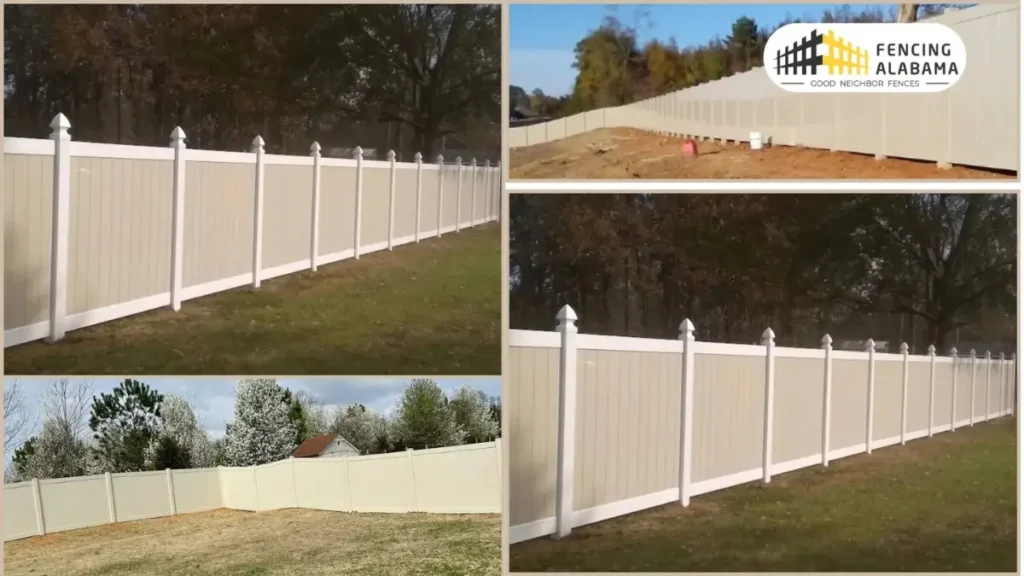
What Alabama Heat Actually Does to a Vinyl Fence
Alabama heat makes a vinyl fence expand lengthwise and then pull back in when the temperature drops. Rigid PVC used in exterior building profiles expands at roughly 3.5 millionths of an inch per inch per degree Fahrenheit, so a six-foot rail (72 inches) grows about a quarter of an inch across a 100-degree swing between a winter morning and a dark surface in full August sun. An eight-foot rail moves about a third of an inch.
That quarter inch is the whole story of vinyl in the South. It is a small number, and it is also more movement than a rigidly screwed joint can absorb. A vinyl fence built to swallow that movement is fine in Guntersville, Huntsville, and every hot yard in between. A vinyl fence built without room to move cracks at the fastener, and the homeowner blames the plastic.
Surface temperature matters more than air temperature on a vinyl fence. A white panel in direct sun stays close to the air temperature, while a dark tan or woodgrain panel on a south-facing run absorbs more solar energy and reaches a considerably higher surface temperature, which means more expansion in the same afternoon. Color choice is a heat decision in Alabama, not only a looks decision.
The heat does not weaken the material itself at these temperatures. Rigid PVC fence profiles are made to a published standard, ASTM F964, which sets requirements for material properties, extrusion quality, and weatherability for residential, commercial, and agricultural fencing. Panels made to that spec are not the thing that fails in an Alabama summer.
Does a Vinyl Fence Warp, Sag or Melt in Alabama Summers?
A vinyl fence does not melt in Alabama summers. Huntsville July high temperatures average around 89 degrees, and the July record for the area is 105 degrees, which is nowhere near the temperature at which a rigid PVC fence profile deforms. The homeowners who search some version of “will a vinyl fence melt or warp if it is over 90 degrees all summer where I live” are picturing the wrong failure.
Warping in a vinyl fence usually shows up in one of two places, and neither is caused by air temperature alone. The first is a panel bowing outward where a rail was fastened tight at both ends with no allowance for expansion. The second is heat reflected off a nearby surface, a west-facing brick wall, a metal building skin, or a low-E window that concentrates sunlight onto one spot of a panel and cooks a localized dish into it.
Sagging in vinyl is almost always a gate problem rather than a fence problem. A vinyl gate leaf carries its own weight on two hinges and a post, and if that gate post was not set deep enough or was not internally reinforced, the leaf drops and the latch stops meeting the catch by the second summer. Reinforced gate posts and a proper diagonal support inside the leaf are what keep a vinyl gate square. If a gate on an older vinyl run has already dropped, that is a fence repair job, not a reason to tear out the fence line.
Will a White Vinyl Fence Turn Yellow in the Alabama Sun?
A quality white vinyl fence does not turn yellow in the Alabama sun because the color is not on the surface. Titanium dioxide is blended into the PVC compound as a UV stabilizer and as the white pigment, so ultraviolet light hits a material that is protected all the way through the wall of the profile rather than a coat of paint sitting on top of it.
Cheap vinyl is a different product from fence-grade vinyl, and the Alabama sun finds the difference fast. Profiles made with thin walls and a low share of UV stabilizer chalk, yellow and fade unevenly within a few summers, which is exactly the outcome the skeptical homeowner has heard about from a neighbor. The fix is not avoiding vinyl; it is buying profiles made to ASTM F964 and reading the written warranty term before signing.
Ask for the manufacturer warranty in writing before the order is placed. Vinyl fence lines commonly carry limited warranties in the range of twenty years to lifetime against yellowing, cracking, and peeling, and the length and the exclusions differ between manufacturers. A warranty that is described verbally and never handed over is worth nothing in year twelve.
What Does Fade Look Like on a Vinyl Fence?
Fade on a vinyl fence appears as a chalky, slightly powdery film that dulls the gloss rather than as a change in color, and it shows first on the south and west faces that take the most direct Alabama sun. A wash with mild soap and water usually takes the chalk off in the early stages. Color-through fade that survives a wash is a material quality problem and is the kind of thing a manufacturer’s warranty is meant to cover.
Why Alabama Humidity Is Harder on Vinyl Than the Heat Is
Alabama humidity, not Alabama heat, is what makes a vinyl fence look tired. North Alabama runs humid from May through September, and any shaded, north-facing vinyl surface that stays damp will grow a thin green algae film and a scattering of dark mildew spots. The material underneath is unaffected. The fence just looks neglected.
Two washes a year keeps a vinyl fence in North Alabama looking new, one after pollen season in late spring and one before winter. A garden hose, a soft brush, and dish soap handle the green film on most panels. A pressure washer works if it stays on a wide fan tip at low pressure and well back from the panel, because a narrow tip held close will etch the surface and leave a permanent stripe.
The same humidity is the reason wood in this market carries a maintenance bill. A pressure-treated pine fence in North Alabama typically gives twelve to fifteen years, and cedar fifteen to twenty, and hitting those numbers depends on how the posts were set and whether the fence was ever sealed. We cover that in detail in how long a wood fence lasts in Alabama humidity.
What a Vinyl Fence Costs in Huntsville Compared to Wood
Vinyl fence installation in the Huntsville area typically runs about $25 to $45 per linear foot installed, against $22 to $45 for wood, $15 to $30 for chain link, and $30 to $60 for aluminum ornamental. Vinyl sits above pressure-treated pine and overlaps heavily with cedar, which surprises homeowners who assumed vinyl was in a price class of its own.
| Material | Installed cost per linear foot, Huntsville area | Maintenance in this climate | What the heat does to it |
| Chain link | $15 to $30 | Occasional rinse | Nothing. Galvanized coating handles sun and humidity. |
| Pressure-treated pine | $22 to $45 | Stain or seal every two to three years | Sun and humidity cycle the boards, causing gray, cup and warp. |
| Cedar | $22 to $45 (upper end) | Stain or seal every two to three years to hold color | Weathers to silver-gray if left unsealed, holds shape better than pine. |
| Vinyl | $25 to $45 | Wash twice a year | Expands and contracts. No rot, no repainting, no insect damage. |
| Aluminum ornamental | $30 to $60 | Essentially none | Powder-coated handles UV. Gets hot to the touch in direct sun. |
Height moves the vinyl number more than most homeowners expect. Going from a four-foot yard fence to a six-foot privacy run is more than a fifty percent material increase, because taller panels catch more wind and need heavier posts and deeper holes to carry that load. Full figures for every material sit on the fence cost page.
Slope changes the price on a vinyl job in a way it does not on wood. Vinyl panels are preassembled units, so a sloped lot on the rise toward Monte Sano or Bailey Cove gets stepped panels with taller posts rather than a panel racked on the fly, and that run is quoted on the actual lot rather than a flat per-foot rate.
The Twenty-Year Math on Vinyl Versus a Wood Fence
Over twenty years, a vinyl fence in North Alabama usually costs less in total than a wood fence that was actually maintained. Wood in this climate needs staining every two to three years, which is seven to ten stain cycles in twenty years, each one costing either a weekend of the homeowner’s time plus product or a contractor day rate. Vinyl asks for two washes a year and nothing else.
The comparison flips if the wood fence is never maintained, and that is the honest version nobody puts on a brochure. An unsealed pine fence in Alabama humidity still stands for years; it just goes gray, cups, and starts dropping pickets sooner. Homeowners who genuinely will not stain a fence should compare vinyl against a wood fence at its real service life, not the fifteen-year figure that assumes a sealing schedule they will not keep.
The break-even point lands around years eight to ten for most Huntsville and Madison yards. Before that, wood is cheaper in total dollars. After that, the stain cycles stack up, and vinyl pulls ahead and stays ahead. Anyone selling the house inside five years is buying vinyl for the look and the low upkeep, not for the money.
One more line item that rarely gets counted: a wood fence in this climate eventually needs post work. Red clay swells when it takes on water and shrinks back in a dry spell, and that cycle levers a shallow-set post loose a little more each season until the panel it carries starts to lean. A vinyl post set in concrete below the frost line resists the same cycle, but only because it was set that way.
How the Installation Decides Whether Alabama Heat Wins
Installation, not the panel, is what determines whether a vinyl fence survives twenty Alabama summers. ASTM publishes a separate practice, ASTM F1999, covering the installation of rigid PVC fence systems, which exists precisely because the material can be correct and the fence can still fail if it is assembled wrong. Four details do most of the work.
- Rails are routed through the post, not screwed to the face of it. A routed rail can slide a fraction of an inch inside the post pocket as the panel expands on a hot afternoon and slide back at night. A rail screwed rigidly at both ends has nowhere to go and cracks at the screw.
- The manufacturer’s expansion gap is left at every rail connection. That gap is the reason a quarter inch of summer growth on a six-foot rail is a non-event. Closing it up for a tighter look is the single most common way a vinyl fence gets ruined during installation.
- Posts go in concrete, below the frost line, with corner and gate posts set deeper than line posts. Corners and gates carry the load, and they are the two spots where a fence fails first in North Alabama red clay.
- Gate posts and gate leaves get internal reinforcement. A vinyl gate without a reinforced post and a proper internal brace will drop out of square, and a dropped gate is the complaint that gets blamed on the heat more often than anything else.
Every job also starts with an 811 utility locate. Alabama law requires the locate before digging, so the marks go in and the wait period runs out before a single post hole is opened. On a vinyl job that matters twice over, because post spacing on a vinyl fence is fixed by the panel length, and there is no shifting a hole eight inches to dodge a gas line the way there is on a wood fence.
Where a Vinyl Fence Is Genuinely the Right Call in North Alabama
Vinyl is the right call for a homeowner in an HOA subdivision who wants a privacy fence that looks the same in year fifteen as it did in year one. White and tan vinyl privacy panels read as finished from both sides, which matters where an architectural review committee has a rule about which way the finished face points. HOA committees in this metro run their own timelines and no contractor can shorten them, which we cover in HOA fence approval in Huntsville subdivisions.
Pool areas are the second strong case for vinyl in Alabama. Semi-privacy vinyl with spaced pickets or a lattice top blocks the sightline while still letting air move through a pool deck in August, and vinyl does not splinter under wet bare feet the way weathered wood does. Barrier height, gap, and self-latching gate requirements are set by code, so anything going around water has to be checked against the current requirements for your address before it is built. Our pool fence installation page covers the barrier side of it.
Vinyl also suits homeowners with a physical reason to avoid maintenance. A fence that needs a ladder, a sprayer, and a full weekend every second summer is a real obstacle for an older homeowner or anyone who travels for work out of Redstone Arsenal. Two hose-downs a year is a different commitment entirely.
Where Vinyl Is Not Worth the Money in Alabama
Vinyl is not worth the money on a long rural boundary. Fencing several hundred feet of a Toney or New Market property line in vinyl costs multiples of what a field fence or chain link costs for the same run, and vinyl brings no advantage against livestock or a tree line. Long agricultural runs belong in wire or chain link, with vinyl or wood kept for the fenced area nearer the house.
Vinyl is a poor fit on a heavily wooded lot with a falling-limb problem. A rigid panel takes a hard hit from a limb differently than a wood picket does: the wood board breaks and gets replaced for the price of a board, while a vinyl panel section cracks and has to be matched to an existing profile and color. Panels are replaceable, but the material and the color match are the constraints on an older fence.
Vinyl is also the wrong choice for anyone who wants a stained wood look. Vinyl comes in white, tan, gray, and printed woodgrain, and it cannot be painted or stained afterward without voiding the warranty and creating the exact peeling surface the material was chosen to avoid. Homeowners set on a dark stained cedar look should read cedar or pressure treated for an Alabama fence and price wood fence installation instead.
And vinyl is hard to justify on a short hold. A homeowner planning to sell a Madison or Harvest house inside three or four years is paying the vinyl premium and handing the twenty-year savings to the next owner. A well-built wood fence, sealed once, looks excellent at the closing table for less money.
Vinyl Against Wood and Aluminum in This Specific Climate
The three residential materials handle Alabama differently, and the deciding factor is usually privacy rather than climate. Vinyl gives full privacy with almost no upkeep, wood gives full privacy with a stain cycle, and aluminum gives no privacy at all but is the strongest performer on a sloped or difficult lot.
| Vinyl | Wood | Aluminum ornamental | |
| Privacy | Full, solid tongue-and-groove panels | Full, and boards can be cut to any height | None. Pickets are spaced by design. |
| Upkeep in Alabama | Wash twice a year | Stain or seal every two to three years | Essentially none |
| Reaction to heat | Expands and contracts, absorbed by routed rails and gaps | Cups, checks, and grays under the sun and humidity | Expands slightly, gets hot to the touch |
| Sloped Huntsville lots | Stepped, taller posts, panels stay rectangular | Racked or stepped, boards cut on site | Racks smoothly, follows the grade best |
| Storm damage repair | Replace the affected panel and match the profile | Replace individual boards cheaply | Replace the affected panel section |
| Best fit | HOA yards, pool areas, low-maintenance owners | Budget builds and anyone wanting a stained look | Front boundaries, views, steep grades |
Sloped lots deserve a second mention because North Alabama has plenty of them. The ground rises sharply toward Monte Sano and Bailey Cove, and a preassembled vinyl panel cannot be racked to follow a grade the way an aluminum fence panel can. On a steep run, vinyl gets stepped with taller posts, which is more posts, more concrete, and more labor than the same footage on flat ground in Madison.
Can a Vinyl Fence Be Repaired After an Alabama Storm?
A vinyl fence can be repaired panel by panel after a storm, as long as the posts on either side of the damaged section are still sound. Rails pull out of the routed post pockets, the broken panel comes out, and a matching panel drops in. There is no need to take down a whole fence line for one cracked section.
Wind load on a solid privacy panel is real, and a six-foot vinyl run on undersized posts will not hold through a bad North Alabama storm night. The panel itself is rarely what gives way. The post is. That is why post depth, hole diameter, and concrete volume on a six-foot vinyl privacy fence are not the same as on a four-foot picket run, even though the panels come from the same catalog.
The practical warning for an older vinyl fence: match the profile before the storm season, not after it. Manufacturers change profiles and discontinue colors, so a homeowner with a fifteen-year-old fence may find the exact panel is no longer made. Keeping one spare panel in the garage from the original order is the cheapest insurance in fencing.
Vinyl Fence Questions We Get Asked in North Alabama
Does a vinyl fence get too hot to touch in Alabama summer?
A white vinyl fence stays close to air temperature and is comfortable to touch even on a 95-degree Huntsville afternoon, because white reflects most of the solar energy hitting it. Dark tan, gray, and woodgrain panels absorb more and get noticeably warm on a south-facing run in full sun. Vinyl does not get hot the way a black aluminum or metal fence does.
How long does a vinyl fence last in Alabama?
A properly installed vinyl fence in North Alabama outlasts a pressure-treated pine fence, which typically lasts twelve to fifteen years here. Manufacturer-limited warranties on fence-grade vinyl commonly run twenty years or longer against yellowing and cracking. Service life depends far more on post setting and expansion allowance than on the number of hot summers the fence sees.
Is vinyl fencing more expensive than wood in Huntsville?
Per linear foot, vinyl runs about $25 to $45 installed in the Huntsville area, and wood about $22 to $45, so vinyl is more expensive than pressure-treated pine but overlaps with cedar. Over twenty years, wood adds seven to ten stain cycles at two- to three-year intervals, which is where vinyl closes the gap and then passes it.
Do HOAs in Huntsville subdivisions allow vinyl fences?
Many Huntsville-area subdivisions allow vinyl, and some specify it, but the architectural review committee sets the rule for your neighborhood on height, color and which way the finished side faces. Get written approval before any post goes in the ground. Build first, and the committee can require removal at your own cost.
Will a vinyl fence crack in a North Alabama winter?
Fence-grade vinyl handles North Alabama winters without cracking. Cracking that shows up in cold weather is almost always an installation fault: posts set above the frost line, or rail joints tightened with no expansion allowance, so the panel has nowhere to contract into when the temperature drops.
Can you paint or stain a vinyl fence to change the color?
Painting or staining a vinyl fence is a bad idea in Alabama. The color runs through the material rather than sitting on the surface, so paint has nothing to bond to, it peels under UV and heat, and it usually voids the manufacturer’s warranty. Pick the color at order time or choose wood if a custom stain color is the goal.
Get a Written Vinyl Fence Quote for Your Property
Fencing Alabama installs privacy, semi-privacy, and picket vinyl fencing across Huntsville, Madison, and the rest of North Alabama, working from Guntersville. We measure the run on site, walk the line with you, and hand you an itemized written price before anything is ordered.
Call (256) 900-8518 or schedule a free on-site estimate. Monday to Saturday, 9:00 AM to 5:00 PM.