
Stain vs Seal vs Paint for an Alabama Fence
Key points
- A pigmented stain carries the UV protection. Clear sealer alone lets Alabama sun gray the wood underneath while the water repellency is still working fine.
- Paint sits on the surface as a film, and any film on a fence eventually traps moisture at the board ends and peels from the back out.
- A new pressure-treated fence needs drying time before any finish goes on, while cedar is usually ready much sooner.
- In this climate, I plan on refinishing a stained fence every two to four years depending on how much afternoon sun the run takes.
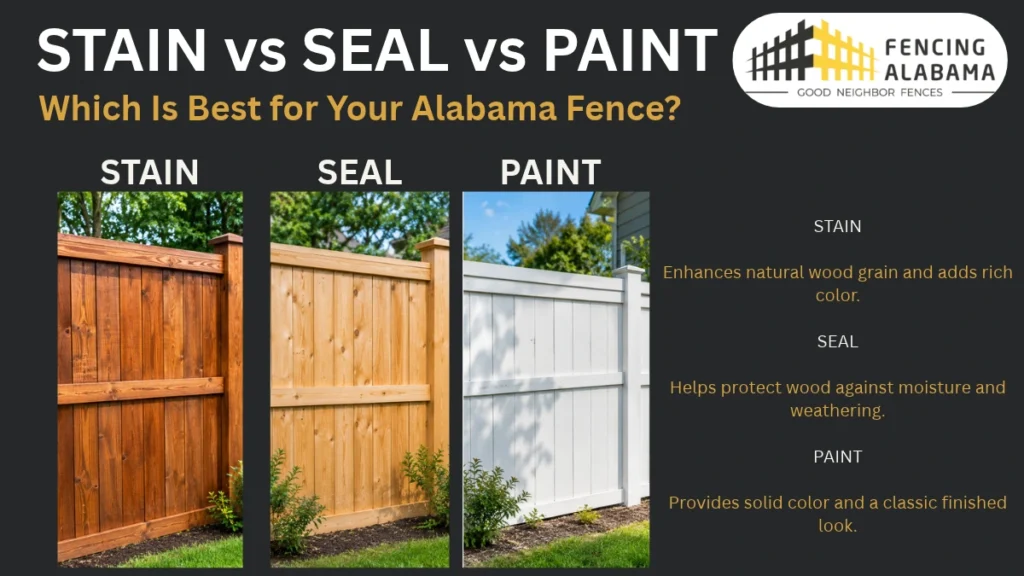
What Stain, Sealer and Paint Actually Do to Wood
Stain, sealer, and paint are three different products solving three different problems, and homeowners mix them up constantly because the cans sit on the same shelf at the hardware store. Here is the short version of each, in the order I’d rank them for a wood fence in Madison County.
Stain
A fence stain is pigmented oil or an oil-modified water-based finish that penetrates the top layer of the wood rather than sitting on it. The pigment is doing the real work. It absorbs the ultraviolet light that would otherwise break down the lignin in the surface fibers and turn a brand new pine fence that silver-gray color you see on every neglected run off Highway 72. Most fence stains sold for exterior wood include a water repellent in the same can, so a semi-transparent stain gives you sun protection and water protection together.
Stains come in three opacities. Clear carries no pigment and almost no UV defense. Semi-transparent carries enough pigment to block a good share of the UV while still showing the grain. Solid stain carries the most pigment and hides the grain almost completely, which puts it close to paint in appearance while still soaking in rather than forming a thick film.
Sealer
A fence sealer is a clear water repellent that keeps liquid water from soaking into the board. It does nothing about sunlight. A sealed fence sheds a rainstorm beautifully and still goes gray on schedule, because graying is a UV reaction, not a water reaction. I use clear sealer when a customer genuinely wants the natural cedar color and understands that the color is going to drift anyway.
Sealer is also the right answer on a fence where the wood is already weathered to a color the homeowner likes and they want to stop further checking and splitting without changing the look.
Paint
Exterior paint is a film. Latex paint lays a flexible plastic layer across the surface of the board, and that layer is only as good as its grip. On a fence, water gets behind that film from three places nobody paints: the end grain where the picket was cut, the back face if only one side was coated, and the bottom inch or two where the board sits closest to the splash zone. Once water is behind the film, Alabama heat drives it back out as vapor and the paint lifts.
That is the whole story of why painted fences fail here and painted houses mostly do not. A house has siding over a weather barrier, flashing, and an overhang. A fence is a board standing in the weather with both faces exposed and its end grain pointed at the sky.
Stain vs Seal vs Paint at a Glance
| Semi-transparent stain | Clear sealer | Exterior paint | |
| How it works | Soaks in, pigment blocks UV | Soaks in, repels water only | Forms a film on the surface |
| UV protection | Good | Very little | Excellent while intact |
| How it fails | Fades evenly | Wood grays, repellency drops | Peels, cracks, flakes |
| Typical refinish window in North Alabama | 2 to 4 years | 1 to 2 years | 3 to 5 years, then stripping |
| Shows the wood grain | Yes | Yes | No |
| Prep for the next coat | Wash and recoat | Wash and recoat | Scrape, sand, prime, repaint |
| Reversible later | Yes | Yes | Not realistically |
The last row is the one I’d read twice. Stain and sealer are decisions you can change your mind about in four years. Paint is close to permanent, because getting paint back off 180 linear feet of picket fence costs more in labor than the fence is worth.
Should You Stain or Paint a Fence in Alabama?
Stain a fence in Alabama unless you have a specific reason that only paint solves. The two reasons I accept are a white or bright color the homeowner has already matched to the house trim, and an HOA that has approved a painted finish for the neighborhood and will not approve a stain color. Outside of those, stain wins on lifespan, on maintenance cost, and on what happens in year six.
Here is the part that convinces most people. When a stained fence reaches the end of its finish, it looks faded. When a painted fence reaches the end of its finish, it looks broken. A faded fence gets washed and recoated in a weekend. A peeling fence needs every square inch scraped before anything new touches it, and the scraping is slow because a picket fence has edges and gaps and 400 board faces.
For a property that already has a painted fence in decent shape, I usually recommend staying with paint rather than trying to convert. Converting means stripping, and stripping wood that is already twelve years old often turns up rot nobody knew about.
How Long Each Finish Lasts on an Alabama Fence
A semi-transparent stain on a North Alabama fence holds its color for roughly two to four years, with the south-facing and west-facing runs always failing first. That spread is not vagueness. It is the actual difference between a run shaded by mature oaks in Hampton Cove and a run taking full afternoon sun across an open lot in Harvest.
Clear sealer needs renewing more often, usually every one to two years, because you have nothing visual telling you it is gone. The test I give homeowners is to flick a cup of water at the fence. If it beads, the repellent is still alive. If the board darkens where the water hit, it is time.
Paint on a properly prepped fence can hold three to five years before the first failures show, and it is almost never uniform. The gate stiles go first because they move. Then the bottom rail. Then the end grain on the picket tops.
None of these numbers help if the wood was never going to last anyway. Pressure-treated pine gives you about 12 to 15 years in this climate and cedar runs 15 to 20 or more, and the finish you pick is a smaller lever than how the posts were set. There is more on that in our article on how long a wood fence lasts in Alabama humidity
What Staining, Sealing or Painting a Fence Costs
Cost splits into material and labor, and the two move in opposite directions depending on which finish you choose.
On material, a gallon of exterior stain covers roughly 150 to 200 square feet on smooth, planed wood and drops to around 100 to 125 square feet on rough-sawn or weathered boards, because dry rough wood drinks. That coverage figure is printed on the can of every major brand and it assumes one coat. Measure both faces of your fence if you intend to do both faces, which you should.
On labor, paint is the expensive one and it is not close. Paint needs a clean surface, often a primer coat on bare wood, and a second finish coat. Stain on a clean fence is one coat applied wet and back-brushed, and a crew can move through a residential run quickly.
Spraying is faster than brushing by a wide margin and it is also how you end up with stain on a neighbor’s white vinyl siding. If you are hiring, ask whether they spray and back-brush or spray only. Back-brushing after the spray pass is what pushes the finish into the grain rather than leaving it sitting on top, and it is the difference between a three-year finish and an eighteen-month one.
For current pricing on fence staining in the Huntsville metro, we quote on the actual fence after measuring it, because a six-foot privacy run and a four-foot picket with 40 gate pickets are not the same job per linear foot.
Why I Stopped Recommending Paint on Privacy Fences
A few years back I walked a job in a Huntsville subdivision where the homeowner had painted a six-foot privacy fence a crisp white the summer it went up. Two summers later the street side still looked like a magazine photo. The yard side, the side nobody had painted because nobody can see it, had gone gray and started cupping. Water had been going in through the unpainted face, sitting under the painted face with nowhere to leave, and lifting the paint in long strips at the bottom of every third board.
That fence taught me the rule I have used since. If you paint a fence, paint every surface of every board, including the back, the edges, and the top and bottom end grain, and understand that you are signing up for scraping in year five. If you are not willing to coat the back face, do not paint the front face. A one-sided paint job on a fence is a slow moisture trap.
Stain does not punish you the same way, because a stained board that takes on moisture can release it back out through the finish. The board still breathes. That single property is why stain is the default on almost every wood fence we build.
When Clear Sealer Is the Right Call
Clear sealer makes sense on brand new cedar where the homeowner wants that reddish color on display for the first season, and on an older fence that has already weathered to a silver the homeowner has decided they like. In both cases the goal is water protection without changing the color.
What sealer will not do is stop the graying. A clear-sealed cedar fence in Madison will still shift toward gray over the first 18 months or so because UV is doing that, not rain. Homeowners who expect sealer to lock in the new-cedar look are usually disappointed by the following spring, so I say it plainly before the quote is signed.
If you want to hold a color, you need pigment, and that means a semi-transparent or solid stain. Our guide to choosing stain colors for cedar and pine covers how each one reads once it is on the wood rather than on the sample card.
The Best Time of Year to Stain a Fence in North Alabama
Spring and fall are the windows I aim for, because stain wants a surface temperature in a moderate range and a couple of dry days on both sides of the job. Most exterior stains list an application range on the label that rules out a July afternoon in Alabama when a south-facing fence face can be far hotter than the air temperature.
Staining in heat causes a specific failure. The surface flashes dry before the finish penetrates, so you get color sitting on the board rather than soaking in, and it wears off in patches the following year. Staining too close to rain is worse, because a shower on uncured stain leaves spots that will not buff out.
Check the forecast for 24 to 48 hours of dry weather after the job, and remember that North Alabama humidity extends drying time well past what the can assumes. A finish that says four hours to recoat in ideal conditions can want considerably longer in an August dew.
How Often to Restain or Reseal a Fence Here
Plan on two to four years between coats for a stained fence in this market, and inspect every spring rather than waiting for the fence to look bad. The water-flick test tells you where you stand in about ten seconds per section, and the fence will fail in sections rather than all at once.
The runs that need attention first are the ones facing south and west, the bottom 12 inches of every board where splash-back hits, and any section where a sprinkler head has been pointed at the fence for three years. That last one is the most common cause of premature failure I see, and it costs nothing to fix. Turn the head.
A gate deserves its own look each spring. Gates move, so the finish at the joints flexes, and a gate that gets dragged on a high spot wears through the finish at the bottom rail long before the rest of the fence does.
What I Do Before Any Finish Touches the Wood
Prep decides the outcome more than the product does. On a new fence we let pressure-treated lumber dry before anything goes on, because the treatment process leaves the wood wet and stain will not penetrate a saturated board. Cedar is drier out of the gate and usually accepts a finish much sooner. The timing question comes up on nearly every new install, so we covered it at length in when to stain a new wood fence .
On an existing fence the sequence is wash, dry, repair, then finish. Washing removes mildew and the loose gray surface fibers that a new coat would otherwise bond to instead of bonding to solid wood. Pressure washing works, but a wide fan tip held back from the board is the only safe way to do it, because a narrow tip held close will carve grooves into southern yellow pine fast enough to surprise you.
Repairs go in before the finish, not after. Replacing a cracked picket after the fence is stained means you have one bright new board in a run of finished ones, and matching it later never quite works.
Frequently Asked Questions
Is it better to stain or paint a wood fence in Alabama?
Stain is better for almost every wood fence in Alabama. Stain penetrates the board, blocks UV with pigment, and lets trapped moisture escape, so it fades rather than peeling. Paint forms a film that eventually lifts where water gets behind it, and removing failed paint from a fence costs far more in labor than recoating a faded stain does.
My fence is about a year old and turning gray. Did I wait too long to stain it?
A year of graying is normal and it is not too late. The gray layer is UV-damaged surface fiber, and a wash with a deck and fence cleaner followed by a thorough rinse removes most of it and brings the color back close to original. Let the wood dry fully, usually a couple of dry days, then apply a semi-transparent stain. Waiting several more years is where real problems begin, because checking and splitting start once the surface has broken down.
Can I put stain over a fence that was painted years ago?
No, not without removing the paint first. Stain works by soaking into wood, and a painted surface blocks it, so the stain sits on top and wipes away. Removing old paint from fence pickets means scraping, sanding, or chemical stripping across every face and edge, which is usually more expensive than the fence is worth. Repainting the existing fence or replacing it are the two practical options.
Do I need to seal my fence if I already stained it?
No, in most cases. Most exterior fence stains sold for this purpose already include a water repellent, so a separate sealer coat is unnecessary and can interfere with the stain. Read the label on the product you used. If it describes itself as a stain and sealer, or lists water repellency, you are covered. A pigment-free toner is the exception and does benefit from a sealer.
How soon after a new fence is installed should I stain it?
It depends on the wood. Cedar is generally dry enough to accept a finish within a few weeks. Pressure-treated pine holds treatment moisture and often needs considerably longer, and the way to know is the water test: sprinkle water on the board, and if it beads the wood is still too wet to accept stain, while if it absorbs within a minute the board is ready.
Is it worth paying someone to stain a fence or should I do it myself?
Doing it yourself is realistic on a short run with good access. The job turns against a homeowner on fences over about 150 linear feet, on sloped lots, on tall privacy fences where both faces need coating, and anywhere overspray could reach a neighbor’s siding, car, or landscaping. The labor is the cost either way. The question is whether you want to spend two weekends on it.
Get a Written Quote on Staining Your Fence
We build and finish fences across the Huntsville metro from our shop in Guntersville, and staining is work we do on fences we installed and on fences somebody else built. If you want a straight answer about whether your fence should be stained, sealed, or left alone for another season, call us and we will come look at it.
Call (256) 900-8518 or schedule a free on-site estimate . We measure the fence, write an itemized quote, and nothing gets ordered until you have seen it in writing.