
Swing vs Sliding Gate: Which One Fits Your Driveway?
Short answer
A swing gate is the right call on a flat driveway with open space behind the gate line, and a sliding gate is the right call when the drive rises, bends, or runs short of room for a leaf to arc open. Space and grade decide this, not looks.
The Short Version
The choice between a swing gate and a sliding gate comes down to four measurements I take on every estimate: the width of the opening, the slope of the first twenty feet of driveway, the clear run of ground beside the gate line, and how far back the gate sits from the road.
| Factor | Swing gate | Sliding gate |
| Room needed | Clear arc inside the property equal to the leaf length | Clear flat run beside the opening, roughly 1.5 times the opening width for a cantilever |
| Sloped driveway | Binds or drags once the grade rises | Handles a rising drive because the gate never travels over it |
| Install cost | Lower, fewer parts in the ground | Higher, track or cantilever rail plus a longer foundation |
| Storm wind | More load on the hinge post with a solid panel | Load spreads across rollers and posts |
| Daily speed | Opens in roughly 10 to 15 seconds per leaf | Slower on a long opening, faster on a short one |
| Maintenance | Hinges, posts, and the opener arm | Track clearing, rollers, and the drive chain or rack |
What most Huntsville homeowners end up with
- A flat suburban driveway with a 12 to 16 foot opening almost always gets a dual swing gate, because the arc fits and the hardware count stays low.
- A driveway that climbs toward the house, which is common off Bailey Cove and on the Monte Sano side, usually gets a sliding gate because a swinging leaf would catch the rising grade.
- A cantilever sliding gate needs clear level ground beside the opening of about one and a half times the opening width, so a 16 foot opening wants roughly 24 feet of run.
- North Alabama red clay moves enough through a wet winter to lift a ground track, which is why I set cantilever gates rather than V track on residential clay wherever the budget allows.
- Both gate types have to meet the same entrapment protection rules under UL 325 and ASTM F2200, so safety is not a reason to pick one over the other.
What a Swing Gate and a Sliding Gate Actually Are
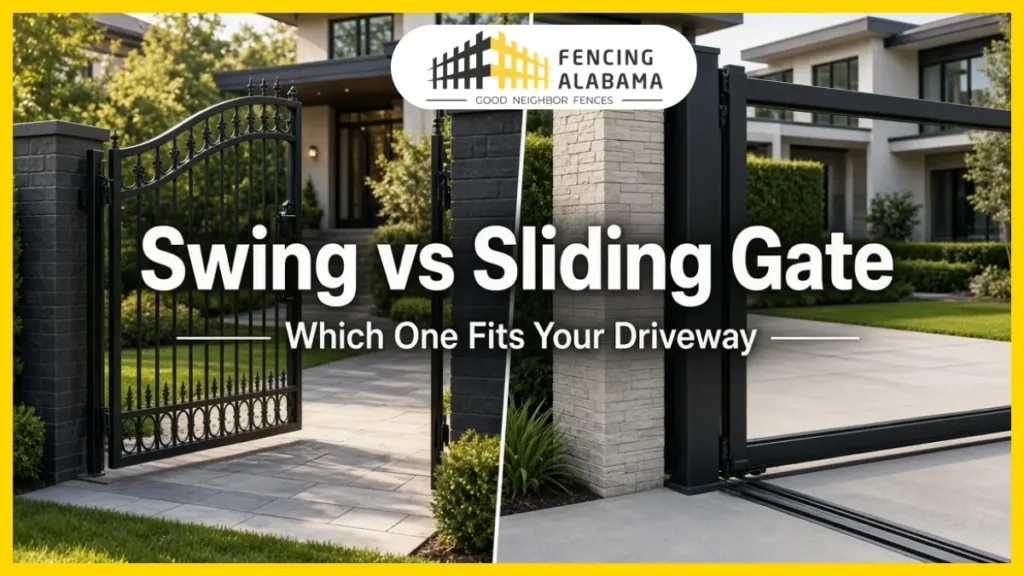
A swing gate is a hinged gate that pivots on a post and opens in an arc, the same way a door does. A sliding gate is a gate that travels sideways along the fence line, either rolling on a ground track or hanging from a cantilever rail that keeps it off the ground entirely.
A swing gate comes as a single leaf or a dual leaf. A single 14 foot leaf is one long panel on one hinge post, and a dual gate splits the same opening into two 7 foot leaves that meet in the middle. I lean toward dual on anything over about 10 feet, because a shorter leaf puts less twisting force on the hinge post and the gate stays square for years longer.
A sliding gate comes in two builds that behave very differently. A V track gate rolls on steel wheels that sit in a track set into the driveway apron, and a cantilever gate hangs from rollers mounted on posts, with a counterbalance tail that extends past the opening. The cantilever never touches the ground, which matters more in North Alabama than almost anywhere else, and I will get to why in a minute.
How Much Room Does a Swing Gate Need to Open?
A swing gate needs a clear arc inside the property equal to the length of each leaf, measured from the hinge post. A dual swing gate on a 16 foot opening has two 8 foot leaves, so each one sweeps an 8 foot quarter circle into the driveway. Nothing can sit in that arc: no mailbox post, no retaining wall, no parked truck, no azalea you are fond of.
The arc is also the reason a swing gate fails on a short driveway. If your gate sits 12 feet off the road and you pull in with a full size pickup, the nose of the truck has to stop clear of the swing path while the gate opens inward. On a drive that shallow, the back bumper is still sitting in the road. I have watched that exact standoff play out more than once, and the homeowner always says the same thing, which is that nobody mentioned it.
A swing gate can be built to open outward toward the road, and I almost never do it. An outward gate puts a moving leaf into a public right of way, most HOA boards reject it on sight, and a vehicle rolling up to the gate has to reverse to let it open. Outward swing has a place on a long rural drive with a wide shoulder, and almost nowhere else in a Huntsville subdivision.
Why a Sliding Gate Needs a Backdrop as Long as the Gate Itself
A sliding gate needs clear level ground beside the opening for the gate to park in when it is open, and that run is longer than most people expect. A V track gate needs a backdrop roughly equal to the opening width. A cantilever gate needs more, roughly one and a half times the opening, because the counterbalance tail that holds the gate up has to travel too.
Run the numbers on a real driveway. A 16 foot opening with a cantilever gate needs about 24 feet of clear, level ground running parallel to the fence line on one side. If there is a flower bed, a slope, a propane tank, or a neighbor’s property line sitting at 18 feet, the cantilever gate does not fit and the conversation moves back to swing.
The backdrop also has to be reasonably level. A sliding gate travels in a straight horizontal line, so if the ground beside the opening falls away by a foot over that 24 foot run, the gap under the open gate grows into something a dog walks through without breaking stride. I measure that fall with a laser on every slide gate estimate, because eyeballing it is how installers end up regrading someone’s yard for free.
Does Your Driveway Slope Decide the Answer?
Driveway slope is the single factor that most often settles a swing versus sliding gate decision, and it settles it in favor of sliding. A swing gate opens by sweeping a leaf across the driveway surface, so the ground under that arc has to be flat or falling away. If the drive rises toward the house, the bottom rail of the gate runs into the grade partway through the swing and stops.
There are two workarounds for a rising drive, and both cost something. Rising hinges lift the leaf as it opens, which buys a few inches of clearance and adds strain to the hinge post. Cutting the bottom of the gate on an angle to follow the grade buys clearance too, and leaves a wedge shaped gap under the closed gate that a determined dog treats as an invitation.
A sliding gate sidesteps the slope entirely because the gate never travels over the driveway. It moves across the fence line beside the drive. The ground it travels over has to be level, but the driveway itself can climb as steeply as it likes. On the hillier parcels around Monte Sano and Big Cove, that difference decides the job before we talk about anything else.
What North Alabama Red Clay Does to a Sliding Gate Track
Red clay swells when it takes on water through a wet North Alabama winter and shrinks back through a dry summer, and that cycle moves anything set shallow in it. A V track sliding gate puts a steel track directly on or into the ground across the driveway opening, which means the track rides every bit of that movement. A track that lifts by half an inch turns a smooth gate into one that binds, jumps, and eventually strips the drive gear in the opener.
This is the piece most national gate articles leave out, and it is the reason my recommendation here differs from theirs. On clay, I set a cantilever gate where the budget and the backdrop allow, because the gate hangs from posts set deep in concrete and never touches the ground. When the soil moves, the posts move together with the gate rather than against it.
A V track gate still has a place here, mostly on a concrete apron poured specifically for it, where the slab spreads the load and the track sits on something that moves as one piece. What I avoid is a bare track set into compacted clay on a residential drive. It works for two seasons and then it does not, and the homeowner thinks the opener failed when the ground is the actual culprit.
Both gate types depend on post depth more than on anything else in the build. A gate post carries a cantilevered load every second of its life, which is different from a fence post that only holds a panel up. Deeper holes and concrete on every post are not an upsell on a gate, they are the gate.
Which Gate Holds Up Better in Alabama Storm Wind
A sliding gate handles storm wind better than a swing gate of the same size and infill, because the wind load spreads across a rail and multiple rollers rather than concentrating on a single hinge post. A swing gate transfers everything the wind pushes into one point, and that point is the top hinge.
Infill matters more than gate type though. A solid privacy panel on a 14 foot leaf is a sail, and a spring line coming through at 50 miles an hour finds every weak hinge in the neighborhood. The same gate built with spaced aluminum pickets lets the air through and barely registers the gust. If you want a solid faced gate on an exposed lot, the answer is heavier posts and a dual leaf rather than a single, not a lighter gate.
After a bad night of weather, the repair calls I get on gates follow a pattern worth knowing. Swing gates fail at the hinge or the post. Sliding gates fail when debris packs the track or a limb bends the rail. A gate that is dragging, clicking, or reversing on its own after a storm is telling you something, and it is cheaper to look at it that week than after the next front.
Swing vs Sliding Gate Cost: Where the Money Actually Goes
A sliding gate costs more to install than a swing gate of the same width and material, and the gap comes from the ground work rather than the gate panel. A swing gate needs two posts and an opener arm. A cantilever sliding gate needs a longer post run, deeper footings, a rail and roller assembly, and a counterbalance section of gate that you pay for but never see in the opening.
These are the line items that move a gate quote in either direction, and an honest written quote should show each one separately rather than rolling them into a single number:
- Opening width, since every extra foot adds panel, and on a cantilever adds counterbalance tail too.
- Infill type, because spaced aluminum picket, solid wood, and composite panel sit at very different price points per foot.
- Post depth and concrete volume, which rise on clay and rise again on a slope.
- Opener class and horsepower, which is driven by gate weight and how many cycles a day it runs.
- Power supply, meaning a trench and conduit from the house or a solar setup at the gate.
- Safety devices, including photo eyes on both sides of the travel path and edge sensors where they are required.
- Access hardware, from a simple keypad up to phone entry and a separate exit loop buried in the driveway.
I give a real number only after I have stood on the driveway, because the two biggest cost drivers on a gate are invisible from a photo: what the soil does when we dig, and where the nearest power is. Anyone quoting an automatic gate over the phone is quoting a guess. Our own installed pricing for both gate types is covered on the automatic gate cost article linked below.
How Fast Each Gate Opens and Why Daily Traffic Matters
A dual swing gate on a residential opening typically clears in 10 to 15 seconds per leaf, and a sliding gate on the same opening often runs a little slower because it has more distance to cover. The difference sounds trivial until you multiply it by a household that comes and goes eight times a day through a rainy February.
Cycle count is the number that actually drives the opener spec. A gate at the end of a quiet rural drive might run four cycles a day. A gate on a household with three drivers and a teenager with a job runs closer to twenty, and that gate needs a heavier duty operator with a better duty cycle rating or the motor burns through its service life in a few years.
Tell your installer the honest traffic number rather than the flattering one. Undersizing an opener is the most common way a good gate build turns into a warranty argument eighteen months later.
Openers, Power and What Happens in a Power Cut
Swing gates and sliding gates use different operators. A swing gate runs on a linear arm, an articulated arm, or an underground operator, and each leaf needs its own. A sliding gate runs on a single operator that drives a chain or a toothed rack along the bottom of the gate, which is one motor rather than two.
Every automatic gate needs a manual release, and you need to know where yours is before you need it. A power cut with a vehicle inside the fence and no release key within reach is a bad evening. I walk the release with every customer at handover and leave the key somewhere that is not inside the car that is stuck behind the gate.
Battery backup is worth the line item on both gate types. Most residential operators accept a backup battery that carries a reasonable number of cycles through an outage, which in a metro that loses power to spring storms every year is money well spent. The choice between running power out from the house and going solar at the gate is its own decision, and I have covered the tradeoffs in the solar versus hardwired article in this hub.
The Safety Rules Both Gate Types Have to Meet
Every automatic gate installed in the United States falls under UL 325, the safety standard for gate operators, and ASTM F2200, the standard that covers how the gate itself is built. Neither standard favors swing gates or sliding gates. Both require entrapment protection so the gate stops or reverses when something is in its path, and both require the gate to be built so a person cannot be caught in a moving part.
In practice that means photo eyes covering the travel path, an operator set to reverse on obstruction, and on a sliding gate, screening or spacing that keeps fingers out of the rollers and the rack. A sliding gate that runs past an open picket fence also needs the gap between the moving gate and the fixed fence handled, because that pinch point is exactly where the standard focuses.
An installer who does not raise any of this with you is a reason to get another quote. Gate entrapment injuries involve children more often than adults, and the hardware that prevents them costs a small fraction of the gate.
Maintenance: What Each Gate Asks of You
A swing gate asks very little: check the hinge bolts once a year, watch for the leaf starting to drop at the latch end, and keep the opener arm clear. A gate that has begun to sag at the free end is telling you the hinge post has moved, and that is a post problem rather than a gate problem.
A sliding gate asks for more attention in exchange for the clearance it gives you on a slope. Keep the track or rail clear of gravel, leaves, and the mulch that washes down after a storm, because a single stone in a V track is enough to stop a gate mid travel. Roller bearings want a look once a year, and the chain or rack wants to stay clean.
Mark one weekend a year as gate day and both of these take under an hour. Skip it for four years and the repair is a service call with parts.
When I Recommend a Swing Gate
I recommend a swing gate when the driveway is flat or falls away from the house, the opening sits well back from the road, and there is clear arc space inside the property. That describes most suburban lots in Madison, Harvest, and the flatter parts of Huntsville, and on those jobs a dual swing gate is the better value by a clear margin.
A swing gate also wins on appearance for a lot of homeowners, because a pair of leaves meeting in the middle of a driveway reads as traditional and sits comfortably in front of a brick house. It is the lower maintenance option, the lower cost option, and on the right lot there is no engineering reason to pay more.
When I Recommend a Sliding Gate
I recommend a sliding gate when the driveway climbs toward the house, when the gate has to sit close to the road, or when there is simply no arc space because of a wall, a bank, or a turning circle. On a rising drive, a sliding gate is not the preferred option so much as the only one that works properly over time.
A sliding gate is also the better answer on a narrow lot where the swing arc would eat the only place to park a second vehicle, and on rural parcels around Toney and New Market where the gate sits at a field edge and the drive is longer than the sight line. The requirement to check first is always the backdrop: without the clear run beside the opening, a sliding gate is off the table no matter how well it suits the slope.
What to Confirm Before You Order Either Gate
Three things need checking before a gate is ordered, and all three catch people out. The first is who sets the rules for your property, because a parcel inside the Huntsville or Madison city limit follows a municipal code and a parcel in unincorporated Madison County follows county rules, and the thresholds are not the same. Confirm with the authority for your address rather than relying on what a neighbor built.
The second is your HOA. A large share of this metro sits under an architectural review board, and a board can rule on gate height, material, color, and sometimes on whether a gate is allowed at the street line at all. Boards here take anywhere from a few days to several weeks, and no contractor can speed that up. I prepare the drawing and spec and submit early rather than waiting for the build slot.
The third is utilities. An automatic gate means digging post holes and usually a trench for power, so an 811 locate goes in on every job and we wait out the mark period before anything breaks ground. Cutting a buried line on your own property is your bill, which is a conversation nobody enjoys having twice.
Frequently Asked Questions
My driveway slopes uphill from the road and I want an automatic gate. Which type should I be looking at?
A sliding gate is almost always the answer on an uphill driveway. A swing gate has to sweep its leaf across the rising surface, so it binds against the grade partway through the opening. A sliding gate travels across the fence line beside the drive and never crosses the slope at all. The thing to check is whether you have a level run of ground beside the opening, roughly one and a half times the opening width for a cantilever gate.
Is a sliding gate worth the extra cost over a swing gate, or am I paying for the look?
You are paying for ground work rather than looks. A sliding gate costs more because it needs a longer post run, deeper footings, a rail and roller assembly, and a counterbalance section of gate that sits outside the opening. On a flat driveway with arc space, that spend buys you nothing a swing gate does not already do. On a sloped or short driveway, it buys you a gate that works.
How much space do I actually need behind the gate for a swing gate to open?
A swing gate needs a clear arc equal to the length of each leaf. A dual gate on a 16 foot opening has two 8 foot leaves, so each one needs an 8 foot quarter circle of clear ground inside the property. Nothing can sit in that path, including parked vehicles, raised beds, and retaining walls. If your gate sits closer than about 20 feet from the road, measure where a pickup will have to wait while the gate opens.
Will a sliding gate work in Alabama clay or will the track shift on me?
A ground track in bare clay will shift. North Alabama red clay swells with winter rain and shrinks back in summer, and a V track set into compacted clay moves with it until the gate binds. The fix is either a cantilever gate, which hangs from posts set deep in concrete and never touches the ground, or a V track installed on a concrete apron poured for it so the whole assembly moves as one piece.
What happens to my automatic gate when the power goes out and my car is inside the fence?
Every automatic gate has a manual release that disengages the operator so you can move the gate by hand. Find yours and keep the key somewhere that is not inside the vehicle parked behind the gate. A backup battery is the better answer in a metro that loses power to spring storms, and most residential operators accept one as an add on at install.
Which gate is safer around children, a swing gate or a sliding gate?
Neither type is inherently safer, because both have to meet the same requirements under UL 325 and ASTM F2200 for entrapment protection. What makes a gate safe is the hardware and the setup: photo eyes covering the travel path, an operator that reverses on obstruction, and on a sliding gate, proper handling of the pinch point where the moving gate passes the fixed fence. An installer who does not bring this up unprompted is worth a second opinion.
Do I need a permit or HOA approval for an automatic driveway gate in Huntsville?
It depends on whether your parcel sits inside a city limit or in unincorporated county, and the requirements change, so confirm with the authority for your address before you order anything. HOA approval is the more common holdup in this metro. Architectural review boards here rule on height, material, and placement, and they take from a few days to several weeks. Submit the drawing early.
Get a Written Quote for Your Driveway
The honest way to settle a swing versus sliding gate question is to stand on the driveway with a tape measure and a laser level, which is what I do on every automatic gate estimate. I measure the opening, the arc space, the backdrop run, and the grade, then tell you which gate fits and what it costs in writing before anything is ordered.
Fencing Alabama has installed fences and gates across the Huntsville metro since 2019, from Guntersville out to Madison, Athens, Harvest, Toney, and New Market. Call (256) 900-8518 or book a free on site estimate and I will walk your driveway with you.