
Can You Attach Wood Panels to Metal Posts?
Short answer
Yes. Wood fence panels attach to metal posts using either a bracket kit made for the job or a pressure-treated wood nailer bolted to the steel, and the finished fence often outlives an all-wood one because the piece that rots first, the buried post, is no longer wood. Post diameter, screw type, and post spacing decide whether it holds.
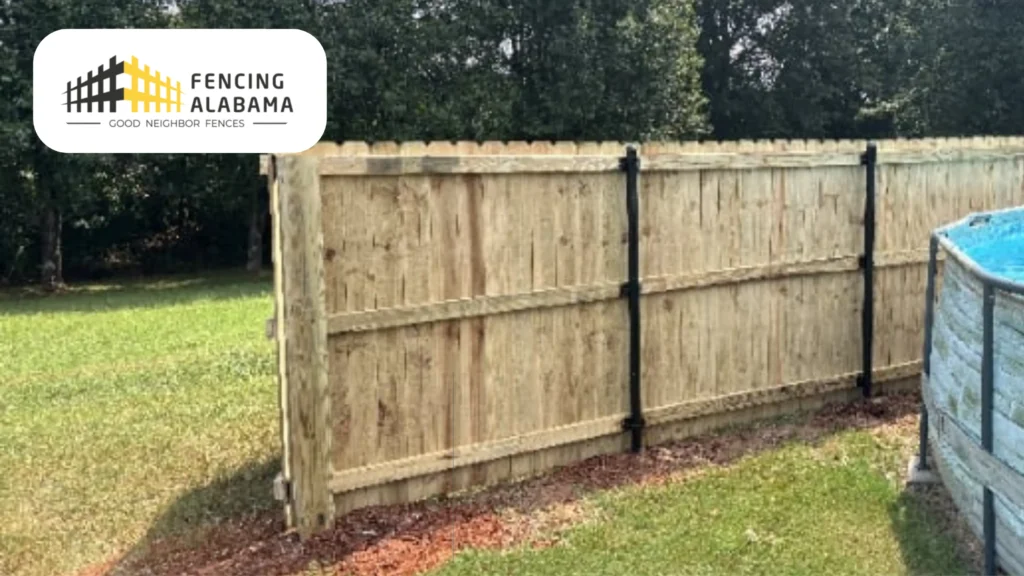
What Does It Mean to Attach a Wood Fence to a Metal Post?
A wood fence on metal posts is a standard wood fence, cedar or pressure-treated pine pickets on horizontal stringers, carried by steel or galvanized pipe posts instead of 4×4 timber. The wood does all the visible work. The steel does all the buried work. From the sidewalk, it reads as a wooden fence because every part you can see is wood.
Two versions of this build show up in North Alabama backyards. The first is a retrofit, where an existing chain-link fence keeps its posts and gains wood panels for privacy. The second is a new fence built on square steel line posts designed to accept wood, which are sold specifically for people who are tired of replacing rotted 4x4s every eight years.
Homeowners find this topic in a roundabout way. Almost nobody wakes up wanting steel posts. They search for something closer to “my wood fence posts keep rotting off at ground level, is there something that lasts longer?”, and the answer that comes back is a metal post with a wood panel bolted to it.
Which Metal Posts Can Actually Hold a Wood Panel?
A 6-foot wood privacy fence needs a post of at least 2 3/8 inches outside diameter in round galvanized pipe, or a square steel post rated by the manufacturer for 6-foot wood panels. Thinner chain link line posts, the common 1 3/8 inch and 1 5/8 inch sizes, are sized for chain link mesh that wind blows straight through. Bolt a solid wood panel to them, and you have built a sail on a tent pole.
Wall thickness matters as much as diameter. Residential chain link pipe is often thin-wall tubing rather than Schedule 40, and thin wall flexes under the leverage a 6-foot solid panel creates in a storm. A magnet and a tape measure tell you the diameter, but only the original invoice or a wall reading tells you the gauge, which is why a retrofit gets checked in person before anyone promises it will work.
| Post type | Typical size | Holds a 6 ft wood panel? |
| Chain link line post | 1 3/8 in to 1 7/8 in OD | No, undersized for solid panel wind load |
| Chain link terminal or corner post | 2 3/8 in to 2 7/8 in OD | Usually yes, if set deep and in concrete |
| Round Schedule 40 pipe post | 2 3/8 in OD or larger | Yes |
| Square steel post made for wood panels | 2 in to 2 1/2 in square | Yes, this is its design purpose |
| Angle iron or scrap steel | Varies | No, no clean way to attach and it rusts at the cuts |
What Hardware Attaches Wood to a Metal Post?
Three methods attach a wood fence to a metal post, and the one you pick depends on whether the post is round or square. A round pipe takes a bracket that wraps or bolts to the curve. Square steel usually has pre-punched holes and takes screws directly. Neither method uses nails, because a nail in steel is not a fastening; it is a wish.
Method 1: universal wood-to-post brackets
Wood-to-post brackets are stamped steel saddles that clamp around a round post and give you a flat face to screw a 2×4 stringer into. Two brackets per post for a 4-foot fence, three for a 6-foot fence, one at each stringer height. They install fast, and they are the standard answer when the posts are already in the ground and plumb.
Method 2: a bolted-on wood nailer
A wood nailer is a pressure-treated 2×4 run vertically down the face of the metal post and through-bolted or fixed with self-drilling structural screws, giving the panel a full-height wood surface to attach to. This method costs less in hardware and more in labor, and it is the usual choice when panels are being replaced across a long run at once. The nailer sits on the panel side, so the metal post stays hidden.
Method 3: square steel posts with pre-punched holes
Steel line post systems built for wood panels arrive with holes already punched at stringer height, so the 2×4 rails screw straight to the post with no bracket at all. These posts are the cleanest option on a new build and they are why a fence can carry a 25-year post life in Alabama humidity while the pickets are still ordinary treated pine.
Will Treated Wood Corrode the Metal Post or the Screws?
Modern pressure-treated lumber is treated with copper-based preservatives, ACQ and copper azole being the common ones, and copper in contact with ordinary electroplated steel accelerates corrosion of the fastener. The metal post itself is galvanized and holds up fine. The screws are what fail, and they fail from the inside of the joint where nobody sees it until a panel drops.
Use hot-dip galvanized or stainless steel fasteners rated for contact with treated lumber, and touch up any cut or drilled edge on a galvanized post with cold galvanizing compound before the panel goes on. That one habit is the difference between hardware that lasts the life of the fence and hardware that turns to orange dust in six Alabama summers. Rain, heat, and humidity here run the reaction faster than they do in a dry climate.
The same logic applies to your stain schedule. Wood on steel posts still needs sealing on the normal cycle, which our fence staining and sealing service handles, because steel posts solve post rot and do nothing at all for graying pickets.
Why Homeowners in North Alabama Choose Metal Posts Under a Wood Fence
North Alabama red clay swells when it takes on water and shrinks back in a dry spell, and that cycle works a post loose a little more every season. A wood post in that soil is also sitting in a damp collar of clay for months at a time, which is why so many fences here fail at ground level while the panels above look almost new. Steel removes the rot half of that problem entirely, and the leaning half is handled by depth and concrete, covered in our guide to how long a wood fence lasts in Alabama humidity.
Pressure-treated pine posts typically give 12 to 15 years in this climate, and cedar 15 to 20, which means an all-wood fence usually needs post work before the pickets are finished. A galvanized steel post has no rot clock at all, so the next time that fence gets touched, it is a panel swap and the posts stay put. Homeowners planning to stay in the house for 20 years tend to like that math.
The other common reason is a chain-link fence that already exists. A wire fence keeps the dog in and gives you nothing else, and converting it to wood panels is cheaper than tearing out the posts, hauling them off, and starting again.
Can You Attach Wood Panels to an Existing Chain Link Fence Without Replacing the Posts?
Sometimes, post spacing is what kills the idea. Chain-link line posts are commonly set 10 feet apart because mesh stretches to any span, while wood panels and 2×4 stringers want 6 to 8 feet between supports. A 10-foot span of wood stringer sags in the middle within a couple of years, which turns a clever save into a wavy fence.
Four checks decide a chain link conversion, and all four have to pass:
- Post diameter of at least 2 3/8 inches, measured on the line posts and not just the corners.
- Spacing of 8 feet or less between posts, or a plan to sister in extra posts where the gaps run wide.
- Posts are still plumb and solid in concrete, tested by pushing hard at the top rather than by looking at them.
- Enough embedment depth for the extra wind load a solid panel adds, which is where most 1990s chain link comes up short.
When those checks fail, the honest answer is a new fence rather than a retrofit, and we say so on the estimate. If the existing wire fence is in good shape and you would rather keep it and add privacy another way, that is a chain link fencing conversation instead.
How the Build Goes, Step by Step
A wood panel on a metal post build follows the same sequence as any fence, with the post work changed and the panel work unchanged. On a typical residential run in Huntsville or Madison, the whole job finishes in one to three days once materials arrive.
- Submit the 811 utility locate and wait out the marked period before any digging. This happens on every job we run, no exceptions.
- Set the line, mark post centers at 6 to 8 feet, and confirm the layout against the property line and any HOA setback.
- Dig post holes and set each steel post in concrete, deep enough for the soil and the panel height rather than to a habit.
- Let the concrete cure before hanging any weight on the posts. Panels bolted to green concrete pull posts out of plumb.
- Attach brackets or the treated wood nailer at stringer heights, using hot-dip galvanized or stainless fasteners.
- Screw the 2×4 stringers to the brackets or nailer, checking level as you go and stepping or racking on a slope.
- Fasten pickets, cap the posts, hang the gates, then walk the finished line with the homeowner before calling it done.
What Does a Wood Fence on Metal Posts Cost Compared to All Wood?
Wood fencing in the Huntsville area typically runs $22 to $45 per linear foot installed, as listed on our fence cost page, and steel posts sit at the upper half of that band because the post material and the bracket hardware both cost more than a treated 4×4 and a handful of nails.
The trade runs the other way over time. Replacing rotted posts on a finished fence means pulling panels, breaking out old concrete, and resetting, which is labor-heavy work that a steel post fence simply never generates. Price the fence over 20 years instead of over one weekend, and the gap narrows or closes, depending on how long you plan to own the house.
Terrain moves the number too. A steep lot toward Monte Sano or Bailey Cove takes stepped or racked panels and more labor per foot than a flat yard, which is why a sloped property gets quoted on the actual lot rather than at a flat per-foot rate.
Metal Posts vs Wood Posts for a Wood Fence
| Factor | Wood 4×4 posts | Metal posts |
| Post rot in clay soil | The usual failure point is 12 to 15 years in treated pine | None, galvanized steel does not rot |
| Upfront cost | Lower per post | Higher per post plus bracket hardware |
| Appearance | All wood, nothing to hide | Post face hidden behind the panel or nailer |
| Wind load in storm season | Good if sized and set right | Better, steel does not soften when wet |
| Repair after 15 years | Pull panels, break concrete, reset posts | Swap panels, posts stay in the ground |
| Gate posts | Sags over time under gate weight | Holds a gate better, needs the correct diameter |
What Goes Wrong When Wood Meets Metal?
Four failure modes account for nearly every wood-on-metal fence that disappoints its owner, and each of them traces back to a decision made in the first hour of the build.
Undersized posts are the most common. Someone bolts 6-foot solid panels to 1 5/8 inch chain link line posts, the fence looks perfect in April, and the first straight-line wind event in spring lays a section over. Wind load on a solid privacy panel is a real force, and thin pipe bends rather than breaks, which means the whole run tilts instead of failing in one spot.
Wrong fasteners are the second. Electroplated deck screws in contact with ACQ-treated lumber corrode from the shank outward, and the panel that felt solid at handover is hanging on rust three summers later. The screws cost a few dollars more per box in the correct rating, which is not a place to save money.
Stringers spanning over 8 feet are the third. A 2×4 rail carrying pickets across a 10-foot chain-link post spacing bows visibly, and no amount of bracket quality fixes a span that was too long from the start.
Bare cut ends are the fourth. Cutting a galvanized post to height opens the raw steel, and untreated raw steel in Alabama humidity starts rusting at that cut and works down. Cold galvanizing compound on every cut takes about ten seconds. If your fence already has a section leaning or a panel pulling loose, that is a fence repair call rather than a full replacement in most cases.
Do HOA Rules Allow Wood Panels on Metal Posts?
Most architectural review committees write their fence rules around what the fence looks like, meaning height, material, color, and which way the finished side faces, and a wood panel on a hidden steel post reads as a wood fence on all four counts. The rules that vary are the ones on visible post caps and on painted versus galvanized finish where a post face shows. Submit the drawing and the material spec before you build, as covered in our guide to HOA fence approval in Huntsville subdivisions.
Zoning is a separate question from the HOA and it depends on your parcel. Whether your address sits inside a city limit or in an unincorporated county changes which rules apply, so confirm with the authority for your property before you build rather than trusting a number from a forum. Our post on fence permit rules in Madison County explains how that split works, and homeowners in Toney and Harvest run into it constantly because those parcels commonly fall outside a municipal code.
What About the Gate?
A gate needs a heavier post than the fence line does, so a wood gate hung on a metal post wants a 2 7/8 inch or larger terminal post set deeper than the line posts and in more concrete. Gate posts carry a swinging load thousands of times a year, and that repeated leverage is why sagging gates are the single most common fence complaint we hear. A steel gate post handles it better than a 4×4 because it does not soften at the ground line, which is the usual reason a wood gate post starts to lean, and it is a normal part of gate installation on these builds.
Who This Build Suits, and Who It Does Not?
Metal posts under a wood fence suit a homeowner staying in the house long term, a lot with heavy clay or persistent wet spots along the fence line, and a property already carrying sound chain link posts at reasonable spacing. Those three situations are where the extra upfront cost turns into a real saving.
The build suits a short-term owner less well because the payoff arrives at year 12 and beyond rather than at closing. It also suits a buyer chasing the lowest possible bid poorly, since the correct fasteners and the correct post diameter are exactly the line items a cut-rate quote quietly drops.
Frequently Asked Questions
Can I attach wood fence panels to existing chain-link posts?
Sometimes. The line posts need to measure at least 2 3/8 inches in diameter, sit 8 feet apart or closer, and still be solid and plumb in their concrete. Chain link is often set at 10-foot spacing, which is too wide for wood stringers and causes visible sag, so a conversion usually means adding posts between the existing ones.
What screws do I use to attach wood to a metal fence post?
Use self-drilling structural screws rated hot-dip galvanized or stainless steel. Modern pressure-treated lumber is copper-based and corrodes ordinary electroplated screws from inside the joint, so the correct rating is not optional in Alabama humidity. Touch up any cut edge on the post with cold galvanizing compound before attaching the panel.
Do metal fence posts last longer than wood posts in Alabama?
Yes. Pressure-treated pine posts typically last 12 to 15 years in North Alabama soil, and cedar 15 to 20, while a galvanized steel post has no rot cycle at all. Steel posts do not stop the pickets from graying, so the wood above ground still needs sealing on the usual schedule.
Does a wood fence on metal posts look different from an all-wood fence?
From the outside, no. The pickets, stringers, and caps are all wood, and the steel post sits behind the panel or behind a treated wood nailer. On the inside face, you may see the post edge depending on the bracket method, which matters for HOA rules about which way the finished side points.
How far apart should posts be for wood panels on metal posts?
Set posts 6 to 8 feet apart, measured center to center. Eight feet is the practical maximum for a 2×4 stringer carrying pickets before sag shows, and 6 feet is the better choice on a 6-foot privacy fence or on a windy, open lot.
Is a wood fence on metal posts worth the extra cost?
It depends on how long you plan to own the property. The added cost lands up front, and the saving lands at year 12 and beyond, when a steel post fence needs a panel swap rather than a post reset. Homeowners planning a long stay in Huntsville, Madison, or Meridianville usually come out ahead.
Get a Straight Answer on Your Fence Line
Whether your existing posts can carry wood panels is a question that takes about ten minutes on site and cannot be answered from a photo. Fencing Alabama is based in Guntersville and builds wood fence installations across Huntsville, Madison, Athens, Decatur and the rest of North Alabama, and we will measure your posts, check the spacing, and put a written itemized number in your hands before anything is ordered.
Call (256) 900-8518 or schedule a free on-site estimate. We call back the same day and book the visit within the same week.
Fencing Alabama, 4741 Bakers Chapel Rd, Guntersville, AL 35976. (256) 900-8518. Monday to Saturday, 9:00 AM to 5:00 PM.